Fixed - CECHA01 ylod hit me outta nowhere

So I gave up trying to get a good measurement on the caps, since I already had them off, and took some off a parts board(H01) which only had 330 tantalum's so I used a couple 470 I had on hand. I got them years ago to replace tokins but never used them.

Put it back together, even though I was expecting another ylod, which I did, and now the error is 1701. The dev wiki says be attention, but might be the hdd. So I connected the power supply and turned it on and got 1200, which is cell thermal I believe. Is it worth putting back together to make sure it's only 1701? Or does it look like the cell might be having an issue, or is it still a problem with power delivery?
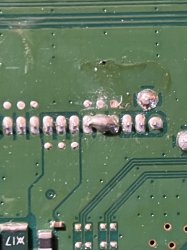
 
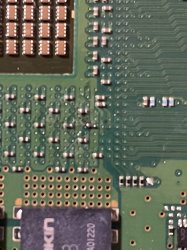
Since the board is still out I took a look at the data port. On the opposite side there are six tiny vias and one has no solder, and there is a blob of solder across three pins that looks like an accident. Is it supposed to be there?
E91C5D9F-9F3C-4E67-BC0E-0E9A152797BA.jpeg
 
I found someone through google that had my error codes cleared by the same caps I replaced, followed by the same 1701 error and he said it's always the cell side tokins. It seems everyone wants to blame the poor defenseless tokins, but on closer inspection, it looks like the corner on one of mine is damaged. I don't know how to check them without a scope, but if I touch positive to positive, I get .02 ohms. I remember when I delid the cell they were 1.78 ohm(or something like that).
 
on the HD connector, you can leave that solder trail, it is connecting three terminals itself but the three are GND and are connected to the same point, in other words there are three terminals but all with the same value.

I don't know much about the error codes, but how many nec tokin did you remove? how many tantalos are you putting in place of each nec? did you make the jumper it should have when you remove a nec?

if possible post a picture of the plate at the points where you placed the tantalums.
 
Capacitors cannot be reliably measured in circuit and they are by their nature blocking to DC, they should read OL when measured with a multimeter.

All those other readings you got were not the resistance across the cap, they were the resistance of some random path to get from 1 side of the probe to the other side.

Capacitive reactance (measured in ohms) is defined mathematically as Xc = 1/(2*pi*f*c)

f = frequency, the frequency of DC voltage from you meters probes used when making measurements is 0.

Therefore no matter what c (capacitance) is, when f=0 you get Xc=1/0 = infinite (open line).

You have a top end Fluke 87 III there, the newer 87 V is a £600 piece of kit, it when used incorrectly it will give you rubbish readings.

The old computer adage applies here…GIGO = Garbage In Garbage Out
 
I haven't touched the tokins on this board yet, and if I do, I would only remove one side. I have 4x 470 attached to jumpers I was thinking about tacking on to see if the error changes, but if there's an internal problem on that tokin, it would ruin the circuit until it is removed, right?
 
Im not touching the tokins unless necessary, but I'm sitting at the vet with my dog, thinking.

If 1701 was the hdd, it did disappear when I ylod without hdd installed, but then I got the 1200 which I just now realized might have been because the fan was unplugged, since it has something to do with cell thermal and it wasn't on long enough to generate any heat.

the dev wiki says to check ic1101, or perhaps the cell has died.
 
7D813496-7314-41A3-B0EA-72E7968093BB.jpeg
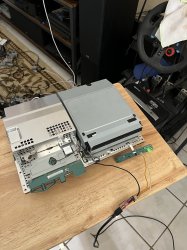
I tried to center it in the pic, but that ant sized smd was askew. I didn't want to use hot air for fear of the bga under the cell. I tried three different tips for my soldering iron to get the right size, kept squeezing too hard with my tweezers and losing it, taking more off the donor board, and three hours later, I had it good enough. I couldn't remember what I was planning to look at before I saw it, so I put most of it together, plugged in the Syscon and turned it on without the hdd to see what error I got. To my surprise, the light stayed green!
F4236430-92D9-418A-A4C9-BE9BB05B8070.jpeg
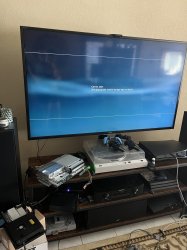
I turned it off and moved to the tv, still good!
EC3600F9-87C2-48EA-9A2A-89A82C75DE4F.jpeg
then I was afraid it was the hdd since that's why I bothered to work on it. Still works with the drive in!

Now I need to take it apart, desolder the uart, and put it back together to see if it still works…
 
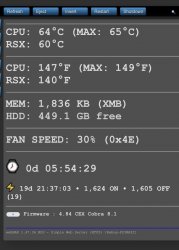
So far so good. Temps are stable. Apparently, it only has 19 days on it, and judging by the on/off count, it never had a ylod before I bought it. I got it for $80 five or six years ago, and never used it until I practiced delidding on a dead board or two.
9695CD89-41C5-40BB-97B0-640BF17DCA5C.jpeg
 
If you were originally getting 2120 and 3013 why did you go for other paths?

2120 (HDMI)

HDMI Error (IC2502)
A0202120/A0213013 error combinations are common. They appear to be related to VDDIO. IC6301 is involved in the formation of +1.7V_MISC, which amonge other things provides input power to the DC-DC converters that output +1.2V_YC_RC_VDDIO, +1.5V_YC_RC_VDDA, +1.2V_SB_VDDC and +1.2V_SB_VDDR. Lack of voltage to these DC/DC converters downstream of IC6301 suggests F6302 has blown. A number of people have fixed these 2120/3013 errors by finding shorts at or near C6320 and replacing Fuse F6302. But there are many other SMD nearby that might cause these fuses to blow. So you will need to track the source of the short and fix it, or the fuse will just blow again.
A bad thermistor (TH2501) has been reported to cause A0002120.
A0802120 and A0902120 errors may be related to the actual HDMI transmitter (IC2502). Or they can be caused by BGA/Bump defects affecting VDDIO, on the RSX or CELL. BGA defects on the RSX VDDIO pads have been confirmed with a pressure test to have caused 2120 errors.

https://www.psdevwiki.com/ps3/Syscon_Error_Codes#Error_code_format

This seems to be a bga drama somewhere. The only thing that can be giving you different states when manipulating a board like this are bgas making, or not making contact with the board.
 
Google turned up a repair shop that had several Facebook posts detailing those capacitors with those error codes as always being the problem. I knew that was something I was able to do, whereas other things would have a steeper learning curve. I think I might have just been lucky, but who knows?

But the dev wiki does talk about the smd near F6302, which is what I replaced.
 
Google turned up a repair shop that had several Facebook posts detailing those capacitors with those error codes as always being the problem. I knew that was something I was able to do, whereas other things would have a steeper learning curve. I think I might have just been lucky, but who knows?

But the dev wiki does talk about the smd near F6302, which is what I replaced.

I have about 10x A022120 and 1x A0203013, I don't understand your process. You said you put it back together and it ended up working, but you also said that you replaced the fuse after? Can you elaborate? Do you remember what readings you were getting in resistance? My fuse has low resistance but my C6320 and all capacitors like it increase in resistance continiously up until 5ish
 
You can't really get a reading while they're in the circuit and I was led to believe that the bad caps would blow the fuse, but the fuse was good. The caps were not shorted, but when I took them off the board one was giving me a negative number, and one would climb or drop but not give me a steady reading. Most of the readings I was trying to get anywhere on the motherboard were like that until they were replaced. It was very frustrating because the tokins looked bad, but everything looked bad.

Once those smd were replaced I was able to get a good read on the tokins. If I remember, I now get 2.2 on cell and 2.6 on rsx.

I will add that the only reason I was willing to start taking caps off was that I had a G01 board that wasn't worth fixing to steal parts from. If I had to buy new capacitors it wouldn't be worth it to remove parts on a whim.

The error codes are very vague because the power circuit is so complex, it could be almost anything. I'm not comfortable probing around a live motherboard following voltages yet, so I'm stuck reading the forum and trying to make educated guesses and learn from others.

I can't say this will always fix this error combination, but I would recommend checking this first because it's early in the circuit, and it's away from sensitive parts and low risk.
 
You can't really get a reading while they're in the circuit and I was led to believe that the bad caps would blow the fuse, but the fuse was good. The caps were not shorted, but when I took them off the board one was giving me a negative number, and one would climb or drop but not give me a steady reading. Most of the readings I was trying to get anywhere on the motherboard were like that until they were replaced. It was very frustrating because the tokins looked bad, but everything looked bad.

Once those smd were replaced I was able to get a good read on the tokins. If I remember, I now get 2.2 on cell and 2.6 on rsx.

I will add that the only reason I was willing to start taking caps off was that I had a G01 board that wasn't worth fixing to steal parts from. If I had to buy new capacitors it wouldn't be worth it to remove parts on a whim.

The error codes are very vague because the power circuit is so complex, it could be almost anything. I'm not comfortable probing around a live motherboard following voltages yet, so I'm stuck reading the forum and trying to make educated guesses and learn from others.

I can't say this will always fix this error combination, but I would recommend checking this first because it's early in the circuit, and it's away from sensitive parts and low risk.

the 2.2 and 2.6 on the tokins is that related to resistance or voltage you were getting so I can check rn?
 
It is resistance. Negative probe was on the ground around the edge of the board, positive probe was on the vias just past the tokin.

My understanding is that a healthy circuit would be 2.0-3.0 or higher and you have a problem below 2. The problem is, if there's a problem, it could be anything in the power circuit, including the bga, so not necessarily fixed by a tokin replacement. I got 1.7 before replacing those smd, and 2.6 after. No reflow, and I didn't touch the tokins.

Most of what I know is from @RIP-Felix and if he sees this, he can correct me if I'm missing something.
 

Similar threads

Back
Top