PS3 Frankenstein PHAT PS3: CECHA with 40nm RSX

I'm thinking if I should lend it to someone here with the right tools and trustworthy so they can fully inspect the motherboard for this project also.
 
ther is one more with sony official mod. he said he will look at it propably inside this week. so you might not need to sent it to no one. but is very kind from you. that you wanna help the project
 
Does botakompong have an official Sony refurbished? AFAIK he's only talking about the mod he and Kiaw made.

The math for a voltage divider says it doesn't matter the value of resistors used. The only difference having a higher value makes is lowering the voltage closer to zero Like 0.0012 instead of 0.012. The threshold for low voltage logic is already met, so there is no reason I can discern for adding a 47k. Just extra work.

He does have an official Sony refurbished one as well.

I am familiar with the voltage divider idea. But if we remove one then the voltage drops. Yet if we leave both in, it will provide voltage. And I guess it's still unclear does GS_CLKI need a voltage or not ? What's more confusing is that it can work both ways, but not always (GLOD only on some boards?)
 
26 ohms sounds right for the OG resistor. You can't get an accurate measurement of a resistor in circuit, but it would have been 1000x higher if they had replaced it. So that confirms they just removed the other one. Thank you for that.

@DeadEnd removing one resistor drops Vout to ~0v. Removing the other one doubles it.
 
26 ohms sounds right for the OG resistor. You can't get an accurate measurement of a resistor in circuit, but it would have been 1000x higher if they had replaced it. So that confirms they just removed the other one. Thank you for that.

@DeadEnd removing one resistor drops Vout to ~0v. Removing the other one doubles it.

Yes, but have you figured out why is it required to drop it to down to 0v against stock 0.75v ? Other than the fact that some boards get a GLOD, is there a better explanation of the process that goes on ? Why is it that certain boards work with both and and others don't ? Could it also be dependent on the version of the syscon perhaps?

I am probably digging too deep with this, so don't mind me. I just got curious about how GS_CLKI works, but don't have the energy to research it myself.
 
Last edited:
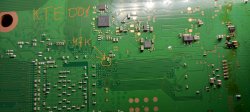
Btw @RIP-Felix the coloring of the 47k resistor really does not matter. Here i have a KTE-001 board where the 47k resistor is blue (realized to snap a pic just after I started trying to desolder it). And yes, I have measured it after desoldering. So it doesn't have to be black.

KTE 001.jpg
 
Last edited:
I tried to track down the purpose of GSCLKI and didn't find much. GS is still not defied. I'm assuming it means Graphics Synthesizer, but IDK for sure. Clock input is pretty simple. Its a timing signal to keep coordination between subsystems synchronized. Which sub systems and exactly why it sometimes works and doesn't? Again IDK.
About that black resistor. I noticed it on the only picture we had of a COK-001 Sony refurbished at the time, which was not the greatest resolution or lighting. If you notice the 49.9 ohm R2001/2 are a darker blue. It could have just been the lighting. That's why I wanted a better picture. That and we only had the one picture. More is better.

Resistors tend to be color coded, so I thought maybe MLCC resistors might be too. Maybe not. But I don't remember seeing a black resistor in either value (49.9 or 47k). Thats why I wanted to measure it and investigate the signal. Turned out it doesn't matter because its a simple voltage divider and any value would be sufficient to pull voltage low. I just wanted to tie up loose end confirm what the math already told me.
 
I tried to track down the purpose of GSCLKI and didn't find much. GS is still not defied. I'm assuming it means Graphics Synthesizer, but IDK for sure. Clock input is pretty simple. Its a timing signal to keep coordination between subsystems synchronized. Which sub systems and exactly why it sometimes works and doesn't? Again IDK.
GSCLKI is only used on the COK-002, it's generated by IC2200 (CXCG) for synchronisation with the GS.
On all other boards it's terminated (in different ways, compare COK-001 to SEM-001).
 
By the way, remember my analysis on the voltage configuration? https://www.psx-place.com/threads/f...cecha-with-40nm-rsx.28069/page-12#post-272975

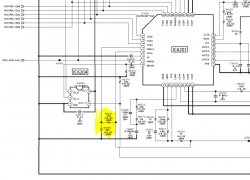
So basically I was right about the change from BD3520 to BD3004 with the new resistors around it to form a different voltage output. It is what Sony did for the 0.95v mod, except they have additionally made one more change to the IC6201 (NCP5318), because it is also needed to reconfigure new power thresholds for VRM core ?

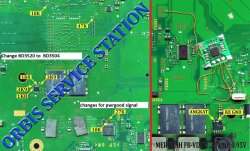
This was discovered once again thanks to @botakompong . Here is his version (Sony way on the left, his suggested "simpler" way on the right).

Full Cok-001 Rsx Syscon-2.jpg

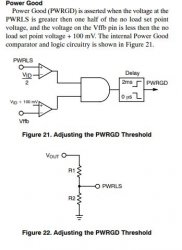
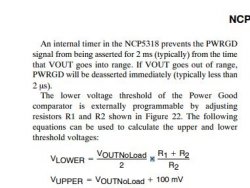
If you are curious, here is the formula for the NCP5318 PWRGD signal calculation. (Excerpts from the datasheet, page 19-20 https://www.onsemi.com/pdf/datasheet/ncp5318-d.pdf)

PWRLS.JPG
voltage 0.95 NCP5318.JPG

I took a quick look and I believe the new resistors (27k and 15k) are installed in place of the original ones outlined in the picture. (But this is to be confirmed, I have not delved too deep into the logic analysis this time)

resistors for NCP5318.JPG
 
Last edited:
Interesting, the changes to PowerGood signal is new. I don't remember seeing that before.
full-cok-001-rsx-syscon-2-jpg.34999


Vout Math:

R1 = R6216 (3900) = VFB/GND
R2 = R6222 (1800) = VFB/VS
R1'= R6214 (3900) = VD/GND
R2' = R6219 (1800) = VD/Vin

Vout = VFB ( [R1' + R2] / R1' ), where VFB is 0.65v.
Vout = 0.65 ( [3900+1800] / 3900) = 0.95v_VDDR

So, @botakompong is right again! What a BOSS!
 
Last edited:
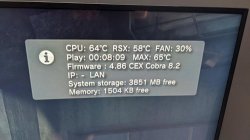
Another unique discovery was have made the other day is that not all 90nm are created equal. There are better chips that can actually run a lot cooler than your average stock RSX. Here is one example of an unopened CECHB01 console with RSX temperature under load.

cool rsx.jpg

We did some digging in the code (thanks to @M4j0r ) and turns out it's got an RSX chip from bin 2, which is a rare occurrence and usually reserved for prototypes. I can imagine they are longer lasting as well and swapping it may be unnecessary.
 
Hello guys!

I've posted pictures and measurements for voltage divider at GSCLKI and VDDR "official" voltmod on a separate thread: https://www.psx-place.com/threads/r...s-replacement-ylod.25260/page-213#post-311094 and https://www.psx-place.com/threads/r...s-replacement-ylod.25260/page-214#post-311124

R2001 is gone, R2002 is 15 kΩ, but value doesn't matter much because w/o R2001, R2002 becomes a pull-down resistor for GSCLKI, no more voltage divider.

I can confirm that diagonal resistor is indeed 10 kΩ, and it's also a pull-down resistor connected to GND plane.

VDDR controller is BD3504FVM, but it's hard to measure R1/R2 values while resistors are soldered to PCB. Measurements that I made look incorrect. I'll try to make a measurements with LCR meter, maybe it will make any difference, but I'm not going to desolder R1/R2, sorry, too much pain in the ass. Also I'll try to measure actual VDDR and post results later.

Knowing real VDDR and that LDO controller is BD3504FVM is enough to deduce R1/R2.

As for PWRGOOD modification, it's hard to measure R6111 and R6112 without desoldering them because NCP5318FTR2G own internal resistance comes into play. For me R6111 is 7.4 kΩ and R6112 is 4 kΩ, but, again, measurements most likely incorrect. But resistors look like they have indeed been resoldered.

IMG_E8465.JPG
 
Last edited:
Interesting, the changes to PowerGood signal is new. I don't remember seeing that before.


Vout Math:

R1 = R6216 (3900) = VFB/GND
R2 = R6222 (1800) = VFB/VS
R1'= R6214 (3900) = VD/GND
R2' = R6219 (1800) = VD/Vin

Vout = VFB ( [R1' + R2] / R1' ), where VFB is 0.65v.
Vout = 0.65 ( [3300+1000] / 3000) = 0.95v_VDDA

So, @botakompong is right again! What a BOSS!
To continue the voltage mod saga, I also wanted to bring up one clarification with regards to replacing the mosfet to get the necessary 0.95v voltage (simpler method). As we have already seen, the Q6200 on Cok-001/002 is indeed a mosfet. But Q6200 on slim boards is a whole step-down voltage regulator (or something similar to it). It is NOT a mosfet. What we do is we ignore the gate pin that comes from BD3520 and simply feed 1.7v and 3.3v into the regulator (not sure which one is VCC for the IC itself) to bring it down to 0.95 as a fixed output. This is how it's done on slim boards, the stepdown buck is integrated into the IC itself so there is no need for BD3520 to control the output, because the new regulator can take care of it on its own. That's from my understanding.

I'm sorry if this was obvious to everybody all along, I did not care to analyze how do we actually receive 0.95v that way. But now I somewhat understand it.
 
Last edited:
It looks like I've measured resistors from the wrong VRM, lol. It was CELL/BE VRM controller, IC6103, not the IC6201. So here is correct one, IC6201, RSX VRM controller:

IMG_E8466.JPG


But again, it's hard to measure resistors value. And what is interesting, measured resistance is the same as for CELL/BE VRM.
So, I can't tell for sure what are real values, but R6207=R6112 and R6205=R6111. Though R6112/R6111 may have also been replaced by Sony, who knows.

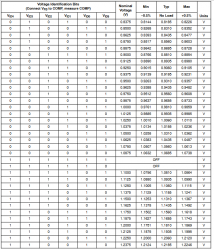
DeadEnd already mentioned that these resistors are for adjusting PWRGODD signal lower threshold. What he didn't mention is that this threshold is primarily depends on Vout_noload/2 value and (R1+R2)/R2 is just a modifier. Vout_noload is defined in NCP5318 datasheet for every selected Vout, which is selected by RSX itself via VID. So if RSX needs 0.95V VDDC, Vout_noload will be 0.9310V and so Vlower will be already set to 0.4655V w/o resistor adjustments.

upload_2021-10-4_16-10-8.png

I don't say that resistor mod is not needed at all. With stock R1(R6207)=15kΩ and R2(R6205)=20kΩ, Vlower would be 0.8146V for 0.95V VDDC - about 0.1 V difference (for 1.2V VDDC this difference would be roughly the same). With modded R1(R6207)=10kΩ and R2(R6205)=27kΩ, Vlower would be 0.6379V for 0.95V VDDC - about 0.3 V difference. I think, if Sony has really done this mod, the reason for it was to have less tight tolerance for PWRGOOD signal after they found out what resource heavy games can do to voltage ripple on both CELL/BE and RSX. So it should also be beneficial to standard Phats. But it's definitely not a prerequisite for RSX replacement.
 
We did some digging in the code (thanks to @M4j0r ) and turns out it's got an RSX chip from bin 2, which is a rare occurrence and usually reserved for prototypes. I can imagine they are longer lasting as well and swapping it may be unnecessary.

This is how you can decode the lv1 av_driver RSX version string:
Code:
boot0_rev nvcore_clock/memory_clock vpe:vpe shd:shd [lot:revision:foundary:wafer_0:wafer_1:wafer_2:ds_0:ds_1:ds_2] [vid:vidbin:process:mstrap:mclkterm:?:?][?:?:?]

Example: b03 1f4/28a vpe:ff shd:3f [G8B644200:1:2:13:8:a:3:f:1][39:2:0:0:1:3:1][0:0:0]
Code:
boot0_rev: b03
nvcore_clock: 0x1F4
memory_clock: 0x28A
vpe: 0xFF
shd: 0x3F

lot: G8B644200
revision: 1
foundary: 2
wafer_0: 0x13
wafer_1: 8
wafer_2: 0xA
ds_0: 3
ds_1: 0xF
ds_2: 1

vid: 0x39
vidbin: 2
process: 0
mstrap: 0
mclkterm: 1

The vidbin is the binning of the chip. It's only really used on 90nm. 2 means good, 3 is regular. 0 means no binning and 1 is invalid.
 
Back
Top