truemaster
Member
well i completly agree back then gpus where fail. even a rebal was a gamble because most of them had bad conections beteween die and substrate. and other on substrate and main pcb


It is true that the BGA/Bump/Underfill situation in 2006 wasn't as good as today, but I argue that FCBGA itself is flawed. I honestly do not think BGA will ever beat the reliability of QFP, and that for the sake of pin count and lower BOM costs, the consumer industry is fine with that. Why we (the public) don't demand sockets is beyond me. Not only can you replace a defective chip, the socket itself provides strain relief. I've never worried about my computer CPU running 70-90C. They thermal throttle at 100C FFS! Your GPU will flex itself to death reaching those temps regularly. And the PS3? Forget it!In a way, it's true. If the console works , perhaps there is no need to go above & beyond to rip out your og RSX for the preventative maintenance sake. However, some of us believe the stock gpu is inherently flawed. It was manufactured at the time when Nvidia struggled to get the packaging formula right. I doubt Sony was immune to the problem. There were reports of bumpgate, inter-layer delamination and underfill issues. It took them a while to perfect the process, but by the time 40nm rolled around the packaging technology had improved. But this is just my own conclusions, everyone is free to think otherwise. Having said that, there are examples of untouched systems working for a decent amount of years as well. So not all 90nm are equally terrible, but noticeably many seem to die sooner rather than later.

 There is no need to desolder and measure them several times. But here's the thing some may have failed to notice. The changes made by Sony concern more than just 1.2 to 0.95v adjustment (FlexIO core voltage). While the simpler method suggested by our friend was to simply add a 0.95v IC, Sony changed the RSX Core VDD well. And yeah, this has already been discussed, but just to remind you. In the picture below, notice that changes to pwrgood signal are not related to other adjustments. It is changing a different voltage (RSX VDD). Now, I don't remember what I may have been babbling about in the past. But this kind of does seem important as well.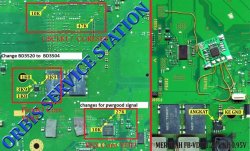
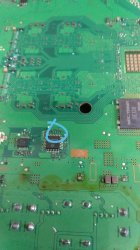
But again, it's hard to measure resistors value. And what is interesting, measured resistance is the same as for CELL/BE VRM.
So, I can't tell for sure what are real values, but R6207=R6112 and R6205=R6111. Though R6112/R6111 may have also been replaced by Sony, who knows.
DeadEnd already mentioned that these resistors are for adjusting PWRGODD signal lower threshold. What he didn't mention is that this threshold is primarily depends on Vout_noload/2 value and (R1+R2)/R2 is just a modifier. Vout_noload is defined in NCP5318 datasheet for every selected Vout, which is selected by RSX itself via VID. So if RSX needs 0.95V VDDC, Vout_noload will be 0.9310V and so Vlower will be already set to 0.4655V w/o resistor adjustments.
View attachment 35027
I don't say that resistor mod is not needed at all. With stock R1(R6207)=15kΩ and R2(R6205)=20kΩ, Vlower would be 0.8146V for 0.95V VDDC - about 0.1 V difference (for 1.2V VDDC this difference would be roughly the same). With modded R1(R6207)=10kΩ and R2(R6205)=27kΩ, Vlower would be 0.6379V for 0.95V VDDC - about 0.3 V difference. I think, if Sony has really done this mod, the reason for it was to have less tight tolerance for PWRGOOD signal after they found out what resource heavy games can do to voltage ripple on both CELL/BE and RSX. So it should also be beneficial to standard Phats. But it's definitely not a prerequisite for RSX replacement.
Yeah I should mention that SONY had an official method, but I don't really want to get into the details of it, since we never actually figured out how to replicate it. Even better would be it's own page that we could link to, in order to keep the error codes section clutter free. It would be beneficial to have this documented "officially" on the wiki. You should sign up! You have as good an understanding of how it works as I do, if not better.@RIP-Felix I have noticed you've been adding more text here https://www.psdevwiki.com/ps3/Syscon_Error_Codes#3034
I think you could also add that modchip is not the only way to install a different model RSX. You can also do it without the modchip by using a flashable syscon or a syscon version 304GB (if I remember right). It requires patching with bus pirate however.
Yes, this is one of the things that got me researching the power control topology. It's been ongoing for the past few months because it's a difficult topic to unpack. I just made a post introducing this topic on the SYSCON thread. Impeccable timing!...In the picture here. Notice , the changes to pwrgood signal are not related to the changes in the FlexIO core. It is adjusting a different voltage. Now, I don't remember what I may have been babbling about in the past. But this kind of does seem important as well.
View attachment 35402
However, Sony has also done the same to Cell BE section in here:
View attachment 35403
And this was confirmed by him as well. Remember, he has analyzed the refurbished boards himself. But he cannot tell why it was done to Cell as well. It doesn't seem to do much to it.
Now @Icferrum had also mentioned earlier that these extra changes are not prerequisites to RSX replacements , but yet beneficial to phats. So you can make your own conclusions if you really want to follow the sony way precisely or not.

I hate BGA too, in small chips with few contacts doesnt makes much sense, and in big chips is a lot less relliable than a socketIt is true that the BGA/Bump/Underfill situation in 2006 wasn't as good as today, but I argue that FCBGA itself is flawed. I honestly do not think BGA will ever beat the reliability of QFP, and that for the sake of pin count and lower BOM costs, the consumer industry is fine with that. Why we (the public) don't demand sockets is beyond me. Not only can you replace a defective chip, the socket itself provides strain relief. I've never worried about my computer CPU running 70-90C. They thermal throttle at 100C FFS! Your GPU will flex itself to death reaching those temps regularly. And the PS3? Forget it!
The default ManaGunz instalaltion contains a collection of the PS2 widescreen patches taken from the official PCSX2 forum (includes more patches than the ones approved by PCSX2 project), and it have an option to apply the widescreen patch to the ISO (and another to remove the patch), you should try itA slightly offtopic worthy mention of anybody who is planning to play ps2 games on a frankenstein or any other model for that matter. It is known that many of the ps2 games do not support widescreen. While you can use the patches in the pcsx2 emulator to correct the situation, it isn't quite as simple if you are playing isos/discs on a ps3. However, there is a way to get them to display correctly in widescreen. Just download ps2 widescreen patches archive and use a tool called Ps2 patch engine to patch the iso. That way you can play almost all of the games in a correct aspect ratio through the ps3. But keep in mind, ps2 patch engine is blocked by an antivirus as a false negative.
This is over my understanding, im just a tinkerer and im still discovering new things, a couple of weeks ago i didnt knew anyting about the "clock generators" of the PS3, and i still dont get the full picture of how works the CELL/RSX power control@sandungas @M4j0r do you know if there is a way to check the VID setpoint for the Cell/RSX at Idle?
The Vid pins VID0-5 on the buck controller form a 6-digit code corresponding to the Vout No load setpoint. Power Good Vmin and Vmax thresholds are relative to that set point. With stock COK-00X voltage divider values (15K and 20k), Vmin = -163mV. Vmax is always +100mV. The Vout voltage cannot deviate more than that. If it does power good goes low and the SYSCON will error.
What SONY's new resistor values (27K and 10K) do is change Vmin = -400mV. So the Low Voltage Drop-Out (LVDO) is now more than twice as low, allowing much more ripple before it triggers an error. That is consistent with my hypothesis above.
But before I can conclude it is correct I would like to know what the VID at idle is, so I can compare actual voltage measurements with the LVDO setpoint. On a console with 1001/1002 error, Vout should drop more than that before it experiances a YLOD.

First you need to diagnose the board with syscon uart - to see the error log that will point what exactly triggers the ylod on your board.I'm located in the USA and interested in obtaining a 40nm RSX modded CECHA01. I already have one that is YLoD, but has never been opened. Can someone point me in the right direction please?
First you need to diagnose the board with syscon uart - to see the error log that will point what exactly triggers the ylod on your board.
I doubt anyone in USA offers any modchip repairs though, so make sure to diagnose it first before coming to the second step - solution.
That picture is confusing. It shows the VDDR voltage mod being done using both a BD3504 MOSFET driver (which uses external resistors to select the output voltage as shown) AND the MOSFET (which I thought was only necessary if you DIDN'T want to change the MOSFET)?But here's the thing some may have failed to notice. The changes made by Sony concern more than just 1.2 to 0.95v adjustment (FlexIO core voltage). While the simpler method suggested by our friend was to simply add a 0.95v IC, Sony changed the RSX Core VDD well. And yeah, this has already been discussed, but just to remind you. In the picture below, notice that changes to pwrgood signal are not related to other adjustments. It is changing a different voltage (RSX VDD). Now, I don't remember what I may have been babbling about in the past. But this kind of does seem important as well.
View attachment 35402
However, Sony has also done the same to Cell BE section in here:
View attachment 35403
And this was confirmed by him as well. Remember, he has analyzed the refurbished boards himself. But he doesn't know why it was done to Cell as well. I haven't looked into that either.
Now @Icferrum had also mentioned earlier that these extra changes are not prerequisites to RSX replacements , but yet beneficial to phats. So you can make your own conclusions if you really want to follow the sony way precisely or not.


