Technically the 65nm RSX's were made during the Bumpgate windo too, they just produce less heat and are thus more reliable because of that. The underfill was improved soon thereafter.
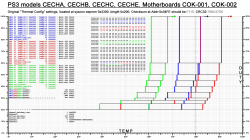
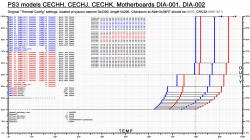
Also thats not true at all. Actually 65nm RSX (newer FAT) are the hottest of all. Yes, they still tend to survive more, but not precisely because they run cooler. Normally they run hotter than 90nm. You can check this in the real world, but also you can see why if you look at their default SYSCON fan curves. (Credits to sandungas for the visual charts)
COK boards: (90nm)
DIA boards (65nm) (Also VER boards):
For example at 85c, while 90nm is already in thermal panic safety shutdown, 65nm is just alright at 35% fan speed.
And while 90nm is at 35% fan speed because it reached 76c, the 65nm is literally just chilling at 23% (warmup stage)
For the 65nm to make the fan speed 35% (an acceptable operating speed), it would have to wait until CPU reach 84c first. (Or 90c ! on the RSX).
Sony increased both the CPU and the RSX target operating temperatures substantially (although is only the CPU curve that actually matters). Maybe because they knew the heat wasnt really going to be the issue anyway so they relaxed the fan profile even more.
And seems they were right. For whatever reason, they are still doing fine for the most part. Even if they are running hotter by design.
I wouldnt be surprised to know if they statistically failed less than 40nm too.
Also thats not true at all. Actually 65nm RSX (newer FAT) are the hottest of all. Yes, they still tend to survive more, but not precisely because they run cooler. Normally they run hotter than 90nm. You can check this in the real world, but also you can see why if you look at their default SYSCON fan curves. (Credits to sandungas for the visual charts)
For example at 85c, while 90nm is already in thermal panic safety shutdown, 65nm is just alright at 35% fan speed.
And while 90nm is at 35% fan speed because it reached 76c, the 65nm is literally just chilling at 23% (warmup stage)
For the 65nm to make the fan speed 35% (an acceptable operating speed), it would have to wait until CPU reach 84c first. (Or 90c ! on the RSX).
Sony increased both the CPU and the RSX target operating temperatures substantially (although is only the CPU curve that actually matters). Maybe because they knew the heat wasnt really going to be the issue anyway so they relaxed the fan profile even more.
And seems they were right. For whatever reason, they are still doing fine for the most part. Even if they are running hotter by design.
I wouldnt be surprised to know if they statistically failed less than 40nm too.
Also thats not true at all. Actually 65nm RSX (newer FAT) are the hottest of all. Yes, they still tend to survive more, but not precisely because they run cooler. Normally they run hotter than 90nm. You can check this in the real world, but also you can see why if you look at their default SYSCON fan curves. (Credits to sandungas for the visual charts)
For example at 85c, while 90nm is already in thermal panic safety shutdown, 65nm is just alright at 35% fan speed.
And while 90nm is at 35% fan speed because it reached 76c, the 65nm is literally just chilling at 23% (warmup stage)
For the 65nm to make the fan speed 35% (an acceptable operating speed), it would have to wait until CPU reach 84c first. (Or 90c ! on the RSX).
Sony increased both the CPU and the RSX target operating temperatures substantially (although is only the CPU curve that actually matters). Maybe because they knew the heat wasnt really going to be the issue anyway so they relaxed the fan profile even more.
And seems they were right. For whatever reason, they are still doing fine for the most part. Even if they are running hotter by design.
I wouldnt be surprised to know if they statistically failed less than 40nm too.
Your also forgetting Sony made the heatsinks in these consoles a lot cheaper, so in order to keep the console quiet they had to relax the fan curves a bit, which lead to them running warmer as a trade off. if you try and apply a reasonable fan curve via webman, they will just turn into jet engines.
That's an excellent question. Though Im afraid I dont know the reason why. Who knows what is going on inside those chips. What I can say is that "heat" alone obvioulsy can't be everything.
And it may not be a true fact. I wish I actually had those statistics. Is Just the impression I got from limited observation. I have seen and heard of way more instances of RSX problems in slim and superslim (40nm) than newer fat boards (65nm).
But they are both OK. Also is not so simple to say the 40nm are the coolest. Yeah they may run a cooler than 65nm but is not that clear. Also there is a lot of variation in the slim boards, particularly in the RSX heatsink construction and even the fans. Even the matching CPUs can matter a lot.
The fan curves also vary and the fact is, I have seen some 40nm slim run hotter than some old 90nm fat, especially RSX. There are more variables.
Your also forgetting Sony made the heatsinks in these consoles a lot cheaper, so in order to keep the console quiet they had to relax the fan curves a bit, which lead to them running warmer as a trade off. if you try and apply a reasonable fan curve via webman, they will just turn into jet engines.
Well I'm not exactly forgetting it, I am pointing it out precisely.
Making the target temperatures higher goes in conjunction with saving some money in the heatsinks. They dont do this randomly though. If they skimp too much without good reason, the gamble may backfire on them and end up losing more money than they save.
They must have done some kind of study and conclude that it was OK to relax on the temperatures even more.
And the fact is that they were right. I dont hear of 65nm RSX failing all that much... (Relatively speaking)
Oh and as anecdote, It was one of the big reasons why I got the interest in developing custom SYSCON fan curves. After the modification they can become much more reasonable, and not necessarily loud or anything, even with the "cheaper" heatsinks.
Edit: Also with that, they no longer turn into "jet-engines" because that is just an additional bug with Webman. It happens for some reason with VER-001 boards.
Haha...struck a nerve with that post huh @Pacorretaco?
2 things.
I'm only saying the underfill was defective. Inappropriate CTE. All the other stuff is beside the point.
The 65nm may run hotter, but it "produces less heat." I'm talking about thermal inertia, not max temp. Say a particularly intense process is occurring, hot-spots on the DIE itself form. Local Temps rise fast before the IHS can absorb and spread that heat. Since the 65nm is more efficient than the 90nm, it doesn't produce as much heat as quickly. Meaning the IHS is more effective at spreading the heat...during these mini cycles. That lowers the local temperature delta (change in temperature) under the DIE at the Bumps, where the defective underfil is located. Max temperature is not the issue. The change in temperature is.
You asked what changed?
Nothing. I do what I always do - Revise my opinions based on research and salient arguments. If you make a good point, I'll gladly admit I'm wrong. I'm always open to learning. @DeadEnd woke me up about Bumpgate. I started reading those links in that Bumpgate research thread. That's what did it for me.
You are correct though, I cannot say for certain whether a BGA or Bump has failed. Or if it's electromigration that caused a short or open fault. Often the error is the same. 3034/4xxx. However, I have begun compiling these error combinations and attempting to correlate specific data errors. And associated errors, like 2120. Certain causes do appear to trigger specific combos, but the number of reports are low and correlating them to a specific cause is difficult. I presented much of this information. Perhaps you missed it. I suggest you read the links in my signature. Specifically the SYSCON review and maybe the Power Control topology series. I have been steadily attempting to break this problem down into it's knowable parts, instead of dismissing it as too complex. IMO, that's a cop out. An easy thing to say, when you don't like what you're hearing.
I don't like the idea that my beloved A01's are going to die. It's more comforting to think that because it survived the YLOD for many years, that it must have escaped the "defect." That it's a good one. And that may be true!
Sound like I'm contradicting myself doesn't it? You may have won the silicon lottery, kept it clean, cool, and well maintained, but the underfil is "defective." That defective underfill may not have killed your console for many reasons, at least not yet. It has lasted long enough to be considered reliable. Like the 65nm RSX, some rare 90nm RSX do run extraordinarily efficient. I've seen some truly impressive temps from 90nm RSX's. Remember, for the defective underfill kills your console according to the change in temperature (Delta T) during those mini-cycles. If your 90nm RSX is as efficient as a 65nm, then it can last much longer. To the point you feel confident it'll last...right up to the day it dies!
And remember, as time goes on and the 90nm RSX's conk out. The only consoles still alive will be the ones that are more efficient. Time is weeding out the hot RSX's.
There is definately more to it than that. Yes. But If my previous post triggered you, then this one will knock your socks off! I make no apologies.
I think another thing to keep in mind is that since these are basically one-off chips for a single system, they weren't "binned." Every PS3 should be the same as the next one. So the QC was a basic "go/no-go" instead. Meaning the shitty chips are definitely mixed in with the good ones as long as they worked, the threshold for the garbage can was likely lowered, and there's probably a brick wall going straight up at either far end of the bell curve. Exacerbating what @RIP-Felix is talking about with the lottery.
Haha...struck a nerve with that post huh @Pacorretaco?
2 things.
I'm only saying the underfill was defective. Inappropriate CTE. All the other stuff is beside the point.
The 65nm may run hotter, but it "produces less heat." I'm talking about thermal inertia, not max temp. Say a particularly intense process is occurring, hot-spots on the DIE itself form. Local Temps rise fast before the IHS can absorb and spread that heat. Since the 65nm is more efficient than the 90nm, it doesn't produce as much heat as quickly. Meaning the IHS is more effective at spreading the heat...during these mini cycles. That lowers the local temperature delta (change in temperature) under the DIE at the Bumps, where the defective underfil is located. Max temperature is not the issue. The change in temperature is.
You asked what changed?
Nothing. I do what I always do - Revise my opinions based on research and salient arguments. If you make a good point, I'll gladly admit I'm wrong. I'm always open to learning. @DeadEnd woke me up about Bumpgate. I started reading those links in that Bumpgate research thread. That's what did it for me.
You are correct though, I cannot say for certain whether a BGA or Bump has failed. Or if it's electromigration that caused a short or open fault. Often the error is the same. 3034/4xxx. However, I have begun compiling these error combinations and attempting to correlate specific data errors. And associated errors, like 2120. Certain causes do appear to trigger specific combos, but the number of reports are low and correlating them to a specific cause is difficult. I presented much of this information. Perhaps you missed it. I suggest you read the links in my signature. Specifically the SYSCON review and maybe the Power Control topology series. I have been steadily attempting to break this problem down into it's knowable parts, instead of dismissing it as too complex. IMO, that's a cop out. An easy thing to say, when you don't like what you're hearing.
I don't like the idea that my beloved A01's are going to die. It's more comforting to think that because it survived the YLOD for many years, that it must have escaped the "defect." That it's a good one. And that may be true!
Sound like I'm contradicting myself doesn't it? You may have won the silicon lottery, kept it clean, cool, and well maintained, but the underfil is "defective." That defective underfill may not have killed your console for many reasons, at least not yet. It has lasted long enough to be considered reliable. Like the 65nm RSX, some rare 90nm RSX do run extraordinarily efficient. I've seen some truly impressive temps from 90nm RSX's. Remember, for the defective underfill kills your console according to the change in temperature (Delta T) during those mini-cycles. If your 90nm RSX is as efficient as a 65nm, then it can last much longer. To the point you feel confident it'll last...right up to the day it dies!
And remember, as time goes on and the 90nm RSX's conk out. The only consoles still alive will be the ones that are more efficient. Time is weeding out the hot RSX's.
There is definately more to it than that. Yes. But If my previous post triggered you, then this one will knock your socks off! I make no apologies.
Nerve? Yeah maybe, but also can just be that I'm on vacation, and I have more time again to be a bored bastard with weird hobby.
When I rhetorically asked: "Who knows what's actually going on inside these chips?"
Silly me should have known it would be our good old friend Rip-Felix.
1- Aaaaaah. So now only the "underfill" is "obviously defective" and not the whole chips. Thats a good change I guess. Or wait, maybe not really. Anyway...
2- Hot-spots huh?
Fascinating, and how convenient.
Except you'll have to come up with something better than that I think.
If it's about "hotspots", "thermal inertia", or the heat "not being transferred to the IHS fast enough"... etc...
You also need to look at the fact that the new chips are not just "more efficient". They are also physically smaller. So they also have a smaller contact area with the IHS, increasing the heat density and reducing the rate at which the produced heat can escape to the IHS and heatsink.
And the smaller size roughly correlates with the "power savings".
So even if these hotspots were a big deal, they would be not necessarily be that different across the different chips.
Still sounds a bit like voodoo to me. Like the "binning story". At the end of the day even the 90nm isn't such a high power consuming chip anyway. And they have their IHS that's there to reduce these hotspots from forming. Not only that, but normally the contact under this IHS tends to be excellent. Unlike the CPU for example, as seen in the pictures.
And you dont need a "rare" 90nm for it to run "cool". Most are like that... Even without modifications. The "binning" story is not very significant even if it were real. They all operate to a closed specification, is a standardized product... There cant be too much variance. No need to win the lottery.
If "nothing changed" and you just happened to now finally read all those documents... That's great. But you were late. Your credibility now is not going to be as high as it could have been before.
Because I know for a fact, something changed. A big change.
There's one more elephant in the room now and that's the ecstasy of gold.
Now that people know about the possibility of replacing RSX and how it can also be profitable... Suddenly there is a new motivation to make the old RSX seem as bad as possible, call them all "defective" or whatever. That they are all obviously dead or will die anyway "because of that defect".
Thereby making the new replacement solution seem much better. Make more people think it is the "ultimate fix" and give them all the reasons why they need it. And that's good and all... Until the exaggerations come.
Sound familiar?
If it doesnt to you, to me it very much does.
Remember how the NEC Tokin capacitors were "obviously defective" too? Oh yeah, they were failing all the time in Toshiba laptops, it's in the papers! the companies went out of business, they revive with heat, yaddy yaddy... look at them, they are brown! ... The problem was "so real", that Sony dropped them and moved to "more reliable" Tantalum capacitors in the Slim models.
So obviously, let's hack them all to pieces. Why diagnose if they'll go bad anyway? Nobody wants defective capacitors, lets replace them with "non-defective" tantalum and the machine will be "a tank".
Yeah... Actually, it may even be true that the Tokins had some kind of "defect". But you know too well how that story went. (Absolute disaster)
Except now people are willing to pay over 900 USD for something like that. So thay may make the elephant even bigger.
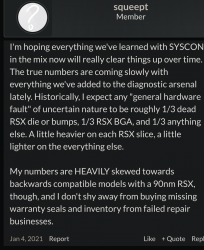
Even Squeept for example may be having an internal struggle with this now. Trying to balance a conflict between his own interests. On one hand, saying one thing may give him more potential buyers for his frankenstein machines. But going too far to that extreme could bring his track record into question.
However is not all bad... If we stick to reality everybody can be happy. There's no need for things to get exaggerated out of place.
After all, it is already a great thing that everybody should be happy about. Doesn't need any exaggeration.
Also you are right, I missed your super post. And it wasnt precisely because it was small or easy to miss! I was away for a while.
Yesterday I had to go to sleep before finishing the read, but I did. However, I actually liked it. A lot of work, and no I didnt find that many triggering statements, even if I went in ready to find them.
I did see that you mixed up the fan curves though. Seemingly small mistake but actually it can make all the difference. I think it is a crucial detail, and it happened to be related to the previous discussion.
The original FAT models do not shut down hotter at 97c. That's the newer fat (65nm). The original (90nm) shut down at a much lower 85c. They run cooler by design, not hotter.
Sony didnt tighten the fan curves in the new revision, to "try to reduce the disastrous hardware issues" or whatever. They did the opposite. They relaxed them substantially. I wonder why...
No. The CTE of FR4 firberglass (PCB and interposer material) is specifically formulated to match copper for this reason. All other materials chosen in the processor sandwich are formulated to match as closely as material science allows. From Solder bumps chemictry, to underfill chemistry and even the thermal epoxy.
That's actually what wrong with the 90nm RSX's underfil chemistry. It's CTE didn't match up close enough and led to premature failures with thermal cycling.
In case of a cell delid without the silicon compound between cell PCB-IHS, will the PCP bend/flex under pressure during heatsink assembly and close the small gap (about 0.2 mm? ), i.e. touch the IHS?
I guess the eraser mod isn't good, because it prevents heat transfer?
I don't know if I got this right, but only the 90-65nm RSX needs thermal epoxy glue on the ram chips? 40nm is fine with MX4 on the ram?
Please try not to spin a narrative. If any part of the RSX is defective, the whole thing is. It doesnt matter if 35,000 parts of the space shuttle were perfectly fine, it only takes 1 chipped heat shied tile to bring it down.
I work in Science. I know how to remain objective and have met few others with same apptitude for it. So while I have frankied a few consoles and may sell a few at some point (I havent yet BTW. And I think 900 is too much), I wont let that bias affect my reccomendations.
I have always reccomend that people enjoy their working BC models for as long as they last. There is no need to do anything until the 3034 comes, which can be a long time if you take care of the console. And I have always been a proponent of SYSCON diagnostics!
It can just be the tokins too! Or a blown fuse! I certainly don't assume it's BGA or Bumps! My approach has been evidence based from the begining, and still is. And BTW, we have been seing an uptick in the number of genuine tokin failures lately. So we should all be ready for that script to flip.
I don't see how CTE is voodoo. In Physics I remember calculating how quickly heat can transfer from one material to another. It depends on the material and the difference in temperarure. Bog standard stuff. CAD simulation automates the design process now and quality assurance dials it in for the real world. Only sony engineers could tell you exactly why they made certain choices.
No 2 processors are the same. I did read somewhere that processors made near the center of the silicon wafer tend to me more efficient that the ones near the edge. So there is always going to be variations, especially if they didn't "bin" the chips.
I'll have a look at the fan curves again and revise if necessary. I know @sandungas has been working on these. And I'm developing custom fan tables for 65nm and 40nm RSX on BC models, so I need to get this right. Thanks for the feedback, I'll look into it.
Even Squeept for example may be having an internal struggle with this now. Trying to balance a conflict between his own interests. On one hand, saying one thing may give him more potential buyers for his frankenstein machines.
Let's not venture down that road. I spent a good 6 months to a year as the first and only person to fight the Cult of the TOKIN, dug in at the trenches of the front line withstanding a barrage of very personal attacks from every corner of the PS3 community and having everything I said or did questioned while fighting AGAINST a repair that would make me money. I had form letters to copy and paste to customers explaining why they didn't need to pay me extra.
If I cared about profit over what is correct, I'd have been swapping out those caps for a few years now instead of holding the line by myself and waiting for reinforcements. My scatterbrained musings are purely my honest opinions, experiences, and anecdotes.
Let's not venture down that road. I spent a good 6 months to a year as the first and only person to fight the Cult of the TOKIN, dug in at the trenches of the front line withstanding a barrage of very personal attacks from every corner of the PS3 community and having everything I said or did questioned while fighting AGAINST a repair that would make me money. I had form letters to copy and paste to customers explaining why they didn't need to pay me extra.
If I cared about profit over what is correct, I'd have been swapping out those caps for a few years now instead of holding the line by myself and waiting for reinforcements. My scatterbrained musings are purely my honest opinions, experiences, and anecdotes.
I know, and I respect you for that and more reasons. Please dont take that as some kind of attack or diffamation attempt. That's not the main takeaway I want you or anybody to get from my post.
On the contrary, I know you are able and willing to look at things objectively and not fall for the things I mentioned, even if they may be there. You say what you think is right. And it could be wrong, but never trying to fool anyone. I do the same.
And I know because I was there and I saw you do it. Maybe I didnt join soon enough as you say but I was also there for the most part.
Now having that in mind, how do you think this old estimation aged?
The whole page, and probably the neighboring ones. It was funny when you mentioned we had come "full circle".
Hahaha If that was "full circle" then... By now this must be a spiral now or something. Hopefully one day we'll reach the center.
But also, similar thing I told Squeept, I tell you. Please dont get offended. I respect you a lot. And this is not about the person, is about the idea.
For me it is already obvious that neither of us are here for the money alone. Especially you or me. But we are not everybody.
And even then I dont actually have an opinion on the current prices of the Frankenstein. If thats what people are willing to pay, then great. After all, they are paying for something that shouldnt be possible. This is the result of years of reverse-engineering and a collective effort of making this happen. Hard to put a monetary price on that.
Simply that people should know what they are getting.
No worries. I overreact to whether or not the wind is blowing.
I mean, without x-ray and an appropriate sample size from the current inventory of consoles that are still regularly used, these questions can't be answered. That's an indisputable fact. Sure, I'd stand by that well rounded guess, I've just altered my thresholds for tossing a 90nm in the trash now that there are options.
I'll also say for another anecdote... I was on a forum for game console repair in 2007 where they were all doing BGA rework (I was just getting in the business and was only a spectator for BGA shit at the time) and they all seemed to have a lot less work when both the Xbox 360 and PS3 moved down from the 90nm chips. Again... anecdote from a fuzzy memory.
Just to make it clear I didn't put a gun to anyone's head to make them believe one way or the other. @Pacorretaco you need to chill it with your accusations. This isn't a conspiracy against you. I'm also referring to all the talks I've had with you in private. The fact that this topic bothers you to the extent that it does is becoming borderline crazy. I'd understand if you were an ex-Sony employee and you were trying to tell us something we don't know. But i doubt that's the case. "Joined the dark side", again with the dramatic outcry. It seems it has become an obsession of yours to prove something to everybody.
I am sure Felix is capable of using the available resources, studying it and coming to his own conclusions. He mentioned that I convinced him and it seems to bother you... Well, maybe I did, maybe I didn't. It definitely wasn't my mission to "set him straight". I may have linked him a few articles and shared a few thoughts. I pointed at the evidence. Nobody's stopping you from doing the same btw.
Once again, here's a fun read about the underfill problems. Just one of the links where the issue has been documented. But I guess you will also call this an attempt to put "harmful" ideas into people's heads...
Hehe, yeah, good catch, the last images i published in my thread was using a new version of the graph at background (i changed the scale of Y axis, intended to solve the problem of space available and alignments)... but after that i realized i could improve it even more and modifyed it again
The fact is i rebuilt almost everything and i have all the graphs for all retail PS3 models with the new style almost ready to be published
But im a perfectionist and while doing that i realized i could add a new improvement that is still not completed... lets say... is another new milestone for my design but as you mentioned above im involved with a bunch of projects related with PS3, right now i dont have an elegant way to solve this problem yet... so i freezed it temporally until i find a good solution
Is related with web design in HTML and CSS, and image design in general, if i dont find the solution the next time i work on them probably i will ask for help in public just incase some of you have a good idea
One way or the other... yeah.. the collection of graphs is almost completed and looks great, i was not mentioning it in public to dont create hype but now you are asking about it i cant resist the temptation to talk about it a bit
Btw, the photoshop file is actually in version v41. Everyone of that versions represents a big change or a working session of several hours... yeah, this is becoming a big challengue but im about to complete it with many improvements over the original graphs
Btw, there are 3 official thermal configs for COK motherboards... 2 of them was used in retail PS3 models, and another one from a prototype COOKIE-13 motherboard
I only made one of them by now... but in the way how im doing the new graphs is trivial to do the others... so i guess i will do the 3 COK thermal configs for cusiosity sake, just to see what the engineers was doing in COKs
Nerve? Yeah maybe, but also can just be that I'm on vacation, and I have more time again to be a bored bastard with weird hobby.
When I rhetorically asked: "Who knows what's actually going on inside these chips?"
Silly me should have known it would be our good old friend Rip-Felix.
1- Aaaaaah. So now only the "underfill" is "obviously defective" and not the whole chips. Thats a good change I guess. Or wait, maybe not really. Anyway...
2- Hot-spots huh?
Fascinating, and how convenient.
Except you'll have to come up with something better than that I think.
If it's about "hotspots", "thermal inertia", or the heat "not being transferred to the IHS fast enough"... etc...
You also need to look at the fact that the new chips are not just "more efficient". They are also physically smaller. So they also have a smaller contact area with the IHS, increasing the heat density and reducing the rate at which the produced heat can escape to the IHS and heatsink.
And the smaller size roughly correlates with the "power savings".
So even if these hotspots were a big deal, they would be not necessarily be that different across the different chips.
Still sounds a bit like voodoo to me. Like the "binning story". At the end of the day even the 90nm isn't such a high power consuming chip anyway. And they have their IHS that's there to reduce these hotspots from forming. Not only that, but normally the contact under this IHS tends to be excellent. Unlike the CPU for example, as seen in the pictures.
And you dont need a "rare" 90nm for it to run "cool". Most are like that... Even without modifications. The "binning" story is not very significant even if it were real. They all operate to a closed specification, is a standardized product... There cant be too much variance. No need to win the lottery.
If "nothing changed" and you just happened to now finally read all those documents... That's great. But you were late. Your credibility now is not going to be as high as it could have been before.
Because I know for a fact, something changed. A big change.
There's one more elephant in the room now and that's the ecstasy of gold.
Now that people know about the possibility of replacing RSX and how it can also be profitable... Suddenly there is a new motivation to make the old RSX seem as bad as possible, call them all "defective" or whatever. That they are all obviously dead or will die anyway "because of that defect".
Thereby making the new replacement solution seem much better. Make more people think it is the "ultimate fix" and give them all the reasons why they need it. And that's good and all... Until the exaggerations come.
Sound familiar?
If it doesnt to you, to me it very much does.
Remember how the NEC Tokin capacitors were "obviously defective" too? Oh yeah, they were failing all the time in Toshiba laptops, it's in the papers! the companies went out of business, they revive with heat, yaddy yaddy... look at them, they are brown! ... The problem was "so real", that Sony dropped them and moved to "more reliable" Tantalum capacitors in the Slim models.
So obviously, let's hack them all to pieces. Why diagnose if they'll go bad anyway? Nobody wants defective capacitors, lets replace them with "non-defective" tantalum and the machine will be "a tank".
Yeah... Actually, it may even be true that the Tokins had some kind of "defect". But you know too well how that story went. (Absolute disaster)
Except now people are willing to pay over 900 USD for something like that. So thay may make the elephant even bigger.
Even Squeept for example may be having an internal struggle with this now. Trying to balance a conflict between his own interests. On one hand, saying one thing may give him more potential buyers for his frankenstein machines. But going too far to that extreme could bring his track record into question.
However is not all bad... If we stick to reality everybody can be happy. There's no need for things to get exaggerated out of place.
After all, it is already a great thing that everybody should be happy about. Doesn't need any exaggeration.
Also you are right, I missed your super post. And it wasnt precisely because it was small or easy to miss! I was away for a while.
Yesterday I had to go to sleep before finishing the read, but I did. However, I actually liked it. A lot of work, and no I didnt find that many triggering statements, even if I went in ready to find them.
I did see that you mixed up the fan curves though. Seemingly small mistake but actually it can make all the difference. I think it is a crucial detail, and it happened to be related to the previous discussion.
The original FAT models do not shut down hotter at 97c. That's the newer fat (65nm). The original (90nm) shut down at a much lower 85c. They run cooler by design, not hotter.
Sony didnt tighten the fan curves in the new revision, to "try to reduce the disastrous hardware issues" or whatever. They did the opposite. They relaxed them substantially. I wonder why...
Paco, i must ask is there something that makes you think that somehow the 90NM RSX is special and doesnt have the same defect literally every GPU made in the mid to late 2000's suffers from? the RSX is a mostly nVidia design and it was mostly nvidia that was affected by this, look at the 8800GTX for example that thing dropped left right and center, and it had a massive die, with its own heat spreader like the RSX has! Take the 360 as well for example, that thing had such a high failure rate due to microsoft allowing these faulty chips run upwards of 80C for hours on end, the 90nm RSX gets no where near this. although there were two varaints of the xenos gpu in original 360, the "taiwan" varaint and a "korean" varaint, the taiwan varaint being the defective one, that suffered from bump/underfill issues, and the much rarer korean varaint seeminly not suffering as bad, but they ultimatly do fail still from the same issue. This could explain why some 90NM RSX's do seem to last longer than others, but in the end they will still ultimatly fail with the classic 3034 etc.., due to an inherent design flaw with flipchip from this era. why else do you think you can heat a dead RSX upto 150C and it will magically come to life? just like every faulty GPU from this era...
Just to make it clear I didn't put a gun to anyone's head to make them believe one way or the other. @Pacorretaco you need to chill it with your accusations. This isn't a conspiracy against you. I'm also referring to all the talks I've had with you in private. The fact that this topic bothers you to the extent that it does is becoming borderline crazy. I'd understand if you were an ex-Sony employee and you were trying to tell us something we don't know. But i doubt that's the case. "Joined the dark side", again with the dramatic outcry. It seems it has become an obsession of yours to prove something to everybody.
I am sure Felix is capable of using the available resources, studying it and coming to his own conclusions. He mentioned that I convinced him and it seems to bother you... Well, maybe I did, maybe I didn't. It definitely wasn't my mission to "set him straight". I may have linked him a few articles and shared a few thoughts. I pointed at the evidence. Nobody's stopping you from doing the same btw.
Once again, here's a fun read about the underfill problems. Just one of the links where the issue has been documented. But I guess you will also call this an attempt to put "harmful" ideas into people's heads...
What accussations, and yeah why would there be a conspiracy against me?
On second thought, I don't want to know.
You cant argue with anything of what I said, so you try to dismiss everything by basically suggesting I'm crazy or something.
And no, I am not Sony employee or have any weird or hidden motivations. If anything, I would also benefit more from joining the party too and do what you all are trying to do.
But it aint right. And I could be wrong but this is not a democracy. Just because I'm alone, doesn't make me wrong.
Once again, here's a fun read about the underfill problems. Just one of the links where the issue has been documented. But I guess you will also call this an attempt to put "harmful" ideas into people's heads...
There may or may not be anything inherently wrong with those links. I won't get there.
But you are using stuff like that to somehow try to "prove" that all the chips are "defective" and that they are all obviously dead or are all going to fail anyway "because of that".
Basically telling people what they want to hear now, and that's where the "danger" can be.
And no, that story doesnt even explain most of our sub-cases where the chip is actually dead, let alone the rest. "Broken bumps" cant explain internal shorts or VRAM problems for example. Stuff that has also been actually found to occur in the real world, Real COKs.