PS3 Frankenstein PHAT PS3: CECHA with 40nm RSX

^ final update on this one. I'll rewrite the sheet tomorrow to post in the syscon thread so it's legible since it's got so many rambling notes on it now.

Pulled a fresh 40nm donor, swapped it in, and she's all good now. So, be aware that if you are pulling your own 40nm chips, they'll occasionally crack some RAM when you pry the IHS off and it can throw 10x 2120 and 1x 3013, or no error codes, or 1x 2120 all with 1 second YLOD.
 
[mention]squeept [/mention] what's your method for delidding RSX do you remove them and then use razor blade to remove IHS?

I've used razor blades recently while off and it works pretty well although not sure if I've done a 40nm just 65/90. Do 40nm have harder thermal glue? Btw which thermal glue now that you've order some more would you recommend?


Sent from my iPhone using Tapatalk
 
^ final update on this one. I'll rewrite the sheet tomorrow to post in the syscon thread so it's legible since it's got so many rambling notes on it now.

Pulled a fresh 40nm donor, swapped it in, and she's all good now. So, be aware that if you are pulling your own 40nm chips, they'll occasionally crack some RAM when you pry the IHS off and it can throw 10x 2120 and 1x 3013, or no error codes, or 1x 2120 all with 1 second YLOD.

Damn... I de-lidded all of mine whilst off board and I've had two chips throwing 10 x 2120 and a single 3013. I've been using razors to do it. I was extremely careful too. I wonder if the interposer flexes too much during de-lid when it isn't being held flat by solder balls on the underside? We might need to start de-lidding with cheese wire ahahaha.
 
^ final update on this one. I'll rewrite the sheet tomorrow to post in the syscon thread so it's legible since it's got so many rambling notes on it now.

Pulled a fresh 40nm donor, swapped it in, and she's all good now. So, be aware that if you are pulling your own 40nm chips, they'll occasionally crack some RAM when you pry the IHS off and it can throw 10x 2120 and 1x 3013, or no error codes, or 1x 2120 all with 1 second YLOD.
Where are you sourcing the 40nm RSX from? 2101, 2501, 3001 boards?
 
@Computer Booter yeah, the thermal glue is significantly harder. I was using the same method that I've always used - painter's knives. For the RSX, I take the board straight out of the drying oven (100C) and jam one in under the IHS to protect the substrate then use a small flathead screwdriver to pop it off. First time I did that on a 40nm, the painter's knife metal was too flexible and it dented the substrate. So I took a flat exacto blade (hardened tool steel) and ground the sharp edge off. That solved the denting problem, but then a few chips later, I actually popped the top off of one of the RAM chips and was looking straight at the silicon. From there, I thought I had solved that by heating the IHS up more to around 150C before popping the top. Apparently the method needs rethought. I haven't had a chance to test out the MG epoxy yet.

@NewRetroRepair I'm positive in my case it's the strong glue ripping on the RAM. From the one that the top came off and now this one with the associated error codes, that has to be it for me.

@raidriar Anything. I think I've had at least one from each of those models now and all the 40nm have had the same super hard glue. Both the dead chip and the new one that worked were from KTE boards. I'm not sure about 65nm slims, I've only had 65nm fats I think. I don't really fix any other PS3 besides BC models so I just don't remember if the 65nm slims are a pain too.


So, the next step here is to up the game on delidding 40nm. I don't like borking chips, even if it's like a 5% chance or less. I'm going to try removing with IHS on (I don't like doing this, the idea of hot spots forming from the top heat having to funnel through the dies bothers me, but I've never actually heard of anyone being able to blame any problems on this, so...) then using a delidding tool. I had an old der8auer but the RSX was too big to fit in the jig. I saw they make a new one for some monster intel CPU, so I'll give that a try.

Adhesives are stronger against perpendicular forces than parallel forces, something about vacuums I think? The delidding tool is basically a vice that pushes from the side, so if I can get everything to fit in the tool then that should be the ideal solution. If that doesn't work, I'm going to start looking in to CNC removal finally. I should have done that years ago anyway. It has the added benefit of cutting out a lead-free rework cycle on both the donor chip and the receiving board.
 
Whats about the 'NSC' method, a.k.a. the famous *razorblade + hammer* RSX delid method... :D
saw a recent stream from him, he also adds now some heat to the IHS via a nice gas blowtorch ;)
 
Whats about the 'NSC' method, a.k.a. the famous *razorblade + hammer* RSX delid method... :D
saw a recent stream from him, he also adds now some heat to the IHS via a nice gas blowtorch ;)

If I had to guess, I'd say it's the same odds of damage (haven't seen a video, just assuming what he's doing). The razor blade wouldn't actually be cutting after the first millimeter or so when you do that, I've measured all the thicknesses with a micrometer. It's using the blade as a wedge, so I think all the same forces are still applying. I have no idea. All I know is I want CNC now.
 
Is there perhaps a chemical that can dissolve the glue? Maybe acetone or toluene?


This explains why I killed my 2101 trying to delid the RSX. No damage on the PCB, but YLOD after reassembling so I probably killed the RAM.
 
Last edited:
I'm a big fan of not using strong solvents. Accidents happen to the best of us. But I know there's stuff that can dissolve a lot of types of underfill, but even those have to be used carefully as they can potentially damage any other components they come in contact with. And they're usually for site cleaning where you can apply it to the whole surface of what you want removed instead of just the sides.

Without CNC, we need to apply either a twisting or lateral force. And the only way I see being able to apply sufficient force without damaging other things is lifting the chip with IHS in place, then using a specially made delidding tool. I'm betting I can whip something up for a 3D printer that twists.... if I can get it strong enough but still thin enough to clear everything on the board, I could probably make something that will twist it off on the board. Maybe even a protective bracket to guard all the components on the board from the "twister" part....

Actually...does it matter if it's safe for the board? I just want the chip.... but I understand some people would probably just like to safely delid their slims.

I'll drink on it this weekend and see what I can whip up.

edit: yes, it should not damage nearby components so I can test the chip on the board after removing the IHS. Okay, that's settled.
 
Last edited:
If I had to guess, I'd say it's the same odds of damage (haven't seen a video, just assuming what he's doing). The razor blade wouldn't actually be cutting after the first millimeter or so when you do that, I've measured all the thicknesses with a micrometer. It's using the blade as a wedge, so I think all the same forces are still applying. I have no idea. All I know is I want CNC now.

Here is the video stream I mentioned, his RSX delid starts at 1:00:30

I guess (except the hammer?) it's a bit safer than the screwdriver method, since he cuts at least one adhesive joint infront the pop off ;)
 
Here is the video

My way is definitely safer on the 90nm, the IHS basically falls off. His way might actually cut the adhesive on the 90nm RSX, but what I measured for the 40nm it's only gonna cut for the first millimeter or two (until the blade tapers to full thickness). The thickness of the adhesive is definitely less than the thickness of a razor on the 40nm.
 
My way is definitely safer on the 90nm, the IHS basically falls off. His way might actually cut the adhesive on the 90nm RSX, but what I measured for the 40nm it's only gonna cut for the first millimeter or two (until the blade tapers to full thickness). The thickness of the adhesive is definitely less than the thickness of a razor on the 40nm.
Curious if you can pull the cell and RSX off the board, can you solder the IHS on to both and remove the problem with thermal paste?
 
My way is definitely safer on the 90nm, the IHS basically falls off. His way might actually cut the adhesive on the 90nm RSX, but what I measured for the 40nm it's only gonna cut for the first millimeter or two (until the blade tapers to full thickness). The thickness of the adhesive is definitely less than the thickness of a razor on the 40nm.
I was doing some experiments meassuring the gap sizes in a CECH-25xx by inserting wires with different diameters, etc... and the gap is around 0.15mm

The problem with the razor blades is most of them are thicker than that... so is pretty much like if we are inserting a "wedge" (i hope i used the accurate word, i had to google the translation, lol). You know... the most we insert the wedge = the most we are "unsticking" the IHS from the DIE, and that effect happens very soon, after 1 of 2 milimeters
Also, eventually the razor blades could break because the metal alloy (lot of carbon to increase hardness) used in that kind fo blades makes them very fragile

The only thing that fits in the gap with enought mechanical resitance is one of that wires to remove smartphone screens and it needs to be smaller than the 0.15 of the gap, because we need to keep in mind we are not removing the silicone, the wire is "cutting" the silicone in front of it, but is also "compressing" the silicone at his top and bottom
In other words... a wire of 0.10mm is fine... and a wire of 0.12mm is the max diameter we could use
The diameters bigger than that probably are going to create that "wedge" effect so annoyinig and are not going to work fine

--------
I see why you got the idea of the CNC, but im not so sure if is going to generate more problems than solutions because the metal cutting tool is going to generate lot of metalic dust particles that are going to spread everywhere in your motherboard and your workroom

So if you go for it you are going to need to find some way to isolate the motherboard from that metal particles very well (inside a plastic bag and lot of tape everywhere ?) + clean/brush everything very well + try to do it in a different room because that metal particles are like the kryptonite for electronics \o/
 
I see why you got the idea of the CNC, but im not so sure if is going to generate more problems than solutions

It's pretty well established in the last decade as mobile phone repair skyrocketed (easiest way to deal with replacing all those underfilled chips), it just doesn't have any documentation by the standards bodies. This is one of the top firms doing bulk repair / rework for corporate customers, and they have a procedure in their handbook for it: https://www.circuitrework.com/guides/9-5-1.html

Between a vacuum nozzle, the bag procedure they describe, an enclosed area with air filtration, and the scrubbing plus ultrasonic bath afterwards, I'm not worried about it at all. I'm gonna work on a twisting jig this weekend, and if that doesn't give satisfactory results, I'll probably start saving my pennies.

This all, of course, assumes I can mill the IHS without generating too much heat, and that the tiny layer left behind will be easier to peel off.
 
It's pretty well established in the last decade as mobile phone repair skyrocketed (easiest way to deal with replacing all those underfilled chips), it just doesn't have any documentation by the standards bodies. This is one of the top firms doing bulk repair / rework for corporate customers, and they have a procedure in their handbook for it: https://www.circuitrework.com/guides/9-5-1.html

Between a vacuum nozzle, the bag procedure they describe, an enclosed area with air filtration, and the scrubbing plus ultrasonic bath afterwards, I'm not worried about it at all. I'm gonna work on a twisting jig this weekend, and if that doesn't give satisfactory results, I'll probably start saving my pennies.

This all, of course, assumes I can mill the IHS without generating too much heat, and that the tiny layer left behind will be easier to peel off.
In the PS3 IHS's there is a lot of metal to remove by milling it in paralell, lets say... you are going to convert more than 95% of the IHS material into "dust", the milling machine and the milling tip needs to be robust, not sure how much expensive a machine of that size could be, but for sure it needs to be way bigger than the ones used for smartphones

When you mentioned it for first time i was mostly thinking in cutting "slots" (this is another word i had to google translate, hope is accurate) in the IHS, lets say... starting by cutting an X... then into an asterisk
This way we are dividing the IHS in triangles (4 cuts = 8 triangles), some of them are going to fall appart and the others can be used to grab them and rotate them a bit to unstick them

You know.. the kind of thing that could be made with a dremel tool in a ghetto way just having a good pulse and keeping in mind we still have a layer of paste in between IHS and the electronics (thats our only visual reference, lol, and yeah is something around 0.15mm only)
It would be a lot better to mount the dremel into a machine with a pillar to calculate his height and to keep it in paralell to the surface accuratelly
 
Last edited:
is there a trick to Franky'ing a DIA-001?
I have done so with a 2983 65nm RSX and have the GLOD with and without the resistor mod
I feel i am missing something simple
 
I was doing some experiments meassuring the gap sizes in a CECH-25xx by inserting wires with different diameters, etc... and the gap is around 0.15mm

The problem with the razor blades is most of them are thicker than that... so is pretty much like if we are inserting a "wedge" (i hope i used the accurate word, i had to google the translation, lol). You know... the most we insert the wedge = the most we are "unsticking" the IHS from the DIE, and that effect happens very soon, after 1 of 2 milimeters
Also, eventually the razor blades could break because the metal alloy (lot of carbon to increase hardness) used in that kind fo blades makes them very fragile

The only thing that fits in the gap with enought mechanical resitance is one of that wires to remove smartphone screens and it needs to be smaller than the 0.15 of the gap, because we need to keep in mind we are not removing the silicone, the wire is "cutting" the silicone in front of it, but is also "compressing" the silicone at his top and bottom
In other words... a wire of 0.10mm is fine... and a wire of 0.12mm is the max diameter we could use
The diameters bigger than that probably are going to create that "wedge" effect so annoyinig and are not going to work fine

--------
I see why you got the idea of the CNC, but im not so sure if is going to generate more problems than solutions because the metal cutting tool is going to generate lot of metalic dust particles that are going to spread everywhere in your motherboard and your workroom

So if you go for it you are going to need to find some way to isolate the motherboard from that metal particles very well (inside a plastic bag and lot of tape everywhere ?) + clean/brush everything very well + try to do it in a different room because that metal particles are like the kryptonite for electronics \o/

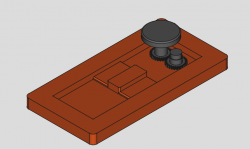
You just gave me an idea for a special jig for using with that molybdenum wire you're talking about. I'm thinking some kind of jig to hold an RSX with a screw knob that the wire mounts to. Pop the chip into the jig, screw down a second half of the jig to hold the chip firmly in place and then turn the screw to apply even tension to the molybdenum wire so it cuts evenly into the thermoglue of the RSX.

This is kinda an early WIP but maybe shows what I'm trying to describe a bit. The two channels will be for the molybdenum wire.

<Edit> I updated the design which shows what I mean a lot better. The idea is to turn the RSX upside down, so BGA pad side facing up and hook the molybdenum wire between the IHS and the VRAM modules and to two posts on the gears on the right hand side.

After that place a cover I've yet to design over the top, clamp it down and screw down a small plastic bolt to hold the RSX firmly in position. Finally, use the wheel to tighten the molybdenum and slice right through the thermoglue on the RSX VRAM modules.
 

Attachments

  • Screenshot from 2022-04-28 08-40-21.png
    Screenshot from 2022-04-28 08-40-21.png
    17.9 KB · Views: 57
  • Screenshot from 2022-04-28 13-13-40.png
    Screenshot from 2022-04-28 13-13-40.png
    34.1 KB · Views: 50
Last edited:
I wouldnt rule out the idea of using some kind of solvent, because after all the goal is to do it in the most gentle way possible and it could help.

When the Chip is off the board, I guess there could be many relatively safe ways. For example, the chip could be upside down and apply some solvent in a precise way without necessarily flooding the substrate, only the Heatspreader.

First I would try something mild and harmless, like Isopropyl alcohol. You could even submerge the thing to a level that covers the IHS but not much more.

Alternatively, (what I have been doing so far with success) Is place whatever solvent (I only used alcohol) in the blade. This make the application quite precise.
For me, harmless alcohol has been enough but this should be an OK way to use other chemicals if necessary.

With some patience Im sure there can be non destructive ways.

(And yeah haha, if all else fails, sounds fun to obliterate the whole IHS with a CNC machine haha, but a partial destruction wouldnt be that difficult either. It is Nickel plated copper, not that hard. And there is some margin between the die and the glued VRAM chips to cut them independently, perhaps with hand tools and without turning the whole thing into dust.
But I think there may be easier ways...)
 
Last edited:
Preliminary test of the required torque for my 3D printed twister idea is a fail. Can't be done with plastic parts. I'm playing board games with a friend that's a CNC operator tomorrow, so I'll pick his brain after a few beers.
 
Back
Top