logane1102
Forum Noob
FreeHDBoot with all the games Master Guide:
-------------------------------------------------------------------------------------------------------------------------
Chapter 1: Obtain your equipment
- HDD-Capable PS2 console. 3000X series, 5000X series, etc.
- Freemcboot memory card may or may not be required depending on your procedure.
- PS2 Network adapter, Official NA with SATA mod recommended. Another alternative is the game star adapter but this does not have a functional network port. If you're going for a loaded HDD ps2, you should check out the online games that still have functional private servers in 2022!
- The storage device of your choosing. Recommended storage device is the largest SATA hard drive or SSD you can get, up to 2tb. Anything higher than 2tb is not supported. SSD's will be slightly better than HDD's as they do not have to spin-up before it can function, will transfer faster from PC than HDD and will be lighter and quieter.
- An appropriate adapter to connect your storage device to your PC. Preferably one that is powered with an external power supply. USB power only will most likely cause issues.
- A caddy for your HDD to keep it secure in the expansion bay. There are 3D-printed ones for both 3.5" and 2.5" drives. Original 40gb sony hdd brackets may also work depending on what you use.
- Your game backups stored on your computer ready to transfer to a hard drive. Obtaining game backups will not be covered here. This guide assumes you already have your backups.
-------------------------------------------------------------------------------------------------------------------------
Chapter 2: Formatting your storage device
- Two ways:
- Path A is good for going for a clean install and is better at teaching you how this works, but has more steps and takes longer.
- Path B is quicker, easier, and doesn't require FreeMCBoot. This is the recommended path.
---------------------------------------------------------
- Path A: Use a Freemcboot memory card and format the storage device using ulaunchELF's HDD manager.
- Before exiting HDD manager, Press R1 and then select Create partition. Name it "+OPL".
- Once the +OPL partition is created, press R1 again and select Expand. Move the slider to your desired size. If you want all the bells and whistles later on, your partition size should be ~10MB per game you are going to install. This accounts for the flair and 1 8mb Virtual Memory card assigned to each game.
You can generate larger VMC's up to two 64mb VMC's per game so if you plan on making those, expand the partition accordingly.
Afterwards, proceed to chapter 3a.
---------------------------------------------------------
- Path B: Download a sectoral clone image of an already-formatted PS2 HDD with FreeHDBoot off of the internet, or one that you have already created yourself. This method does not require a freemcboot memory card.
- Download HDD Raw copy tool and the clone image of your choice.
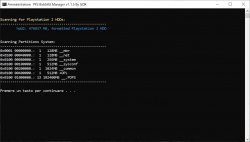
- Use HDD raw copy to write the image to your storage device. When done, reconnect it to your PS2 to make sure it worked. It should boot to FreeHDBoot without any memory cards connected.
- If it worked, go to ulaunchELF's HDD Manager.
- In HDD manager, Press R1 and then select Create partition. Name it "+OPL". If it is already there, expand it.
- Once the +OPL partition is created, press R1 again and select Expand. Move the slider to your desired size. If you want all the bells and whistles later on, your partition size should be ~10MB per game you are going to install. This accounts for the flair and 1 8mb Virtual Memory card assigned to each game.
- Some games utilize save data from other games which are special cases that you will need to take into account and generate generalized VMC's accordingly.
- You can generate larger VMC's up to 2 64mb per game so if you plan on making those, expand the partition accordingly.
-Once done, reconnect the HDD to your PC.
If you use this method, skip step 3a and proceed to chapter 3b.
-------------------------------------------------------------------------------------------------------------------------
Chapter 3a: Install FreeHDBoot (Path A)
- On your computer, download the FreeMCBoot installer.
FreeMCBoot installer should have FreeHDBoot installation on it as well.
- Transfer the FreeMCBoot installer to your PS2 memory card somehow.
Either copy it to a FAT32 USB pendrive, or alternatively you can use PFS HDD manager to transfer the files to one of the non-system partitions on your storage device. USB stick is easier but PFS is faster.
In ulaunchELF, transfer the freemcboot installer to your memory card. Once transferred, run the freemcboot installer ELF file. You will be taken to the Freemcboot screen. Navigate to the FreeHDBoot installer and proceed.
After the installation is complete, verify that FreeHDBoot is working. If so, proceed to chapter 4a.
-------------------------------------------------------------------------------------------------------------------------
Chapter 3b: Installing HDDOSD
(Optional, not recommended) (Path B)
- If your sectoral image contained HDDOSD, check and see if it is 48-bit HDDOSD. This can be checked by going into HDDOSD and looking at the available space on your storage device. If your storage device is larger than 128 gigabytes and HDDOSD only displays roughly 128,000 MB free, HDDOSD is 24-bit and needs to be upgraded to 48-bit. Otherwise, the console will softlock if more than 128 gigabytes of data in installed on the storage device when going into HDDOSD.
- Download the 48-bit HDDOSD package and transfer the files to your HDD directly using ulaunchELF. Once transferred, 48-bit HDDOSD will work. Verify by checking the available space that is displayed in HDDOSD.
- It should be noted that HDDOSD is basically useless and only gets slower the more loaded up your storage device is. It only makes OPL's In-game-reset function / PS2 browser take longer to load. There's basically no reason to have HDDOSD installed on your storage device unless you really insist on having/using it. Otherwise, I recommend that you either uninstall HDDOSD or start over with a different sectoral image that doesn't have it.
Skip step 4a and proceed to chapter 5.
-------------------------------------------------------------------------------------------------------------------------
Chapter 4a: Installing HDDOSD
(Optional, not recommended) (Path A)
- If desired, download the 48-bit HDDOSD file pack and transfer the files to your HDD directly using ulaunch ELF. Once transferred, 48-bit HDDOSD will work. Verify by checking the available space that is displayed in HDDOSD.
- It should be noted that HDDOSD is basically useless and only gets slower the more loaded up your storage device is. It only makes OPL's In-game-reset function / PS2 browser take longer to load. There's basically no reason to have HDDOSD installed on your storage device unless you really insist on having/using it. Otherwise, I recommend that you either uninstall HDDOSD or start over with a different sectoral image that doesn't have it.
-------------------------------------------------------------------------------------------------------------------------
Chapter 5: Installing your apps and configuration
- On your computer, download all of your desired homebrew apps from the internet, afterwards, transfer them to your storage device.
The default path is hdd0:/__sysconf/FMCB/APPS/
Please note that only a select few apps will run from the storage device. 99% of all homebrew apps have to be run from the memory card or the USB port.
The ones that we need for the storage device is the latest version of OPL and uLE at least. Other apps that work are Simple media system, HDD Checker, and a few others that aren't particularly necessary.
-------------------------------------------------------------
- Once your apps are transferred to your storage device, it's time to hit up the FreeHDBoot configurator.
In the configurator, configure your settings to your liking. The important bits are the OSDSYS settings and the E1/E2/E3 launch keys.
- In the OSDSYS settings page, set up the app shortcut list. Point the shortcuts to the ELF files that they correspond to. Rename the shortcuts to your liking.
- Make any other customizations that you desire.
- Enter the Configure scrolling options menu. Note the settings for the final 4 cursor/delimiter settings at the bottom of the list.
Take a picture or something of the code of each of these settings. There is a discrepancy with the settings that are applied at install, and the settings that are applied when you press the select button on each of those settings. If you simply revert to default by pressing select, you will end up with the incorrect icons of a few UI elements in the OSDSYS. It's just a couple numbers that are different.
- Enter the E1 Launch Keys Menu. This is where you can assign hotkeys to the controller to select an app to boot at system startup.
At the top is AUTO: this is the autoboot setting. If you want this to automatically boot into an app without holding a button on the controller, point it to that app's ELF file. Otherwise, leave it alone or blank it out.
- The E2 and E3 launch keys are essentially the same thing but the second and third (last) resort if the PS2 can't find the app and has to resort to an alternative. This is for a HDD setup so most likely this isn't relevant.
- Once done, select save CNF to hdd0:/ DO NOT SAVE UNSUCCESSFULLY TO ANY OTHER STORAGE DEVICE AND THEN SAVE TO hdd0:/ IT WILL WRECK THE CONFIGURATION. IF THIS HAPPENS, DO NOT SAVE. EXIT THE CONFIGURATOR AND TRY AGAIN. ONLY SAVE TO HDD0:/ AND NOTHING ELSE.
For some reason when this happens, it corrupts the current settings and if you try to save again it will apply the corrupted settings and it's annoying to fix this.
- Return to the PS2 main menu. Make sure every app works. If done, proceed.
-------------------------------------------------------------------------------------------------------------------------
Chapter 6: Installing the games (finally)
- Reconnect your storage device back to your computer. From here, round up your backups. If you have CD games in bin/cue format, you will need to convert them to ISO format which is easy. Some CD games have the .ISO file extension but will still be problematic with our installer software. Not to worry, as we have a tool that can fix the CD games easily that will be explained later.
- The current state of things as I know it are as follows:
- You CANNOT use one single program to install every type of game at least at the time of writing this.. (type meaning DVD9 which is the dual-layer DVD games, DVD5 which is regular DVD games and CD games)
-------------------------------------------------------------
- For ALL DVD9 games (bigger than ~4,600,000 KB): Use HDLDUMB. This program will guarantee that the ISO will not have any installation-related issues. Some obscure unreleased games that aren't DVD9 need to be installed with HDLDUMB as well. One that I know of is the Gran Turismo 4 Online Public Beta Disc.
But, it does not have any bulk installation features at the time of writing this so limit this to only your DVD9 ISOs so this doesn't take ages to install every game one at a time. If you only have a small collection, just use HDLDUMB for everything. If you have a large collection, I suggest you use the next program to install everything else.
-------------------------------------------------------------
- For ALL DVD5 (equal to or smaller than ~4,600,000 KB) and CD games: Use HDLBatch installer. This program for some reason cannot install DVD9 games correctly at the time of writing this which is why we used HDLDUMB in the previous step. If you use this to install DVD9 games, they will hang on a black screen.
-------------------------------------------------------------
- If you have HDDOSD, before installing anything, decide whether or not you want HDDOSD to display the games you install. It's recommended that HDDOSD does NOT display them.
The two programs install games differently when it comes to HDDOSD. Games installed with HDL Batch installer will not boot from HDDOSD but HDLDUMB games will.
There is no option for hiding games from HDDOSD in HDLDUMB, but there is one for HDLBatch installer. In HDLBatch installer's settings menu, make your selection regarding the HDDOSD-hiding. I recommend turning this on. The HDDOSD-hiding for the DVD9 games will come later.
-------------------------------------------------------------
- HDLDUMB tutorial:
- Open HDLDUMB. Select 'locally connected PS2 HDD' and select the correct hdd from the dropdown menu. it should come up.
- Click install games, and then ISO or optical drive. The game's information should auto-populate, but usually it is named in an unattractive fashion or it pulls from the ISO filename.
- Before clicking install, rename it as desired. If you don't do it here, it will be annoying to do it in OPL. Make sure the 'startup' field is filled in with the game's ID.
It should be something like "SCUS_973.99". Otherwise, the game won't start. You can quickly check an ISO's game id by using PCSX2. Just run the game for a few seconds and then pause the emulation. Look at the PCSX2 console and look for the game ID.
- Uncheck any of the compatibility checkboxes. We don't need them. leave DMA mode at UDMA 4.
- Double-check everything before clicking install. Deleting games is annoying so try not to mess any of them up.
- Optionally you can reinsert your storage device into your PS2 and make sure all of your DVD9 games work. After that take it back to your PC if you still have games to install.
-------------------------------------------------------------
- HDL Batch Installer tutorial:
- Open HDL Batch Installer. Click "Search ps2 HDD's" and select the correct hdd from the dropdown menu. It should come up.
- Go to the browse tab and verify that your DVD9 games are there. They should all have a gold/yellow disc icon next to each one. If they are not gold, they are not DVD9 games. If that's the case it's not an issue. Just make sure what you installed shows up.
- Go to the config tab at the top and configure HDL Batch Installer (HDDOSD-hiding is main concern)
- Go to the install tab and uncheck the "use database" checkbox if you prefer to pull the game's title from the ISO filename.
- Click "Search games" and select all of your remaining ISOs. Problematic CD games will be handled later. Leave those to the side for now.
- Start the installation process. Wait for it to finish. Large collections will take some time. (several hours for REALLY large collections)
You can continue to use your computer while it installs or you can walk away from it for a while until it finishes. When it finishes it will say it couldn't be installed but ignore that. The program is WIP so it's not super polished. Anyway, Click the browse tab and you should see all of your games there.
-------------------------------------------------------------
- CD Games Help
- If you had any CD games rejected by the installer programs or were in bin/cue format, follow this section. Otherwise, skip this section.
- Open up OPL Manager. A dedicated tutorial is further down the guide but for now just follow these steps for the CD Games.
- Click on the Tools tab at the top. Click Disc/Convert to ISO in the dropdown menu. Select "bin/nrg/img/cdi -> ISO" and then click "open file"
- Locate your bin/cue CD files. Select the bin files and the Game ID and title should automatically populate. The title will be pulled directly from the filename so make sure the bin file is named how you want it.
- Next, click Browse and locate the folder that you want the ISO to be generated to. After that click Start. The ISO should now be in the folder.
- Do this for all of your bin/cue games.
- For ISO CD games that were rejected by the installer programs, rename the file extention of the .ISO to .BIN, then run that BIN file through the bin -> ISO converter and try that ISO and see if it is accepted by the installer programs. If it still doesn't work, it is a bad rip and you will need to source another rip.
- After converting all of your CD games to ISO, use HDL Batch Installer to install them.
- At this point your storage device has all of the games installed and should be functional. Though OPL will look very barebones so the next step helps polish the experience.
-------------------------------------------------------------------------------------------------------------------------
Chapter 7: Setting up OPL Flair (Optional)
- Preparing OPL flair (OPL Manager tutorial)
- Open OPL manager. Click the settings tab at the top and click change mode/OPL folder in the dropdown menu. Click Local PS2 HDD and select hdl_dump_092.exe in the dropdown menu. Click save. You will be returned to the main menu. Click Local HDD Options at the top and click get game list.
- All of your games should populate. You can make custom configurations for each game here if you'd like but I prefer to just do it as I go when I'm in OPL.
- At the top, click Batch actions and click ART Download in the dropdown menu. On the right will be a list of checkboxes of what you want to download.
- Make your selections and then click Start. This may take some time.
- Once completed, all of your ART and game configurations will be stored in the folder OPL manager is located on your computer.
Go to that folder and you should see a folder called hdl_hdd. Inside it is the same file structure as what is on your storage device's +OPL partition.
- If you want to download anything else that goes here like themes, cheat files or apps, do that now.
- If you downloaded any apps, you can use the app installer in OPL manager Please note what was previously stated about apps... it's basically pointless to install them to your storage device so I would recommend skipping apps.
- If you downloaded any themes, copy them to the THM folder inside the hdl_hdd folder. All theme folders must start with thm_ in order to be recognized by OPL.
- If you have any games that are missing ART that weren't downloaded earlier, you can go digging through the internet or what have you and source the material yourself and add it to your games using the Manage ARTs button. Most things that OPL manager lacks ART for is demo discs, betas, and games from obscure regions.
- Once you have gathered up all of your OPL flair, make sure it is all contained inside the hdl_hdd folder.
-------------------------------------------------------------
- Installing OPL flair
- Copy the hdl_hdd folder from OPL manager and transfer it to your storage device in the +OPL partition.
Two ways:
-------------------------------------------------------------
Method A: Use PFS HDD Manager to copy the files to your storage device.
- Open PFS HDD Manager. On the right half of the window, click the dropdown menu on the top left (of the right side!) the hdds will populate, select the PS2 storage device.
- It should come up. Click on the +OPL folder (partition). you should see the same folders from hdl_hdd if you ran OPL at least once before. If not, no problem.
- On the left half of the window, click the dropdown menu on the top left (of the left side!) your PC's drives will populate, select which drive your hdl_hdd folder is located.
- Navigate to your hdl_hdd folder and using your mouse, click and drag to select and highlight everything. Once everything is highlighted, click the button in the middle that has the two arrows pointing to the right side. This will start the copying process.
-AT THIS POINT LEAVE YOUR COMPUTER ALONE. WATCH THE HDD ACCESS INDICATOR LIGHT ON YOUR ADAPTER AND WAIT FOR IT TO STOP BLINKING. DEPENDING ON HOW MUCH STUFF YOU HAD WILL DETERMINE HOW LONG IT TAKES FOR IT TO FINISH. IT'S NOT THE FASTEST SO BE PATIENT. ONCE THE INDICATOR LIGHT STOPS FLASHING, IT SHOULD BE DONE.
- Once done, you can exit PFS HDD Manager and eject your storage device and reinstall it into your PS2. Your storage device should be 95% setup.
The only things left are going to be little things such as a few games here and there that are not booting and may require some compatibility settings or may need to be deleted and re-installed. Other little things you might find are going to be game titles and setting up VMC's and other little random stuff.
-------------------------------------------------------------
Method B: Copy the hdl_hdd folder to a USB pendrive and copy its contents to the HDD in uLaunchELF.
- Eject your storage device and reinstall it into your PS2. Insert your USB pendrive with the OPL flair on it into your PS2 as well.
- Boot up the PS2 and go into ulaunchELF. Navigate to mass:/ and then go inside the hdl_hdd folder. Use the mark function to mark everything inside that folder and then press R1, and then select copy.
- DO NOT USE THE EXIT FUNCTION OR IT WILL ERASE THE CLIPBOARD AND YOU WILL HAVE TO DO IT AGAIN.
- Navigate to hdd0:/ then +OPL and then press R1 and select paste. Wait for everything to finish copying, this may take some time. Once done exit ulaunchELF.
The only things left are going to be little things such as a few games here and there that are not booting and may require some compatibility settings or may need to be deleted and re-installed. Other little things you might find are going to be game titles and setting up VMC's and other little random stuff.
-------------------------------------------------------------------------------------------------------------------------
Chapter 8: Checking / Playtesting / Troubleshooting / Etc.
- At this point your storage device should be fully loaded with all the bells and whistles and ready to go.
- Last thing that needs to be done is to go into ulaunchELF and rename all of your game partitions that will be visible in HDDOSD if applicable. If not, skip this.
- In ulaunchELF's HDD manager, go through each game partition and rename it in the double underscore format. Make sure to remember the game ID when renaming. Example: __.SLUS_202.02..Crazy_Taxi
-------------------------------------------------------------
- Start playtesting your games and make adjustments to everything as you go.
-------------------------------------------------------------
- Add your VMC's, go back and download different themes, etc.
Some games utilize save data from other games which are special cases that you will need to take into account and generate generalized VMC's accordingly.
- If you need to transfer save files to/from a VMC, you can either plug the memory card into slot 2 and then run the game with the VMC in slot 1. Load you game in slot 2, then save on slot 1 which is the VMC.
- Another way is to transfer it using uLaunchELF. Navigate to the VMC file in your +OPL partition and then highlight it, press R1, and select mount vmc0: (This is slot 1) or vmc1: (This is slot 2)
It will then take you to the directory of the VMC from here you can back out and go to your physical memory card and find your save, copy it, and paste it into the mounted vmc directory.
Obviously you can also use this to back up your saves that were in your VMC as well.
-------------------------------------------------------------
- If you run into a game that is not booting no matter what settings you try, you likely need to delete and re-install it.
- Depending on what the partition name is for that game, you may have to go through a couple extra steps to be able to delete your game so you can re-install it.
- If you installed it with HDL Batch installer and turned on HDDOSD-Hiding, you will not be able to delete your game without renaming the partition first.
-Go into uLaunchELF's HDD manager and find the game's partition. Press R1 and rename it to something that starts with the + sign followed by a couple random letters or something. By renaming it as something with a + sign at the beginning, the partition is recognized as an unprotected and thus deletable partition, the same as the +OPL partition. Anything that starts with a double underscore is considered a system partition by the PS2 file system and thus any delete operation is denied.
- If you installed it with HDLDUMB and didn't rename the partition to the double underscore format (a.k.a it was named with the PP prefix), you can delete it with ulaunchELF without renaming as long as there are no spaces or dashes in the partition name. If they have illegal characters, rename it to something else first, then delete it.
-------------------------------------------------------------------------------------------------------------------------
Chapter 9: Make a sectoral backup of your storage device (optional)
- You can use HDD Raw copy tool to make a 1:1 sectoral copy of the drive so that if something happens you can restore everything to the same or another drive.
- You can use the sectoral copy to create multiple identical drives for setting up multiple consoles as well.
-------------------------------------------------------------------------------------------------------------------------
Setup complete
-------------------------------------------------------------------------------------------------------------------------
-------------------------------------------------------------------------------------------------------------------------
Chapter 1: Obtain your equipment
- HDD-Capable PS2 console. 3000X series, 5000X series, etc.
- Freemcboot memory card may or may not be required depending on your procedure.
- PS2 Network adapter, Official NA with SATA mod recommended. Another alternative is the game star adapter but this does not have a functional network port. If you're going for a loaded HDD ps2, you should check out the online games that still have functional private servers in 2022!
- The storage device of your choosing. Recommended storage device is the largest SATA hard drive or SSD you can get, up to 2tb. Anything higher than 2tb is not supported. SSD's will be slightly better than HDD's as they do not have to spin-up before it can function, will transfer faster from PC than HDD and will be lighter and quieter.
- An appropriate adapter to connect your storage device to your PC. Preferably one that is powered with an external power supply. USB power only will most likely cause issues.
- A caddy for your HDD to keep it secure in the expansion bay. There are 3D-printed ones for both 3.5" and 2.5" drives. Original 40gb sony hdd brackets may also work depending on what you use.
- Your game backups stored on your computer ready to transfer to a hard drive. Obtaining game backups will not be covered here. This guide assumes you already have your backups.
-------------------------------------------------------------------------------------------------------------------------
Chapter 2: Formatting your storage device
- Two ways:
- Path A is good for going for a clean install and is better at teaching you how this works, but has more steps and takes longer.
- Path B is quicker, easier, and doesn't require FreeMCBoot. This is the recommended path.
---------------------------------------------------------
- Path A: Use a Freemcboot memory card and format the storage device using ulaunchELF's HDD manager.
- Before exiting HDD manager, Press R1 and then select Create partition. Name it "+OPL".
- Once the +OPL partition is created, press R1 again and select Expand. Move the slider to your desired size. If you want all the bells and whistles later on, your partition size should be ~10MB per game you are going to install. This accounts for the flair and 1 8mb Virtual Memory card assigned to each game.
You can generate larger VMC's up to two 64mb VMC's per game so if you plan on making those, expand the partition accordingly.
Afterwards, proceed to chapter 3a.
---------------------------------------------------------
- Path B: Download a sectoral clone image of an already-formatted PS2 HDD with FreeHDBoot off of the internet, or one that you have already created yourself. This method does not require a freemcboot memory card.
- Download HDD Raw copy tool and the clone image of your choice.
- Use HDD raw copy to write the image to your storage device. When done, reconnect it to your PS2 to make sure it worked. It should boot to FreeHDBoot without any memory cards connected.
- If it worked, go to ulaunchELF's HDD Manager.
- In HDD manager, Press R1 and then select Create partition. Name it "+OPL". If it is already there, expand it.
- Once the +OPL partition is created, press R1 again and select Expand. Move the slider to your desired size. If you want all the bells and whistles later on, your partition size should be ~10MB per game you are going to install. This accounts for the flair and 1 8mb Virtual Memory card assigned to each game.
- Some games utilize save data from other games which are special cases that you will need to take into account and generate generalized VMC's accordingly.
- You can generate larger VMC's up to 2 64mb per game so if you plan on making those, expand the partition accordingly.
-Once done, reconnect the HDD to your PC.
If you use this method, skip step 3a and proceed to chapter 3b.
-------------------------------------------------------------------------------------------------------------------------
Chapter 3a: Install FreeHDBoot (Path A)
- On your computer, download the FreeMCBoot installer.
FreeMCBoot installer should have FreeHDBoot installation on it as well.
- Transfer the FreeMCBoot installer to your PS2 memory card somehow.
Either copy it to a FAT32 USB pendrive, or alternatively you can use PFS HDD manager to transfer the files to one of the non-system partitions on your storage device. USB stick is easier but PFS is faster.
In ulaunchELF, transfer the freemcboot installer to your memory card. Once transferred, run the freemcboot installer ELF file. You will be taken to the Freemcboot screen. Navigate to the FreeHDBoot installer and proceed.
After the installation is complete, verify that FreeHDBoot is working. If so, proceed to chapter 4a.
-------------------------------------------------------------------------------------------------------------------------
Chapter 3b: Installing HDDOSD
(Optional, not recommended) (Path B)
- If your sectoral image contained HDDOSD, check and see if it is 48-bit HDDOSD. This can be checked by going into HDDOSD and looking at the available space on your storage device. If your storage device is larger than 128 gigabytes and HDDOSD only displays roughly 128,000 MB free, HDDOSD is 24-bit and needs to be upgraded to 48-bit. Otherwise, the console will softlock if more than 128 gigabytes of data in installed on the storage device when going into HDDOSD.
- Download the 48-bit HDDOSD package and transfer the files to your HDD directly using ulaunchELF. Once transferred, 48-bit HDDOSD will work. Verify by checking the available space that is displayed in HDDOSD.
- It should be noted that HDDOSD is basically useless and only gets slower the more loaded up your storage device is. It only makes OPL's In-game-reset function / PS2 browser take longer to load. There's basically no reason to have HDDOSD installed on your storage device unless you really insist on having/using it. Otherwise, I recommend that you either uninstall HDDOSD or start over with a different sectoral image that doesn't have it.
Skip step 4a and proceed to chapter 5.
-------------------------------------------------------------------------------------------------------------------------
Chapter 4a: Installing HDDOSD
(Optional, not recommended) (Path A)
- If desired, download the 48-bit HDDOSD file pack and transfer the files to your HDD directly using ulaunch ELF. Once transferred, 48-bit HDDOSD will work. Verify by checking the available space that is displayed in HDDOSD.
- It should be noted that HDDOSD is basically useless and only gets slower the more loaded up your storage device is. It only makes OPL's In-game-reset function / PS2 browser take longer to load. There's basically no reason to have HDDOSD installed on your storage device unless you really insist on having/using it. Otherwise, I recommend that you either uninstall HDDOSD or start over with a different sectoral image that doesn't have it.
-------------------------------------------------------------------------------------------------------------------------
Chapter 5: Installing your apps and configuration
- On your computer, download all of your desired homebrew apps from the internet, afterwards, transfer them to your storage device.
The default path is hdd0:/__sysconf/FMCB/APPS/
Please note that only a select few apps will run from the storage device. 99% of all homebrew apps have to be run from the memory card or the USB port.
The ones that we need for the storage device is the latest version of OPL and uLE at least. Other apps that work are Simple media system, HDD Checker, and a few others that aren't particularly necessary.
-------------------------------------------------------------
- Once your apps are transferred to your storage device, it's time to hit up the FreeHDBoot configurator.
In the configurator, configure your settings to your liking. The important bits are the OSDSYS settings and the E1/E2/E3 launch keys.
- In the OSDSYS settings page, set up the app shortcut list. Point the shortcuts to the ELF files that they correspond to. Rename the shortcuts to your liking.
- Make any other customizations that you desire.
- Enter the Configure scrolling options menu. Note the settings for the final 4 cursor/delimiter settings at the bottom of the list.
Take a picture or something of the code of each of these settings. There is a discrepancy with the settings that are applied at install, and the settings that are applied when you press the select button on each of those settings. If you simply revert to default by pressing select, you will end up with the incorrect icons of a few UI elements in the OSDSYS. It's just a couple numbers that are different.
- Enter the E1 Launch Keys Menu. This is where you can assign hotkeys to the controller to select an app to boot at system startup.
At the top is AUTO: this is the autoboot setting. If you want this to automatically boot into an app without holding a button on the controller, point it to that app's ELF file. Otherwise, leave it alone or blank it out.
- The E2 and E3 launch keys are essentially the same thing but the second and third (last) resort if the PS2 can't find the app and has to resort to an alternative. This is for a HDD setup so most likely this isn't relevant.
- Once done, select save CNF to hdd0:/ DO NOT SAVE UNSUCCESSFULLY TO ANY OTHER STORAGE DEVICE AND THEN SAVE TO hdd0:/ IT WILL WRECK THE CONFIGURATION. IF THIS HAPPENS, DO NOT SAVE. EXIT THE CONFIGURATOR AND TRY AGAIN. ONLY SAVE TO HDD0:/ AND NOTHING ELSE.
For some reason when this happens, it corrupts the current settings and if you try to save again it will apply the corrupted settings and it's annoying to fix this.
- Return to the PS2 main menu. Make sure every app works. If done, proceed.
-------------------------------------------------------------------------------------------------------------------------
Chapter 6: Installing the games (finally)
- Reconnect your storage device back to your computer. From here, round up your backups. If you have CD games in bin/cue format, you will need to convert them to ISO format which is easy. Some CD games have the .ISO file extension but will still be problematic with our installer software. Not to worry, as we have a tool that can fix the CD games easily that will be explained later.
- The current state of things as I know it are as follows:
- You CANNOT use one single program to install every type of game at least at the time of writing this.. (type meaning DVD9 which is the dual-layer DVD games, DVD5 which is regular DVD games and CD games)
-------------------------------------------------------------
- For ALL DVD9 games (bigger than ~4,600,000 KB): Use HDLDUMB. This program will guarantee that the ISO will not have any installation-related issues. Some obscure unreleased games that aren't DVD9 need to be installed with HDLDUMB as well. One that I know of is the Gran Turismo 4 Online Public Beta Disc.
But, it does not have any bulk installation features at the time of writing this so limit this to only your DVD9 ISOs so this doesn't take ages to install every game one at a time. If you only have a small collection, just use HDLDUMB for everything. If you have a large collection, I suggest you use the next program to install everything else.
-------------------------------------------------------------
- For ALL DVD5 (equal to or smaller than ~4,600,000 KB) and CD games: Use HDLBatch installer. This program for some reason cannot install DVD9 games correctly at the time of writing this which is why we used HDLDUMB in the previous step. If you use this to install DVD9 games, they will hang on a black screen.
-------------------------------------------------------------
- If you have HDDOSD, before installing anything, decide whether or not you want HDDOSD to display the games you install. It's recommended that HDDOSD does NOT display them.
The two programs install games differently when it comes to HDDOSD. Games installed with HDL Batch installer will not boot from HDDOSD but HDLDUMB games will.
There is no option for hiding games from HDDOSD in HDLDUMB, but there is one for HDLBatch installer. In HDLBatch installer's settings menu, make your selection regarding the HDDOSD-hiding. I recommend turning this on. The HDDOSD-hiding for the DVD9 games will come later.
-------------------------------------------------------------
- HDLDUMB tutorial:
- Open HDLDUMB. Select 'locally connected PS2 HDD' and select the correct hdd from the dropdown menu. it should come up.
- Click install games, and then ISO or optical drive. The game's information should auto-populate, but usually it is named in an unattractive fashion or it pulls from the ISO filename.
- Before clicking install, rename it as desired. If you don't do it here, it will be annoying to do it in OPL. Make sure the 'startup' field is filled in with the game's ID.
It should be something like "SCUS_973.99". Otherwise, the game won't start. You can quickly check an ISO's game id by using PCSX2. Just run the game for a few seconds and then pause the emulation. Look at the PCSX2 console and look for the game ID.
- Uncheck any of the compatibility checkboxes. We don't need them. leave DMA mode at UDMA 4.
- Double-check everything before clicking install. Deleting games is annoying so try not to mess any of them up.
- Optionally you can reinsert your storage device into your PS2 and make sure all of your DVD9 games work. After that take it back to your PC if you still have games to install.
-------------------------------------------------------------
- HDL Batch Installer tutorial:
- Open HDL Batch Installer. Click "Search ps2 HDD's" and select the correct hdd from the dropdown menu. It should come up.
- Go to the browse tab and verify that your DVD9 games are there. They should all have a gold/yellow disc icon next to each one. If they are not gold, they are not DVD9 games. If that's the case it's not an issue. Just make sure what you installed shows up.
- Go to the config tab at the top and configure HDL Batch Installer (HDDOSD-hiding is main concern)
- Go to the install tab and uncheck the "use database" checkbox if you prefer to pull the game's title from the ISO filename.
- Click "Search games" and select all of your remaining ISOs. Problematic CD games will be handled later. Leave those to the side for now.
- Start the installation process. Wait for it to finish. Large collections will take some time. (several hours for REALLY large collections)
You can continue to use your computer while it installs or you can walk away from it for a while until it finishes. When it finishes it will say it couldn't be installed but ignore that. The program is WIP so it's not super polished. Anyway, Click the browse tab and you should see all of your games there.
-------------------------------------------------------------
- CD Games Help
- If you had any CD games rejected by the installer programs or were in bin/cue format, follow this section. Otherwise, skip this section.
- Open up OPL Manager. A dedicated tutorial is further down the guide but for now just follow these steps for the CD Games.
- Click on the Tools tab at the top. Click Disc/Convert to ISO in the dropdown menu. Select "bin/nrg/img/cdi -> ISO" and then click "open file"
- Locate your bin/cue CD files. Select the bin files and the Game ID and title should automatically populate. The title will be pulled directly from the filename so make sure the bin file is named how you want it.
- Next, click Browse and locate the folder that you want the ISO to be generated to. After that click Start. The ISO should now be in the folder.
- Do this for all of your bin/cue games.
- For ISO CD games that were rejected by the installer programs, rename the file extention of the .ISO to .BIN, then run that BIN file through the bin -> ISO converter and try that ISO and see if it is accepted by the installer programs. If it still doesn't work, it is a bad rip and you will need to source another rip.
- After converting all of your CD games to ISO, use HDL Batch Installer to install them.
- At this point your storage device has all of the games installed and should be functional. Though OPL will look very barebones so the next step helps polish the experience.
-------------------------------------------------------------------------------------------------------------------------
Chapter 7: Setting up OPL Flair (Optional)
- Preparing OPL flair (OPL Manager tutorial)
- Open OPL manager. Click the settings tab at the top and click change mode/OPL folder in the dropdown menu. Click Local PS2 HDD and select hdl_dump_092.exe in the dropdown menu. Click save. You will be returned to the main menu. Click Local HDD Options at the top and click get game list.
- All of your games should populate. You can make custom configurations for each game here if you'd like but I prefer to just do it as I go when I'm in OPL.
- At the top, click Batch actions and click ART Download in the dropdown menu. On the right will be a list of checkboxes of what you want to download.
- Make your selections and then click Start. This may take some time.
- Once completed, all of your ART and game configurations will be stored in the folder OPL manager is located on your computer.
Go to that folder and you should see a folder called hdl_hdd. Inside it is the same file structure as what is on your storage device's +OPL partition.
- If you want to download anything else that goes here like themes, cheat files or apps, do that now.
- If you downloaded any apps, you can use the app installer in OPL manager Please note what was previously stated about apps... it's basically pointless to install them to your storage device so I would recommend skipping apps.
- If you downloaded any themes, copy them to the THM folder inside the hdl_hdd folder. All theme folders must start with thm_ in order to be recognized by OPL.
- If you have any games that are missing ART that weren't downloaded earlier, you can go digging through the internet or what have you and source the material yourself and add it to your games using the Manage ARTs button. Most things that OPL manager lacks ART for is demo discs, betas, and games from obscure regions.
- Once you have gathered up all of your OPL flair, make sure it is all contained inside the hdl_hdd folder.
-------------------------------------------------------------
- Installing OPL flair
- Copy the hdl_hdd folder from OPL manager and transfer it to your storage device in the +OPL partition.
Two ways:
-------------------------------------------------------------
Method A: Use PFS HDD Manager to copy the files to your storage device.
- Open PFS HDD Manager. On the right half of the window, click the dropdown menu on the top left (of the right side!) the hdds will populate, select the PS2 storage device.
- It should come up. Click on the +OPL folder (partition). you should see the same folders from hdl_hdd if you ran OPL at least once before. If not, no problem.
- On the left half of the window, click the dropdown menu on the top left (of the left side!) your PC's drives will populate, select which drive your hdl_hdd folder is located.
- Navigate to your hdl_hdd folder and using your mouse, click and drag to select and highlight everything. Once everything is highlighted, click the button in the middle that has the two arrows pointing to the right side. This will start the copying process.
-AT THIS POINT LEAVE YOUR COMPUTER ALONE. WATCH THE HDD ACCESS INDICATOR LIGHT ON YOUR ADAPTER AND WAIT FOR IT TO STOP BLINKING. DEPENDING ON HOW MUCH STUFF YOU HAD WILL DETERMINE HOW LONG IT TAKES FOR IT TO FINISH. IT'S NOT THE FASTEST SO BE PATIENT. ONCE THE INDICATOR LIGHT STOPS FLASHING, IT SHOULD BE DONE.
- Once done, you can exit PFS HDD Manager and eject your storage device and reinstall it into your PS2. Your storage device should be 95% setup.
The only things left are going to be little things such as a few games here and there that are not booting and may require some compatibility settings or may need to be deleted and re-installed. Other little things you might find are going to be game titles and setting up VMC's and other little random stuff.
-------------------------------------------------------------
Method B: Copy the hdl_hdd folder to a USB pendrive and copy its contents to the HDD in uLaunchELF.
- Eject your storage device and reinstall it into your PS2. Insert your USB pendrive with the OPL flair on it into your PS2 as well.
- Boot up the PS2 and go into ulaunchELF. Navigate to mass:/ and then go inside the hdl_hdd folder. Use the mark function to mark everything inside that folder and then press R1, and then select copy.
- DO NOT USE THE EXIT FUNCTION OR IT WILL ERASE THE CLIPBOARD AND YOU WILL HAVE TO DO IT AGAIN.
- Navigate to hdd0:/ then +OPL and then press R1 and select paste. Wait for everything to finish copying, this may take some time. Once done exit ulaunchELF.
The only things left are going to be little things such as a few games here and there that are not booting and may require some compatibility settings or may need to be deleted and re-installed. Other little things you might find are going to be game titles and setting up VMC's and other little random stuff.
-------------------------------------------------------------------------------------------------------------------------
Chapter 8: Checking / Playtesting / Troubleshooting / Etc.
- At this point your storage device should be fully loaded with all the bells and whistles and ready to go.
- Last thing that needs to be done is to go into ulaunchELF and rename all of your game partitions that will be visible in HDDOSD if applicable. If not, skip this.
- In ulaunchELF's HDD manager, go through each game partition and rename it in the double underscore format. Make sure to remember the game ID when renaming. Example: __.SLUS_202.02..Crazy_Taxi
-------------------------------------------------------------
- Start playtesting your games and make adjustments to everything as you go.
-------------------------------------------------------------
- Add your VMC's, go back and download different themes, etc.
Some games utilize save data from other games which are special cases that you will need to take into account and generate generalized VMC's accordingly.
- If you need to transfer save files to/from a VMC, you can either plug the memory card into slot 2 and then run the game with the VMC in slot 1. Load you game in slot 2, then save on slot 1 which is the VMC.
- Another way is to transfer it using uLaunchELF. Navigate to the VMC file in your +OPL partition and then highlight it, press R1, and select mount vmc0: (This is slot 1) or vmc1: (This is slot 2)
It will then take you to the directory of the VMC from here you can back out and go to your physical memory card and find your save, copy it, and paste it into the mounted vmc directory.
Obviously you can also use this to back up your saves that were in your VMC as well.
-------------------------------------------------------------
- If you run into a game that is not booting no matter what settings you try, you likely need to delete and re-install it.
- Depending on what the partition name is for that game, you may have to go through a couple extra steps to be able to delete your game so you can re-install it.
- If you installed it with HDL Batch installer and turned on HDDOSD-Hiding, you will not be able to delete your game without renaming the partition first.
-Go into uLaunchELF's HDD manager and find the game's partition. Press R1 and rename it to something that starts with the + sign followed by a couple random letters or something. By renaming it as something with a + sign at the beginning, the partition is recognized as an unprotected and thus deletable partition, the same as the +OPL partition. Anything that starts with a double underscore is considered a system partition by the PS2 file system and thus any delete operation is denied.
- If you installed it with HDLDUMB and didn't rename the partition to the double underscore format (a.k.a it was named with the PP prefix), you can delete it with ulaunchELF without renaming as long as there are no spaces or dashes in the partition name. If they have illegal characters, rename it to something else first, then delete it.
-------------------------------------------------------------------------------------------------------------------------
Chapter 9: Make a sectoral backup of your storage device (optional)
- You can use HDD Raw copy tool to make a 1:1 sectoral copy of the drive so that if something happens you can restore everything to the same or another drive.
- You can use the sectoral copy to create multiple identical drives for setting up multiple consoles as well.
-------------------------------------------------------------------------------------------------------------------------
Setup complete
-------------------------------------------------------------------------------------------------------------------------