So i was watching this video on difference between PS3 CELL & XBox Xenon. PS3 was a weird architecture and created all kinds of problems for developers.
Sony has learned from its past and next Consoles are more closer to PC architecture. There won't be much difference in PS5 and XSX and both will be friendly for developers.
So i was watching this video on difference between PS3 CELL & XBox Xenon. PS3 was a weird architecture and created all kinds of problems for developers.
Sony has learned from its past and next Consoles are more closer to PC architecture. There won't be much difference in PS5 and XSX and both will be friendly for developers.
PS5 and XSX are just improvements to the same base architecture of ps4/xb1....
Yes, instead of Jaguar cores, they will be zen cores, etc...but still the same x86-64 chips, just faster...
It happened with the PS4, in my oppinion moving to x86-64 architecture was a hard decission, without a way back, and it had many consequences
The most important consequence for sony is since that point nobody could say the playstations had a "special" arquitecture
You know... all the other previous playstations had some innovation at hardware level, either because they was using components "made by sony" or was custom hardware manufactured exclusivelly for sony with some features "designed by sony"
This placed them in a different league... and there are some people (like me) that likes sony for that, we like to mess around with hardware and seeing a hardware company doing experiments with consoles (especially if are successful) is something nice, they was pushing the gaming industry and technology
But this finished with the PS4, since they used an standard APU they went to the mud to fight with the infamous "PC masterace"
Is related with marketing too... if you create a console that uses the technology available in PC then you are going to be beaten soon because the performance of the PC parts increases fast... and a console should resists the fight for at least 5 or 7 years
Is an unfair batlle, because the PC always wins, right ?
..and this is when it comes in play the PS5, where they have added some magic inside the APU "made by sony" (for audio, SSD/RAM IO, COMPRESSION ENGINE, etc) and some surrounding components, controller, etc...
In my oppinion is a way to recover that halo of "exclusive hardware" (and a bit experimental), and is going to work nice as a marketing and survival tactic
You can't expect innovation when same company is developing for both Sony & Microsoft. AMD is to deliver custom built CPUs/APUs to Microsoft & Sony.
I think Sony emulated M$ business model to some degree. M$ wasn't really into innovation, it came into gaming scene to make $$$. With original XBox, they used Pentium 3. With XBox 360, they put in Xenon. Meanwhile Sony was putting R&D effort with IBM & Toshiba for an innovative approach different from conventional PC architecture.
I think Sony realized that gaming industry (just like any other industry) is about $$$, and you don't really need innovation and R&D to make $$$. Also Innovation takes time & money. Why waste time & money when you can just build hardware similar to conventional PC?
But the design of some "blocks" of the APU are made under requirements, in the sense that sony designed it and then sony engineers was working with AMD engineers to see how to do it
And the same happened with microsoft, is just microsoft didnt asked AMD for any fancy stuff, the APU of the XSX is more similar than the ones used in PC
Because your hardware is going to be locked for 5 or 7 years, so in a matter of 2 or 3 years the consumers are going to prefer to buy a PC
As i said... entering that fight is a lost battle... sony dodged that problem... but microsoft entered doing a barrell roll
edit: well, the fact is microsoft has been in that game since beginning
I still think innovation happens with competition. I don't know how much competition is really there when both companies are employing same chip maker to produce their CPU. How much is Sony itself involved in the process & what special things they are doing? I really don't know.
I think we have passed that point of locking of hardware. We got PS4 Pro after 3 years of launch of original PS4.
The PS3 CellBE architecture was brilliant imho, secure, efficient & with great perf. It only needed further improvements such as 64bit instructions. Numerous universities built arrays of ps3 for parallel computing back then, cheap & powerful, you didn't see that with the ps4, did you? And I bet you won't see it happen with the ps5 either...
If ibm/sony had followed up on it, the ps4 would have been better off than with the x86-64 they used. Technically speaking, the ps4 was a real disappointment as far as I am concerned.
As to game developers difficulties, well they had to change their ways, learn how to deal with a new arch & for some of them find a way to develop game engines that could run on ppc & x86 (PC versions), big fucking deal.. Lol
The PS3 had beautiful & fluid games despite its limited memory resources (256Mb RAM + 256Mb Graphics RAM) & the fact that few games actually leverage the full power of CellBE, but in the end, game devs did adapt & learn, in my book that's a good thing.
And I really don't see the point of having consoles using generic PC hardware, in that case you are better off with a PC which at least can be upgraded. Consoles used to be special, not glorified PCs that cannot be upgraded.
PS3 games development took a lot of time and not many developers were interested in that. Time = Money. Exclusive studios like Naughty Dogs spent significant time in development and produced great results.
But biggest problem is commercial launch of games across platforms on same day. With XBox & PC very similar, developers had no problems. But with PS3, they had to spend extra time to optimize those games according to CELL BE. The SPUs of CELL were unconventional and harder to work with.
Imagine PS5 with unconventional architecture like PS3. A game like Resident Evil Village or any other ready for XSX & PC while developer spending extra time & effort just to make it available for PS5. I don't think anybody want that. Gaming industry is getting pretty uniform & streamlined.
Edit - By the way, if Sony wants to really innovate its hardware, it will need many more dedicated studios who are willing to work on that new hardware. I heard somewhere that Naughty Dogs spent significant time learning CELL architecture.
But hiring exclusive studios, developers & professionals take big $$$. Our present industry is based on outsourcing and minimizing footprint while maximizing profits. Keeping studios and developers on payroll for 6 years is not a preferable business model for console makers. Sure they have few exclusive studios to develop exclusive titles, but that is very limited nowadays.
The PS3 was a very ambitious design & so was the first Xbox, even the security flaws came from Sony's errors in parts of the OS implementation but the hardware itself has been flawless.
On the other hand, these new consoles are only about cutting costs, better design & innovations be damned. Let's stick to easy & simple, let's have a console-PC because that costs next to nothing in R&D & unifies gaming development platforms..
It's only the death of consoles as devices that can do things no other device can and beyond just consoles, it is the kind of thinking that gets us no innovations as long as profit margins are good.
Why do better when something kinda works?
It reminds me of Kennedy's speech.
"We go to the moon, not because it's easy but because it's hard... "
Where have those beautiful ideals gone?
Gaming industry has done a lot innovation in last decade, on how to milk $$$ from consumers. Companies like Electronic Arts have learned a lot. You don't really need creativity and R&D to make profit & console makers figured it out too.
But think in the new haptic feedback of the dualsense that is intended to replace the traditional rumble motors, thats something nice because is a bit experimental (and most probably successfull), and have some consequences:
The PS5 SDK is going to have some kind of API/library to implement that functions... i guess is going to be designed in a way that will make easy to the game companies to adapt his game engines to it
Eventually (incase is very successfull)... there are going to be thousands of PC, XBOX, and NINTENDO users asking for it... and it could become an standard
With the tempest engine (for 3D audio) happens something similar... cerny was talking about it in the conference, is a controller integrated inside the AMD APU, but is designed by sony
The beauty of it is the fact that is integrated inside the APU in one of the graphic cores... so it seems to have direct connections with the graphics data (polygons, geometry)... this way you can adjust very well the audio with the polygons (the way how the sound bounces in the walls, the materials of the walls, the echo, etc)
If it works like that (im not sure), i think is a bit genious... and eventually it could become another standard
By now the PC APUs and graphic cards doesnt have that (and the XSX APU doesnt have it either), but maybe in the future all APUs will have it
Other exclusive features of the PS5 APU are the controller/s for memory and SSD... thats very custom too, i dont think this is going to become an standard ever though, is a bit "hacky" and eventually PC architecture will beat it easilly
Anyway... there are many hardware companies that are going to review it "just incase sony was doing something well", lol
This kind of details of the arquitecture are what i mean that are locked... because are very important decissions and they cant step back... and upgrading them is a bit pointless (i dont expect them to upgrade from PCIe 4 to 5 ever or things like that)
What they are going to do for the "pro" versions is to increase the number of compute/graphic cores. The only thing sony and microsoft needs to do is to wait for AMD to tell them "we are ready to do the same at a smaller size"... and they will reply with "keep the same size but add more cores"
Yes, Sony is doing something regarding Haptic control. I don't know what it will actually feel like in gaming & how it will boost the experience of user. But truly speaking, i am not a fan of Dualshock / vibration function. It was cool when i saw it in PS1. But no more.
Also i hate these push button events when you have to convey your feedback with bashing buttons. Its a personal taste in gaming i guess. I think the basic design of PS1 controller was remarkable in comparison to its competitors. And this design is pretty much going on since long & its great. But Rumble/vibration function/haptic control, not something i feel inclined towards. I hope Sony is not creating a Rube Goldberg machine just to look impressive & innovative.
Still i keep an open mind about things. I have to see what PS5 haptic controller has to offer.
To make another point about Consoles in general. If Sony & M$ can keep the price under $500 at launch & bring price down to $399 in a year. Both consoles will be very attractive to gamers.
Anyone who is building a new PC knows that you have to shell out $200-$300 for a decent CPU. Then you spend similar money on Graphics card. Add money for RAM, SSD, PSU, Motherboard etc etc & you know where its going. If Sony & M$ can offer a bundle, a customized compact PC, for $400-$500, than its an attractive deal. It will also have a long shelf life (considering good hardware quality). Though you will be locked in with various restrictions which most likely will be irremovable.
PS2 - cheapest DVD player at the time
PS3 - cheapest Bluray player at the time
PS4 - a less powerful but cheap & decent alternative to PC gaming
PS5 - ??
I was thinking about this compressed or uncompressed data streaming as a not-developer...
What are the factors that makes developers to use one method or the other (5gbps uncompressed data or 9 compressed)??
9gb is almost double the data, but all this data has to be uncompressed though.
I was thinking about this compressed or uncompressed data streaming as a not-developer...
What are the factors that makes developers to use one method or the other (5gbps uncompressed data or 9 compressed)??
9gb is almost double the data, but all this data has to be uncompressed though.
Is going to be used in most/all the games, i guess sony will promote it in his SDK and will provide tools to pack the games easilly
The work is made by a controller inside the APU (the kraken) so is like there is no performance cost, or we could say is made as a "transparent de/compression")
Imagine you and me had a PC with that "kraken" chip, and you send 9gb orf data in raw, then the kraken in your PC compress it and sends me only 5gb... and the kraken in my PC decompress it to the original 9gb
We dont really see what happened (because the kraken chips in ours PCs made it transparently), but the fact is only 5gb was sent by internet
Thats the trick they are using to meassure the amount of data sent in between components of the PS5
The kraken is located in between the SSD and RAM, both are going to be very fast but with the kraken even more
The XSX is going to do it "by software" (they didnt asked AMD to include a compression controller in the custom APU, they prefered to add more graphic cores) so there is a performance cost, anyway in general the specs of XBX in this matter are far away from the PS5
And is imposible to do this in PC because AMD doesnt makes processors with that kind of compressors, if this invention from the PS5 is successful (and probably will be) eventually AMD will start doing it (but they need a royalty free standard to dont pay the kraken licenses)
I guess the PS5 RAM is going to be working at max performance 100% of the time because the kraken is able to "saturate" it (if needed)
I mean... lets say the SSD sends 5gb of compressed data to kraken... then kraken decompress it to 9gb (or bigger)... and that 9gb are sent to RAM
In some way the kraken is boosting the SSD speeds because you are sending more data
I am not familiar with how Kraken will technically work. Maybe i will read more on this.
But my logic is simple. RAM was supposed to really fast memory which CPU communicated with. Hard Disk (i mean old ones) were slow access storage which feeds data onto RAM & CPU deals with RAM to do fast work. Now with SSD, Hard Disk itself is very fast. So basically the barrier between RAM & HDD is greatly reduced. So HDD will be a lot more into play than in old gen consoles. RAM will rapidly access HDD & flush data in & out much more efficiently. And of course CPU will communicate with RAM to do the work.
I agree that PS5 RAM will be fully used at all times & also HDD will play much bigger role. At least for demanding games i think.
I don't think there would be much sense in running games from optical disks anymore. Otherwise, they will have a lot of loading times. Everything in PS5 with practically work from HDD. All games have to be installed on HDD for performance. That's why PS5 has this option of loading various chapters & sections of games onto HDD so that HDD space can be better utilized. Loading 50-100GB games on HDD will be wasting too much of HDD space specially if you wanna have several games installed.
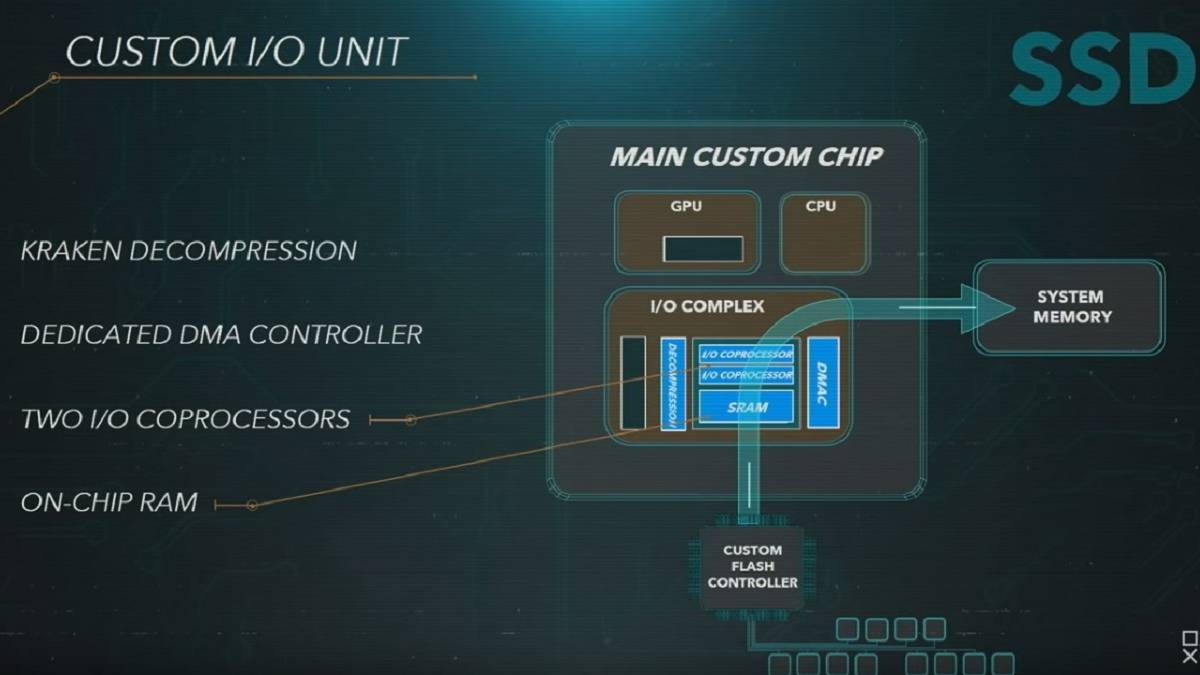
It can be seen in this image (is labeled incorrectly btw, it represents the whole motherboard)
The "main custom chip" is the AMD APU
The kraken is located inside the "I/O complex" (in between SSD and RAM)
Additionally the I/O complex have 2 tiny processors (probably ARM based) dedicatesd specifically, one for RAM and the other for SSD
The I/O complex even have a internal RAM (dedicated to kraken and the ARM processors)
Funny thing... there are a couple of component blacked out... thats a mistery
Anyway, this is just a reduced schematic... im sure there is some more "magic" inside that APU (the audio engine worths his own schematic, is hardware located inside the APU too)
And the SSD is represented by this schematic
The "custom flash controller" probably is made either by: samsung, hinix, of phsion
Is custom because it have 12 data channels in between the controller and the flash chips (the standard ones have less than 12)
Probably what they does with all that channels is to "dedicate" them to specific tasks, as example, you can use one of them dedicated to audio files, other for textures, other for video, etc... (and probably is posible to configure them, so you could have all the 12 channels searching for textures incase is needed)
Other of the nice features is they are using some kind of algorithm to identify the duplicated "assets", cerny mentioned a good eample with the spiderman game. The point is maybe the game needs to represent 5 objects in screen that are identical, and it should work this way:
-the game request 5 objects
-the SSD sends the 5 objects to kraken
-kraken realizes the 5 objects are identical
-so... kraken only sends 1 object to RAM
-then the game can load the 5 objects from RAM (reading the same object 5 times)
Again... we could say we are boosting the SSD speeds because the game doesnt realizes that we have reduced the total amount of data in RAM
Thats one of the reasons why there is no need to increase the RAM size too much... there is a point where is not really needed
the fact is there are hundreds of games smaller than the 16gb of RAM of the PS5... so technically is posible to load that games entirelly in RAM... is just is not needed
As far i remember cerny said the PS5 can load several GB's in less than a second... he mentioned that you could be looking at north (in a open field map of a game), and when you turn back the camera to south the game loads the map instantly
Thats very important for some game genres like racing games, but in general is going to affect every single thing we do (remember when we had to wait 1 or 2 seconds when we press the "start" button to take a look at the world map ?... that kind of delays are going to dissapear completly
There are more features used in the PS5 arquitecture design that are focused in all this IO communications in between SSD and RAM, i cant make a list of all them, but i guess eventually sony should explain them