Reballing fix or fiction ?

Deus

Member
Reballing fix or fiction ?

In reply to:
Well, I read this topic 7 months ago and did not think much of it. I honestly did not expect this topic would gain so much traction and dramatically shift people's idea of what exactly is wrong. As an engineer working in the Semiconductor field it is very well documented and agreed upon in the academic world that BGA with lead-free solder has some inherent issues (especially around the time they were manufactured). However, that does not mean I am not open minded to the idea that there CAN be an issue with the capacitors. I am more frustrated with the idea that people do not approach this scientifically and treat each Playstation 3 as their own entity and troubleshoot them individually.
It's interesting to hear from someone in that field! Can you tell us more about it?
Almost certain squeept and many others have already touched on this at the early stages in the thread so he would just be repeating himself really.
Those are only assumptions, not real studies or research.
And to avoid a reballing discussion in "PS3 Tutorial - NEC/TOKIN Capacitors Replacement - YLOD FIX" it's probably better to answer this in a separate topic.

Enough research, not assumptions, to find on the web, e.g.:

https://www.researchgate.net/public..._analysis_on_soldered_ball_grid_arrays_Part_i (Scroll down to read)
"INTRODUCTION
Failures of BGAs on PCBAs are primarily related to the solder connection and not to a problem at the silicon level." An interesting comment contradicting the "Reballing is bullshit..." theory.
Tells me REBALLING is NOT FICTION (or bu...).

Part 2:
https://www.researchgate.net/public...analysis_on_soldered_ball_grid_arrays_Part_II (scroll down)

PDF: "Studies on the Thermal Cycling Reliability of BGA System-in-Package (SiP) with an Embedded Die". http://143.248.115.96/pdf/foreign_journal/FJ_112.pdf
In "IV. CONCLUSION" you can read: "all failure occurred on inner BGA solder balls rather than the corner solder ball with the largest DNP."
"In addition, there was no failure observed at the embedded die bump interconnection."
Tells me eve more REBALLING is NOT FICTION (or bu..).

Still think reballing is fiction (or bu...)?

Btw, I do like the "NEC/TOKIN Capacitors Replacement" topic. Very well documented. Props to Naked_Snake1995.
Still thinking the problem is caused more often by bad BGA soldering than the Nec/Tokins but I do realise Nec/Tokins are getting old and should be considered too.
People just have to realize it's not the only reason for failing, can be one of the 2 or even both.
 
Last edited:
Reballing fix or fiction ?

In reply to:


And to avoid a reballing discussion in "PS3 Tutorial - NEC/TOKIN Capacitors Replacement - YLOD FIX" it's probably better to answer this in a separate topic.

Enough research, not assumptions, to find on the web, e.g.:
"Studies on the Thermal Cycling Reliability of BGA System-in-Package (SiP) with an Embedded Die". http://143.248.115.96/pdf/foreign_journal/FJ_112.pdf
In "IV. CONCLUSION" you can read: "all failure occurred on inner BGA solder balls rather than the corner solder ball with the largest DNP."
Interesting comment contradicting the "Reballing is bullshit..." theory:
"In addition, there was no failure observed at the embedded die bump interconnection."
Tells me eve more REBALLING is NOT FICTION (or bu..).

Below links to a 2 part document, part 1 stating:
"INTRODUCTION
Failures of BGAs on PCBAs are primarily related to the solder connection and not to a problem at the silicon level." (Telling me again REBALLING is NOT FICTION (or bu...).
https://www.researchgate.net/profil...lysis-on-soldered-ball-grid-arrays-Part-i.pdf

Part 2:
https://www.researchgate.net/profil...ysis-on-soldered-ball-grid-arrays-Part-II.pdf
Still think reballing is fiction (or bu...)?

Btw, I do like the "NEC/TOKIN Capacitors Replacement" topic. Very well documented. Props to Naked_Snake1995.
Still thinking the problem is caused more often by bad BGA soldering than the Nec/Tokins but I do realise Nec/Tokins are getting old and should be considered too.
People just have to realize it's not the only reason for failing, can be one of the 2 or even both.

Good idea on starting a new thread! Seriously don't need another flame war :).

And those were quite the papers! The last one was very thorough. According to that paper, BGA failure is inevitable once a specific life-time has been reached, and once it has, failure is pretty quick. Where exactly on the BGA, it'll depend on the type of material used both on the solder balls themselves, as well as the material between the ball and the board, and between the ball and the chip.

Even this might prove helpful -- if we can determine the materials used on the ps3, we might be able to make a semi-educated guess on where on the board the failure probably happened -- either at the edges or closer to the center. Or maybe it won't be helpful at all, if the only fix is a reball anyway. On that note, I can see how a reflow might be helpful, but only temporarily -- it'll fix cracks, but not air trapped inside the balls.
 
Think it also, if not more, depends on the quantity and layout of the solder balls on a BGA.

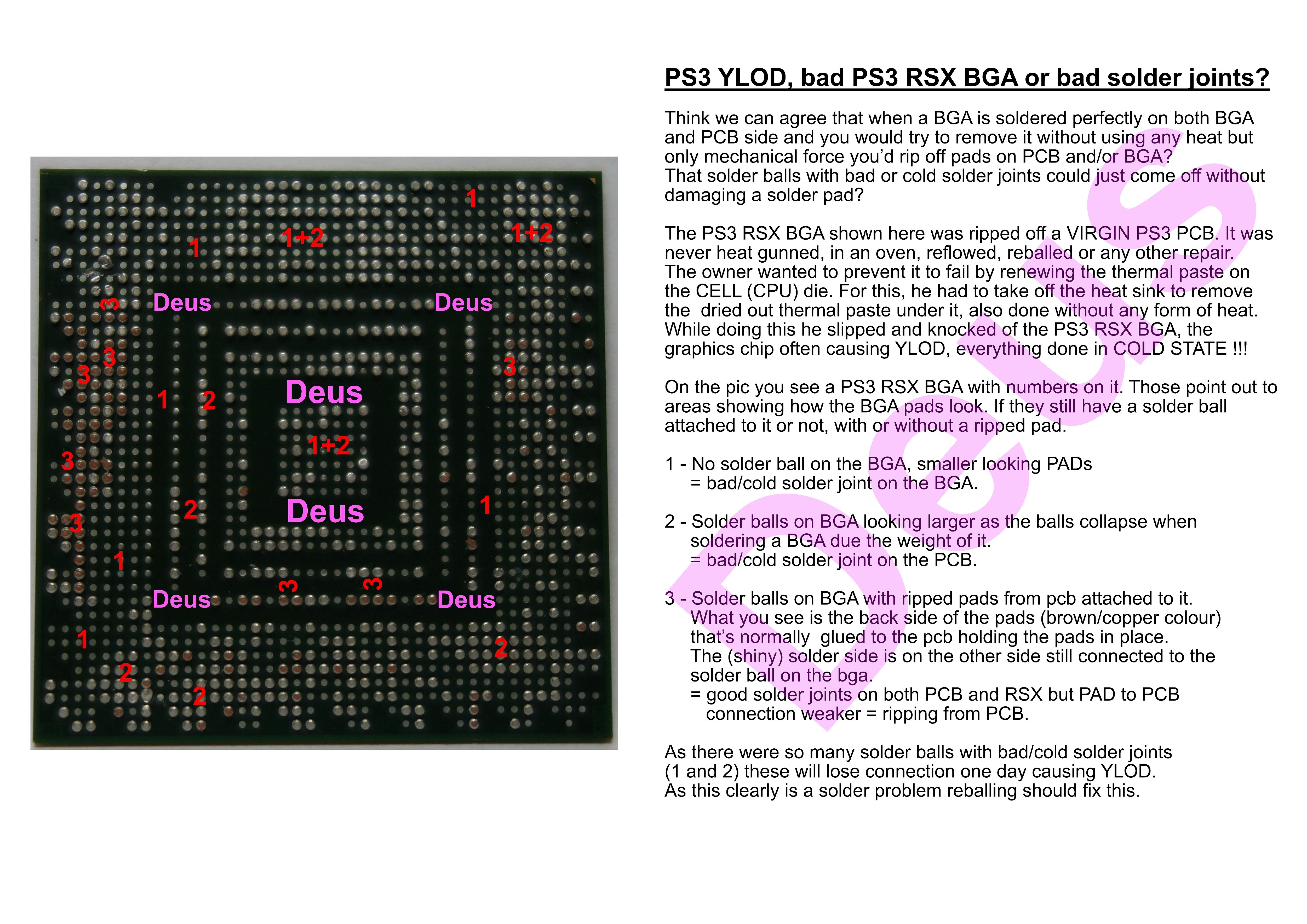
Have a good example of an RSX ripped in cold state from a VIRGIN PS3 PCB.
Never opened before, never seen any heath or any fix or repair showing lots of bad/cold solder joints.
If that still doesn't show there is a solder connection problem...
Q7OMR7.jpg
 
according to my friend who actually knows and work on this things (ECE graduate). to have a crack solder or cold solder to happend, there's 2 possible scenarios. Heat and Vibration. Heat is probably not the issue since the non-lead solder used in PS3 can only be damaged if you manage to reach 180c. The other thing is vibration, this issue is very common on server work type load where a bunch of drives stack on a single rack causing it vibrate really bad, luckily PS3 source of vibration is not enough to cause the solder to damage, blur-ray drive is using a stand with vibrate absorbing pads/stands. fans at stock and even full speed is still not enough for the viration to cause damage to solder joint as well, same with the laptop hdd on ps3.
 
One of the reasons I aways doubted the heat as a root cause is how much heat it takes to do any kind of solder work. Those boards are a huge heat sink, and it's such a pain to work on it.

On the other hand, I still remember the socket A chips from Intel (pentium 3, I think?), that attached via a slot instead of pin array. Overtime, hundreds of on/off heat cycles would cause the board to slowly shrink/expand and creep out of place and cause all sorts of glitching until you re-seated the stupid thing. It's not hard to visualize the same thing happening here, since that's similar to what the Chinese paper described.

As far as vibration, yeah, I agree... Thinking of the fan, though, the ps3 fan is mounted directly on the heatsink, which in turn is connected directly to the cpu's. Would it be possible that a very caked up fan would cause enough wobble that it would eventually cause issues, or more likely make existing issues worse? That's probably a worse case scenario though...
 
Heat is probably not the issue since the non-lead solder used in PS3 can only be damaged if you manage to reach 180c.

In PS3 heat IS the issue but not as you think it needs to go to melting temp (which is 217c on PS3's lead-free solder).

The many heat cycles causing stress breaking the the bad, cold or whatever problem the solder joints have.
Have you looked at the photo? That RXS was pushed off in a COLD state, by accident while removing the heat sink from the cell.
If you zoom in on it you'll see how many solder pads on the bga are still intact or solder balls having a nice flat bottom, both meaning they where not really soldered correctly to the bga or pcb but had bad or cold solder joints most likely.

It's all explained in the studies in the links (lots more to find on the web) examining it scientifically, all coming to the same conclusion.
If a BGA fails it's mostly the solder between bga and pcb causing the problem.
 
Is also needed to think in the "semisolid" states of the materials, that are something intermediate in between solid and fluid
The BGA solders of he PS3 only becomes fluid at a temperature that is way higher of what a PS3 can generate, but the heat makes all the atoms of the solder to "vibrate" in the whole range of temperatures, i guess this is one of the reasons that weakens them

Is stuff that happens at microscopical level, so when we talk about it becomes a bit confusing to tell that there are "micro-fractures", "micro-bubbles", "micro-oxidation" or things like that, because it cant be seen with the bare eyes
 
In PS3 heat IS the issue but not as you think it needs to go to melting temp (which is 217c on PS3's lead-free solder).

The many heat cycles causing stress breaking the the bad, cold or whatever problem the solder joints have.
Have you looked at the photo? That RXS was pushed off in a COLD state, by accident while removing the heat sink from the cell.
If you zoom in on it you'll see how many solder pads on the bga are still intact or solder balls having a nice flat bottom, both meaning they where not really soldered correctly to the bga or pcb but had bad or cold solder joints most likely.

It's all explained in the studies in the links (lots more to find on the web) examining it scientifically, all coming to the same conclusion.
If a BGA fails it's mostly the solder between bga and pcb causing the problem.

I just shown your message to my friend and what he said is "ill believe it once you give me photos of actual degradation of the balls because of hot/cold cycles using xray image"

well to be honest, if the reballing is the ultimate fix, seriously the repair shops here that repair game console wouldnt have headaches because of back jobs.

what he also said that "the most common failure points of electronics today is the IC it self not the solders, dont put the 90s cold solder join issues on the table anymore because it clearly it doesnt".
 
Is also needed to think in the "semisolid" states of the materials, that are something intermediate in between solid and fluid
The BGA solders of he PS3 only becomes fluid at a temperature that is way higher of what a PS3 can generate, but the heat makes all the atoms of the solder to "vibrate" in the whole range of temperatures, i guess this is one of the reasons that weakens them

Is stuff that happens at microscopical level, so when we talk about it becomes a bit confusing to tell that there are "micro-fractures", "micro-bubbles", "micro-oxidation" or things like that, because it cant be seen with the bare eyes
I just shown your message to my friend and what he said is "ill believe it once you give me photos of actual degradation of the balls because of hot/cold cycles using xray image"

well to be honest, if the reballing is the ultimate fix, seriously the repair shops here that repair game console wouldnt have headaches because of back jobs.

what he also said that "the most common failure points of electronics today is the IC it self not the solders, dont put the 90s cold solder join issues on the table anymore because it clearly it doesnt".
i do not know if it is related to the ps3 problems with solder balls and all that...but nivida worked on the rsx around the same time that they were working on other things. they would basically design a laptop or whatever for other companies and then the other company would build/source and sell them as their brand. some of these nvidia designed machines (laptop especially) had similar issues to ps3 (even found the "tear it down and put in oven" advice for laptop model several times).

my laptop exhaust became clogged. it started shutting down own its own (overheat protection but i didnt realize it--i thought cord was bad but did it on batt too). i was appling pressure to the keyboard to get it to turn on at first but it got worse. eventually it stopped working at all.

my slim ps3 has artifacts and sometimes freeze if i forget to put two VERY thick heavy books on top of it. (it has too warm up before problems).

i belive my ps3 and my former laptop have/had the same problem. im not sure the issue or solution. but i call this issue "the nividia problem".

FYI i place the books a little left of center as this seems to be my sweet spot.

EDIT:
i forgot this...i am sure it was the gpu on laptop that was the issue because 3d was messed up after a few auto shutdowns.
 
Last edited:
"ill believe it once you give me photos of actual degradation of the balls because of hot/cold cycles using xray image"
Ok, so you showed him the post, good. But did you and/or him, read the documents? They HAVE X-RAY PHOTOs as well as photos where they polished the BGA and part of the balls showing the faults as they really are. Even a lost ball x-ray didn't show...
well to be honest, if the reballing is the ultimate fix, seriously the repair shops here that repair game console wouldnt have headaches because of back jobs.
Never said reballing is the ultimate fix but it was a fix for most failing ones the first years. As PS3 is aging Nec/Tokins can fail more. Fixing is repairing what is broken. If it's the BGA solder, fix that. If it's the Nec/Tokins, fix those.
Let's do an assumption. If a reballed PS3 lasted another 5 years but then fails again and the problem seems to be Nec/Tokins fixing the problem, don't you think that the reballing it was a valid fix, repairing the BGA solder problem? If changing Nec/Tokin fixes it again for say another 5 years, also a valid good fix, not? But this also means the initial reball lasts 10 years in total now... 2 Different problems, 2 different fixes with both a good combined result.
Maybe REBALLING + Nec/Tokins is the ULTIMATE FIX ???
dont put the 90s cold solder join issues on the table anymore because it clearly it doesnt".
Lead-free solder made that even a bigger problem. Alsoin the studies. And if you look at the photo above, it has plenty.
what he also said that "the most common failure points of electronics today is the IC it self not the solders".
Again, that is also mentioned in the documents.
"https://www.researchgate.net/public..._analysis_on_soldered_ball_grid_arrays_Part_i (Scroll down to read)
You can read it in the INTRODUCTION paragraph:
"INTRODUCTION
Failures of BGAs on PCBAs are primarily related to the solder connection and not to a problem at the silicon level."


They don't assume this, they researched it. Explain what happens, show the errors in different ways...
These researches are done by engineers, universities, organisations working for the electronics industry to find solutions and/or prevention for problems etc...

Think the problem these days is people seem to believe more what "other people on the internet" say, preferably in a video, instead of real documented research... Maybe because it takes a bit more effort to read ?

Did not start this to say or prove it's not the Nec/Tokins but always the BGAs. Only want to point out it's better to keep an open mind on it as it can be Nec/Tokins as well as BGA. There are already lots of comments, even over other places on the web stating "It's not the BGA, it's the Nec/Tokins failing..." taking the Nec/Tokins for granted. Some even saying it never is/was the BGA. Which is definitely fake news.

All this doesn't apply to PS3 only but to all devices having BGAs. It can always be something else but if it has a BGA in it, bad BGA solder can be the problem. Or bad Nec/Tokins like in some (older) laptops.
 
Last edited:
i do not know if it is related to the ps3 problems with solder balls and all that...but nivida worked on the rsx around the same time that they were working on other things. they would basically design a laptop or whatever for other companies and then the other company would build/source and sell them as their brand. some of these nvidia designed machines (laptop especially) had similar issues to ps3 (even found the "tear it down and put in oven" advice for laptop model several times).

my laptop exhaust became clogged. it started shutting down own its own (overheat protection but i didnt realize it--i thought cord was bad but did it on batt too). i was appling pressure to the keyboard to get it to turn on at first but it got worse. eventually it stopped working at all.

my slim ps3 has artifacts and sometimes freeze if i forget to put two VERY thick heavy books on top of it. (it has too warm up before problems).

i belive my ps3 and my former laptop have/had the same problem. im not sure the issue or solution. but i call this issue "the nividia problem".

FYI i place the books a little left of center as this seems to be my sweet spot.

EDIT:
i forgot this...i am sure it was the gpu on laptop that was the issue because 3d was messed up after a few auto shutdowns.
When the problem is fixed (partially or temporally) by pressure it means is a problem in the BGA solder balls
Probably is a ball like the ones that can be seen in the photo above where the ball surface is perfectly plane (but disconnected)

I said the pressure fix works only temporally because usually the fracture gets oxidized
Technically the oxidation happens when there are atoms of oxigen that gets connected to the atoms of metal (becomes part of the atomic crystalline structure of the metal)
Everybody is used to the oxidation that happens in the steel that have a brown color, but in other metals could have other colors (in alluminium is white)
And it happens in the fracture because there are electrons doing microscopical "jumps" to cross the fracture air gap. This is pretty much like micro-sparks
In the practise it creates interferences, and the most time you use it the interferences increases, and eventually the device stops working

Is the kind of problem that worsen with time, so make your mind to it, at some point you will need to decide if taking the PS3 to a reballing, or the risky way tryig to do it at home

Years ago i also had this probem with the GPU of a laptop, and while trying to fix it i killed it definitivelly :(
 
When the problem is fixed (partially or temporally) by pressure it means is a problem in the BGA solder balls
Probably is a ball like the ones that can be seen in the photo above where the ball surface is perfectly plane (but disconnected)

I said the pressure fix works only temporally because usually the fracture gets oxidized
Technically the oxidation happens when there are atoms of oxigen that gets connected to the atoms of metal (becomes part of the atomic crystalline structure of the metal)
Everybody is used to the oxidation that happens in the steel that have a brown color, but in other metals could have other colors (in alluminium is white)
And it happens in the fracture because there are electrons doing microscopical "jumps" to cross the fracture air gap. This is pretty much like micro-sparks
In the practise it creates interferences, and the most time you use it the interferences increases, and eventually the device stops working

Is the kind of problem that worsen with time, so make your mind to it, at some point you will need to decide if taking the PS3 to a reballing, or the risky way tryig to do it at home

Years ago i also had this probem with the GPU of a laptop, and while trying to fix it i killed it definitivelly :(
yeah there were a lot of laptops with issue made right around ps3 design/launch time. i only lost mine because i didnt think about the exhaust maybe clogged. the heat melts the balls a little and cause it. just like on ps3 the first time probably fixes okay with pressure. on my laptop i bent something belonging to cooling system coming off of gpu to push it down a little at first. that might have worked fine long term if i had also cleaned the exhaust.
 
i only lost mine because i didnt think about the exhaust maybe clogged. the heat melts the balls a little and cause it.

Fyi, heat generated by a even a clogged laptop, PS3, XboX or whatever won't melt the solder balls. They were, as all electronics after 2006, soldered with lead free melting at 217c (422,6 F) some newer even 227c (440,6 F).
Most will even shut down automatically after reaching a specific temp, somewhere between 80-125c, depending the device.
It's the the heat and cooling cycles putting mechanical stress on the solder balls making it crack.

If you want to know more about what happens, it's in the first post's links to studies explaining it.
 
Fyi, heat generated by a even a clogged laptop, PS3, XboX or whatever won't melt the solder balls. They were, as all electronics after 2006, soldered with lead free melting at 217c (422,6 F) some newer even 227c (440,6 F).
Most will even shut down automatically after reaching a specific temp, somewhere between 80-125c, depending the device.
It's the the heat and cooling cycles putting mechanical stress on the solder balls making it crack.

If you want to know more about what happens, it's in the first post's links to studies explaining it.
its a poor choice of words on my part (maybe i was in a hurry). i mean what you say...heat and cool cycles causing stress that builds over time.

Mine did shutdown on its own a few times before i opened it up. i thought the first one or two were crashes and then thought bad power cord but batt didnt help.
 
Lets just say solder dry joints has been an issue for electronics since its conception.

Like everything in life, clinging on too a specific thing that will solve your problems without research and understanding could send you down a rabbit hole....

Without repeating myself several times,

1. Reflowing or Reballing has been a fix to 90% of the PS3 boards i've recieved - but only after investigating and testing typical electronic processes and just experience.
2. NEC tokins, like any component on the PS3 board can fail and because of its general high failure rate on other motherboards of its time has been highlighted recently in the threads.

So my personal opionion on this is that its a thing and it happens alot.

So to anyone who wants to repair PS3 boards follow the simple flow diagnostics rule that most electronic engineers use to diagnose any electronic issues (this applies to anything in life).

And a quick plug on a thread to help with this whole diagnostic scenario

https://www.psx-place.com/threads/f...syscon-first-steps-and-error-reporting.30100/

This can then assist your own judgement on what the issue can be
 
Fyi, heat generated by a even a clogged laptop, PS3, XboX or whatever won't melt the solder balls. They were, as all electronics after 2006, soldered with lead free melting at 217c (422,6 F) some newer even 227c (440,6 F).
Most will even shut down automatically after reaching a specific temp, somewhere between 80-125c, depending the device.
It's the the heat and cooling cycles putting mechanical stress on the solder balls making it crack.

If you want to know more about what happens, it's in the first post's links to studies explaining it.

I don't know what it was for the ps3 (over 87 at least C), but I know more about the inner workings of the 360. the shut off temp for that is between 190-200 degrees F (whatever that is in Celsius) for all models slim and phat. the systems abruptly shut off when you shut them down, so the cooling isn't gradual. I think that's why the ps4's fan keeps running (at least in rest mode) for a few moments after shut down. I don't own an xbone to know if it does that as well. I've heard that those systems are very quiet, which could be bad for cooling. though, a loud fan might suggest something is wrong with the system, at least to the user, even if there's actually nothing wrong with it. that could be why they opted for higher temps rather than a louder system.
 
The problem sony and microshit created at that time was trying to shove a server type processor into a tiny box.

The ps3 especially, but since we are starting to learn the secrets of the syscon settings and its default fan settings, it seemed that sony was happy to let the ps3 roast away.

I think they would of been better off, doing what i've been actioning so far, raise the minimum fan speed from 20% to 29% and then tweak the middle ground of fan control settings to hover over 30% to 50% and a quick reaction reduce time based on its min and max temp profile settings.

The old CECHC models i've been fixing recently, usually hover over 69C to 73C at a fan speed of 32%
Before this it would cook all the way to 85C and then fan speed would stay at 50% and not lower until the profile hit 58C which was never going to happen - this would be the reason why it was always recorded that the ps3 fan would not slow down on the old models.

They changed this on the newer models fan policy - the more models i fixed the different policies i discovered.

I don't know what it was for the ps3 (over 87 at least C), but I know more about the inner workings of the 360. the shut off temp for that is between 190-200 degrees F (whatever that is in Celsius) for all models slim and phat. the systems abruptly shut off when you shut them down, so the cooling isn't gradual. I think that's why the ps4's fan keeps running (at least in rest mode) for a few moments after shut down. I don't own an xbone to know if it does that as well. I've heard that those systems are very quiet, which could be bad for cooling. though, a loud fan might suggest something is wrong with the system, at least to the user, even if there's actually nothing wrong with it. that could be why they opted for higher temps rather than a louder system.
 

Similar threads

Back
Top