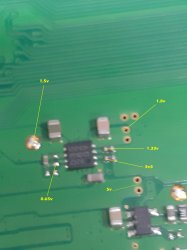
PS3 Frankenstein PHAT PS3: CECHA with 40nm RSX

Here's the overview of voltages on RSX that you may see when probing different points.

1 +1.8V RSX_PLL_VDD (voltage for clock multiplier?)
2 +1.2V RSX_VDDC (main supply voltage)
3 +1.2V RSX_VDDR (memory voltage)
4 +1.2V YC_RC_VDDIO
5 +1.5V RSX_RC_VDDA
6 +1.5V RSX_VDDIO
7 +1.8V RSX_FBVDDQ (memory buffer voltage)

Based on this: https://www.psdevwiki.com/ps3/Talk:RSX

From my understanding, all these lines go into RSX and are, in theory, supposed to be present on all models. The point was still to try and figure out if VDDR actually differs between revisions. I bet that 1.5v @ElGris and @vyktormvmpay25 were seeing is not VDDR, but VDDIO or VDDA. Felix could correct me here since I have a tendency to overlook important logic...

I also just discovered a very raw voltage scheme for DYN-001 (it's still using 65nm RSX), but it claims there may be errors and main supply to GPU is missing. So the schematic is only good for checking IC names.


@ElGris, I have posted here some thoughts about resistors earlier on. If you're talking about the ones related to reset, it was mentioned here

Observation 1: R2153 is removed and bottom pin of R2054 is 'shifted' to nearby ground:


As for the IC and the surroundings resistors, for now the most likely conclusion is to leave it untouched. But what POSSIBLY happened might have been this:
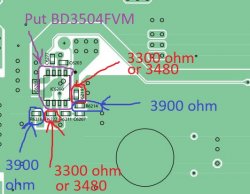
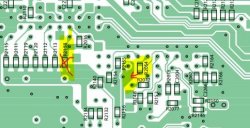
At this point I think many have noticed I'm nearly thinking aloud. Like Felix said, it would be much easier if we had a EE checking voltages and helping with schematics.
 
Last edited:
Here's the overview of voltages on RSX that you may see when probing different points.

1 +1.8V RSX_PLL_VDD (voltage for clock multiplier?)
2 +1.2V RSX_VDDC (measures 1.3v sometimes?)
3 +1.2V RSX_VDDR (memory voltage)
4 +1.2V YC_RC_VDDIO
5 +1.5V RSX_RC_VDDA
6 +1.5V RSX_VDDIO
7 +1.8V RSX_FBVDDQ (memory buffer voltage)

Based on this: https://www.psdevwiki.com/ps3/Talk:RSX

From my understanding, all these lines go into RSX and are, in theory, supposed to be present on all models. The point was still to try and figure out if VDDR actually differs between revisions. I bet that 1.5v @ElGris and @vyktormvmpay25 were seeing is not VDDR, but VDDIO or VDDA. Felix could correct me here since I have a tendency to overlook important logic...

I also just discovered a very raw voltage scheme for DYN-001 (it's still using 65nm RSX), but it claims there may be errors and main supply to GPU is missing. So the schematic is only good for checking IC names.


@ElGris, I have posted here some thoughts about resistors earlier on. If you're talking about the ones related to reset, it was mentioned here


At this point I think many have noticed I'm nearly thinking aloud. Like Felix said, it would be much easier if we had a EE checking voltages and helping with schematics.
That's what the shcematics would lead us to believe those voltages are, but we still haven't found that 1.2v VDDR??? I was just trying to verify that the voltages being fed to the 40nm and 60nm chip matches what a COK-001 provides (without modification). On IC6200 (a BD3520) pin 6 is supposed to feed +1.2v to the the RSX_VDDR. So I wanted to make sure that voltage was the same on other boards. Without their schematics, however finding it has been tricky!

We still need someone to probe pin 6 on a COK-001 to prove it is indeed the 1.2V the schematics says. But I have reason to believe it isn't. I said previously, when @squeept and I scoped the Tokins, we were getting 1.3v on VDDC, not the 1.2v the schematic says. So for all we know, that 1.5v everyone keeps getting could be VDDR. For all we know the schematics lie about the actual voltages we see in the real world. Engineers do that on schematics. We just need to confirm that pin6 on an A model. If it reads 1.2, then we haven't been looking in the right place or need to re-evaluate this approach. If we had the schematics for the slims this would be easy.
 
We still need someone to probe pin 6 on a COK-001 to prove it is indeed the 1.2V the schematics says. But I have reason to believe it isn't. I said previously, when @squeept and I scoped the Tokins, we were getting 1.3v on VDDC, not the 1.2v the schematic says

@vyktormvmpay25 showed you the picture where he's also seeing 1.33v instead of 1.2v. That is indeed VDDC.

voltages 1.3-2.jpg


Take a look here. Again 1.3v instead of 1.2v in VDDC, but VDDR is measured 1.2v. So that should clarify your doubts:

https://www.trisaster.de/page/index.php?topic=459

Someone was measuring these voltages on COK002, and that part of the VRM for RSX is the same for COK001. There is no reason to believe it would be different. 1.3v in VDDC appears to be the only deviation from schematics in RSX voltage lines. Now why there is 1.3v instead of 1.2v? Someone had mentioned that VRM is dynamic. So it can provide whatever voltage GPU requests? I have to read up on VRM logic a bit more. I bet you can't expect it to stay 1.2v at all times unlike VDDR.

Having said that , I very much doubt 1.5v seen in earlier replies is VDDR, but we'll see...

Btw remember, the service manuals may have been modified later on and we don't have access to those. CECHC manual is 5th edition, so who knows how many more editions there have been and what was changed in there. In other words, we can't trust schematics 100% either.
 
Last edited:
@vyktormvmpay25,

While appreciating your cooperation, could you possibly put pics as thumbnails or hide them under "spoiler" , or just attach them in the reply options? These pages become so cluttered and clunky to read when you throw full sized photos like that...

@RIP-Felix

The thread starter had a better idea of what VRM is. So here he pretty much explained why we are seeing 1.3v on VDDC instead of 1.2v. The schematic probably stated approximate/average voltage as 1.2v, while in reality it can be anything from 0.8 to 1.6v

RSX and CELL voltages are supplied by VRM. It's the same type of VRM that is used on PC motherboards - some buck converters with PWM controller operated by VID. Simply put, RSX/CELL tells VRM what voltage it wants (by sending it voltage identification, VID) and VRM supplies it. On CECHA, RSX PWM controller is NCP5318FTR2G - it can produce voltages between 0.8375V and 1.6000V, whatever of which RSX really wants. So voltage is not a problem here.

Basically, that clarifies it with VDDC. Now gotta keep looking for VDDR... I'm sure it's there somewhere. I might get a slim board at some point and check it myself. It's a bit tricky trying to get others to find out the right points based on pictures only...

Another thing that would make it easier if we could chat through Discord or perhaps through direct messages. It's not letting me start a conversation with you when I click on your profile. But I believe it would be easier to clarify our doubts by talking directly instead of posting these long explanations.
 
Last edited:
Yes that would be but cell is from 2500 series, not the one with blackborder like 3000 . Sony had to finish those and put them on superslim?
 
@Deaded you are getting hung up on VDDC, GPU power from the second stage filter (eg tokins). Your right, we already established it pretty well.

I mean VDDR. It should be separate yes? The RAM has it own power needs separate from the GPU and there could be issues sharing the same voltage source. So I just wanted to confirm it on a COK-001/2. It could be 1.5v in standby (reset held), then regulate down to 1.2 once enabled. If so that could be why were seeing 1.5 on the output pins of the slim VRM. Or that's VDDA or something else and we have yet to find VDDR.
 
@Deaded you are getting hung up on VDDC, GPU power from the second stage filter (eg tokins). Your right, we already established it pretty well.

I mean VDDR. It should be separate yes? The RAM has it own power needs separate from the GPU and there could be issues sharing the same voltage source. So I just wanted to confirm it on a COK-001/2. It could be 1.5v in standby (reset held), then regulate down to 1.2 once enabled. If so that could be why were seeing 1.5 on the output pins of the slim VRM. Or that's VDDA or something else and we have yet to find VDDR.

It's hard to keep track in this thread. That's why I'd rather talk directly . I'm not sure is it because you limited your profile from receiving messages from members or is it my member status is not advanced enough to write to higher status members...

I didn't think about the standby mode. I'm still leaning towards that it's VDDA/VDDIO. I've linked all the voltages that somebody had measured just in case. There it also confirms the needed VDDR at pin 6 on COK002 at least (I imagine they would have mentioned different standby-voltages, but who knows). I can try to measure it on my own board too in standby and powered state a bit later. You were saying it's possible the values from the service manual might not match with real ones. Well, yes and no. While VRM voltage could have been specified a bit better, it's probably not a reason enough to doubt the rest of the circuit. Although at the same time there is maybe a small reason to doubt because we only have one edition of the service manual and we don't know if it's even the final one. But that's just my opinion, and I have a tendency to rush to conclusions (ADHD type thing).
 
Last edited:
We still need someone to probe pin 6 on a COK-001 to prove it is indeed the 1.2V the schematics says.
I can confirm that 1.2v is present on IC6200, on a COK-001 (B) that is yloding, these were my readings:

Pin1: Nothing (Why there's a cap in series?)
Pin3: 3.3v
Pin4: 5.16v
Pin5&6: 1.2v
Pin7: 2.6v-2.4v (it changes to 2.4 at the end of the green light moment)
Pin8: 1.7v

This IC is used for some applications on this mobo (there're 4 if I'm not mistaken), does anybody found a pattern that could be relevant? I'm gonna be trying to found those 1.2v on SSs mobos, but I have little time during week, so task will be a little bit slow ha. Btw, there's no chance that we only had 1.5v present on Slim-SSs models for RSX feeding instead of different voltages like in fats?
 
I can confirm that 1.2v is present on IC6200, on a COK-001 (B) that is yloding, these were my readings:

Pin1: Nothing (Why there's a cap in series?)
Pin3: 3.3v
Pin4: 5.16v
Pin5&6: 1.2v
Pin7: 2.6v-2.4v (it changes to 2.4 at the end of the green light moment)
Pin8: 1.7v

This IC is used for some applications on this mobo (there're 4 if I'm not mistaken), does anybody found a pattern that could be relevant? I'm gonna be trying to found those 1.2v on SSs mobos, but I have little time during week, so task will be a little bit slow ha. Btw, there's no chance that we only had 1.5v present on Slim-SSs models for RSX feeding instead of different voltages like in fats?

Felix wanted the confirmation, but I think we are clear on this now. Just like I tried to explain with the provided links, it's been basically already confirmed all along.

As to 1.5v feeding RSX. VDDC and VDDR must be different. Also IMHO I'm quite skeptical now that 1.5v is used for VDDR in either Slim or SS. But that's the whole debate . Just try to find stable 1.2v around RSX on those boards, I'm sure it's there somewhere. And if anyone looked through that website a bit more, you can already see 1.2v in there sort of confirmed on a slim (someone had measured it). Yet it's always best to confirm it properly once more.

At this point I'd bet 70% that Sony technicians replaced the IC with resistors because something was wrong with the original (which means no change in voltage, meaning leave IC6200 and its resistors untouched when you swap GPU+syscon), and 30% that actual voltage was changed (which would mean do replace IC6200 and calculate new resistors for it). I am not talking about the reset resistors though. Right now it's also probably not the most important part of the puzzle anyways, since the main thing is resolving syscon flash...
 
I just glanced over these updates but I'm guessing these voltage differences are just the real world kicking in, probably not anything to worry about. There's plans and there's execution, and never the twain shall meet. I mean you'd be looking at "standby" voltages on a Genesis of like 14VDC from the power supply until you hit the power button and get the 9V under load that you're supposed to.

Anyway, would it be as simple as a quick Python script to fix the EEPROM dump from the 90nm syscon for writing back on the 65nm syscon? I've been a glorified solder jockey for 20 years now, most of my brain cells went up in fumes long ago. I would gladly throw a $100 bounty on that to save me the headaches of trying to relearn things I've long forgotten, and making sure it gets done right by a syscon expert.
 
Felix wanted the confirmation, but I think we are clear on this now. Just like I tried to explain with the provided links, it's been basically already confirmed all along.

The information on the devwiki is taken from the schematic, which has all those voltages listed. They are not verified measurements off a live console. AKA the real world.

But you're right I missed your link. It's in German, which I don't read, but It's pretty clear in the table they have actual measurements taken from JL9651 (VDDR). It was available all along like you said, for a COK-002. Nice find @Deaded. It's 1.20v confirmed. Doubly so by @ElGris , thanks BTW. Also of note, it lists where the other voltages can be found, again on a COK-002 board.

I'm quite skeptical now that 1.5v is used for VDDR in either Slim or SS. But that's the whole debate . Just try to find stable 1.2v around RSX on those boards, I'm sure it's there somewhere. And if anyone looked through that website a bit more, you can already see 1.2v in there sort of confirmed on a slim (someone had measured it). Yet it's always best to confirm it properly once more.

I had a look around that German website you linked and do not see a similar table of information for any of the other board revisions. They saw the need to verify voltages, proving I'm not alone in that thinking. So I still think there's merit in confirming them.

We looked at the schematics for various "D35 _ _ _" Linerar Regulators. Some are fixed at 1.2v others are selectable. A D35821 is fixed at 1.2v, which is why finding 1.5v on a D35282 found near the RSX on a JTP-001 had me concerned:
ad4ae1b004770af3428b17a851648ef3.jpg
0bed8199cc21f902be3f2ca2202c3a6f.jpg
Pin 4 is Vcc (Power supply), so 1.8v from +1.8_main makes sense. Pin 7 is FB, the voltage reference feedback. Most of these data sheets have pin 5/6 (Voltage output and control) in continuity. Again we see that, but this read 1.5v. I suppose that's the difference between the D35281 & D35282. The 282 is selectable. This is RSX_VDDIO, which is supposed to be 1.5v. I just checked the schematic @DeadEnd linked to and JL9656 on a COK-001/2 is in a very similar location on the motherboard. So it equivalent on a COK-001 is a D3521 (IC6017). So that's confirmed now!

Look for a similar target that has 1.2v on pin 5 or 6, if it's nearby the RSX, that's VDDR. If you don't find it, that's bad news!
 
Um, another nugget from that german site about the DYN-001:
blockschaltbild_power_dyn-001.png
This shows the GPU requires 3 voltages, and it show the VRM part numbers for them!
  • 1.0v (D35280) = ??? VDDC ???
  • 1.2v (BD3525) = VDDR
  • 1.5v (D35282) = VDDIO
I guess that D35282 was in there after all. Yeah, 1.5v like we measured. Defiantly VDDIO. What's with the 1.0v (D35280)? On a COK-001/2 that's coming from the switching regulators, not a liner VRM? If that's a fixed 1.0v VDDC, then the RSX wouldn't be able to request dynamic voltage. It would just recieve a constant 1.0v. I wonder if that other mod, may have something to do with this? That's interesting.
 
Um, another nugget from that german site about the DYN-001:
blockschaltbild_power_dyn-001.png
This shows the GPU requires 3 voltages, and it show the VRM part numbers for them!
  • 1.0v (D35280) = ??? VDDC ???
  • 1.2v (BD3525) = VDDR
  • 1.5v (D35282) = VDDIO
I guess that D35282 was in there after all. Yeah, 1.5v like we measured. Defiantly VDDIO. What's with the 1.0v (D35280)? On a COK-001/2 that's coming from the switching regulators, not a liner VRM? If that's a fixed 1.0v VDDC, then the RSX wouldn't be able to request dynamic voltage. It would just recieve a constant 1.0v. I wonder if that other mod, may have something to do with this? That's interesting.

I've linked DYN-001 earlier on as well, maybe it's easy to glance over some of the links. Use google translate for that page (it got translated impressively well).

The drawing is not yet complete, the main supply for the CPU and GPU is still missing. Errors can also be included. Some component names still need to be checked. This drawing shows connections between various circuit units represented by important components. It's not a real circuit diagram, it's just intended to provide an overview. Round elements represent the power pack or consumer. Rectangles represent voltage converters or other components that are connected to them, usually ICs or transistors. Solid lines with arrows represent the power flow. Dashed lines ... to come.

Either they didn't realize 1.0v was actual VDDC and D35280 was tied to it by mistake, or it's something else and they couldn't find VDDC, just like it says. That schematic is to be taken with a grain of salt. But at least 1.2v is sort of confirmed in there, like I've been trying to say before. However, it won't hurt if someone with slim or super slim could reconfirm it just to be sure.
 
Last edited:
I did read this whole thread, so please for give me for my memory. I'm pretty close to believing the hardware side of this mod is ready. I've been reading about the PWM controller the OP mentions and the current sensing. I'm still reading the datasheet and control sensing is pretty complicated. So the BS factor spewing forth through my keyboard is quite high. Thinking out loud here, so fee free to play "Idea Hunt." Shoot'em down as necessary!

I'm far more comfortable now that if the RSX is pinout compatible, it should work regardless of the VDDC seen on it. If the 40nm is indeed 1.0v, that's what it'll pull on a COK-001 as well. I'm pretty confident there is no need to change the board. I still don't understand what the point of grounding CGreset is though. Didn't we decide there is not an obvious hardware incompatability that would require it (like that's how it's wired on a 40nm or 65nm RSX)? I'm thinking perhaps it was an effort to circumvent the RSX being held in reset, perhaps a hardware workaround to a software problem. Like if the PWM controller doesn't recognize the RSX and wont release reset. Or perhaps a SYSCON thing?
 
No worries, I myself struggle to express certain thoughts out of my mind and keep it short and to the point. There is a lot of variables and covering them all may seem chaotic/difficult to follow.

I have nothing to comment with regards to reset for now. Your idea sounds plausible. But whoever's gonna be trying out the swap can experiment with reset resistors as well. If it doesn't work even after syscon swap and flash, you'd have nothing to lose by grounding the resistor to see if it helps. That's just my logic. For the moment I'm going to attempt reading the syscon FW with arduino...
 
Last edited:
Back
Top