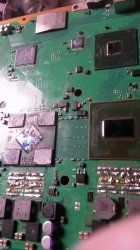
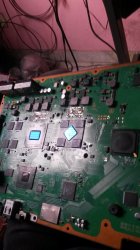
PS3 Frankenstein PHAT PS3: CECHA with 40nm RSX

That's what I've been saying as well. But according to Paco and the rest, it's not logical because 90nm can still be alive. So you must hang on to it like your life depends on it lol.

And another way to look at it is that the COK-001 boards themselves are now the most valuable part of the equation due to the ability to swap. So skipping straight to a known good chip saves wear and tear on those boards that will eventually be the limiting factor.
 
Here you agreed that 40nm can and most likely will outlast 90nm, yet you immediately tried to manipulate the point into the fact that "the board itself may not last long". Completely irrelevant statement because the question was not about the board. The points I made concerned only RSX's lifespan and reliability. The board faults are a whole other discussion and if some of them would need more maintenance, they will need them regardless of what RSX is installed. That was manipulative of you to attempt to distract from the main point .


I'm not missing anything and you're twisting my words again. I never said he shouldn't have reballed. I said it doing it now for 90nm chips when a better alternative is available is not the most logical choice anymore. Promoting such idea with a small chance that it's alive is also not reasonable anymore unless you're trying to save money. It's simple common sense. You even contradict yourself without noticing. You just said that according to squeept there is more evidence that those chips are dead rather than they are alive. Contrary to what you've been claiming before. Now you basically agreed that it's the opposite and what do you do? Well, once again you are attempting to shift attention from the main argument by focusing on what squeept said about reballing... Except that's actually not what he said. He never said it's "most successful than ever". He wrote that the success rate is up because he started doing ohms testing to eliminate the low ohm chips. From my understanding he has become more selective in his reball choices, which does make sense. But I still don't think he would be promoting to keep trying to save 90nm by any means necessary. Again, unless money is in question, you would normally want the customer to choose the better option, to install parts with most reliability.

And Paco, I think I get it. You just need to be right even if you're wrong. Because as you sort of admit that you may be wrong , you are still trying to spin the points in your favour by any means necessary. And I think alty75 is doing something similar by trying to shift focus on his experience and other claims, which are mostly beside the point, while deliberately avoiding my questions and providing very vague and inconclusive data . See below


Well, if you didn't keep a tally on it so the data would be highly approximate and not very conclusive then. Out of 60% that you reballed, how many can you say with absolute certainty had a genuine BGA fault? Considering there is at least 33% chance (this is an assumption but let's play with that) some of them could have appeared to work by reball. It's not easy to know.


Yea, but that is the issue. 90 days is not enough to draw conclusions. Some reballs can reactivate internal damage and will work for several months. Like you say, at least for a period of time. After that, all bets are off. Why the customer didn't return? Plenty of reasons and therefore it's difficult to make any conclusions...


How many though? Again, not enough conclusive data. But of course , some of them will last. We were just saying about approximate 1/3 of all...So it would fit in line within that theory.

dunno mate. You need to bring some real data to the table by the sounds of it! Not to sure you can,can you? Just someone with theories and estimates because what you read and hear? I'm not going to entertain you any more lol
 
Here you agreed that 40nm can and most likely will outlast 90nm, yet you immediately tried to manipulate the point into the fact that "the board itself may not last long". Completely irrelevant statement because the question was not about the board. The points I made concerned only RSX's lifespan and reliability. The board faults are a whole other discussion and if some of them would need more maintenance, they will need them regardless of what RSX is installed. That was manipulative of you to attempt to distract from the main point .


I'm not missing anything and you're twisting my words again. I never said he shouldn't have reballed. I said it doing it now for 90nm chips when a better alternative is available is not the most logical choice anymore. Promoting such idea with a small chance that it's alive is also not reasonable anymore unless you're trying to save money. It's simple common sense. You even contradict yourself without noticing. You just said that according to squeept there is more evidence that those chips are dead rather than they are alive. Contrary to what you've been claiming before. Now you basically agreed that it's the opposite and what do you do? Well, once again you are attempting to shift attention from the main argument by focusing on what squeept said about reballing... Except that's actually not what he said. He never said it's "most successful than ever". He wrote that the success rate is up because he started doing ohms testing to eliminate the low ohm chips. From my understanding he has become more selective in his reball choices, which does make sense. But I still don't think he would be promoting to keep trying to save 90nm by any means necessary. Again, unless money is in question, you would normally want the customer to choose the better option, to install parts with most reliability.

And Paco, I think I get it. You just need to be right even if you're wrong. Because as you sort of admit that you may be wrong , you are still trying to spin the points in your favour by any means necessary. And I think alty75 is doing something similar by trying to shift focus on his experience and other claims, which are mostly beside the point, while deliberately avoiding my questions and providing very vague and inconclusive data . See below


Well, if you didn't keep a tally on it so the data would be highly approximate and not very conclusive then. Out of 60% that you reballed, how many can you say with absolute certainty had a genuine BGA fault? Considering there is at least 33% chance (this is an assumption but let's play with that) some of them could have appeared to work by reball. It's not easy to know.


Yea, but that is the issue. 90 days is not enough to draw conclusions. Some reballs can reactivate internal damage and will work for several months. Like you say, at least for a period of time. After that, all bets are off. Why the customer didn't return? Plenty of reasons and therefore it's difficult to make any conclusions...


How many though? Again, not enough conclusive data. But of course , some of them will last. We were just saying about approximate 1/3 of all...So it would fit in line within that theory.
With accusations like that you are just cluttering the thread and driving the civilized discussion away.

But dont worry friend, I dont need to resort to that kind of behavior to stand by what I said. If you didnt even understand it, I'm sorry.
Maybe some other day, more calmly.

And @squeept I think you may have misunderstood me too.
I am not arguing against the current practicality of replacing the RSX for somebody that can do it (An expert reballer). Of course everybody can "want" to do it, at least now. But I was not talking about that.

I was only inquiring about "the bumps". How often they may actually be the problem and ideally how to identify it. How do the "broken bumps" look like if you have found them, and how do they behave.
Do you really think the ohms can tell something about them?

Because I value the experience of those like you, who have it. I value that more than theory alone. For example when you say that "the bumps" are roughly just as frequent as legitimate BGA problems, I trust that too.
 
With accusations like that you are just cluttering the thread and driving the civilized discussion away.

But dont worry friend, I dont need to resort to that kind of behavior to stand by what I said. If you didnt even understand it, I'm sorry.
Maybe some other day, more calmly.

Haha now you are again trying to divert focus and attempting to discredit what I've been saying. Because you don't like my replies I'm cluttering and not keeping it civilized... Yeah, sure. If you say so. Of course, don't resort to my level. I'm just an uncivilised brute who pointed out the flaws in your logic lol. I guess I'm also not enlightened enough to understand your higher intelligence...

I am not arguing against the current practicality of replacing the RSX for somebody that can do it (An expert reballer). Of course everybody can "want" to do it, at least now. But I was not talking about that.
.

You were arguing that that's not the right way to repair these machines. Because 90nm can still be alive so it should always be reballed first before the swap is attempted. Is that not what you have been implying for a good amount of time ? You don't like the bumpgate theory that Felix will cover in the video, even though the ultimate message was to present clues as to why the chips are simply not reliable enough for the long term.

Ah well. I'm also tired of arguing about this. Let RIP-Felix put the new video and go from there....
 
...It's important to remember that bumps can accidentally (and reliably) be fixed when reballing. The success rate of my reballs is definitely up since I upped my limits on ohms testing.
That is an assumption worth a bit more scrutiny. According to my research into BumpGate, at the time Nvidia was still using High-Lead bumps (Sn10/Pb90) with a melting temp in excess of 300C. At normal reflow temps, 183C for Sn63/Pb37 and 217-220C for SAC305, the bumps shouldn't flow...if the RSX is like all the other BumpGate affected Nvidia chipsets using High-Lead bumps. This is an assumption we should test just to remove the possibility the RSX was somehow manufactured using a different bump material. I'm being more cautious with my assumptions ATM. This is a controversial subject, and just because Nvidia designed the RSX at a time they were using high lead bumps doesn't mean the RSX did too. I "think" they did. But I don't "know" they did.

A test to find out is quite simple. Crack open a die and collect the solder bumps on a clean iron. Lower the iron temp until the solder solidifies. If it's above that of Lead Free, they're High-Lead.

If they are high lead, then your idea that "bumps can accidentally (and reliably) be fixed when reballing" is on shaky ground. It would have to be another mechanism, like thermomechanical reconnection due to strain. Or dielectric healing due to heating it above the curie point. Both of which are temporary. The bump's open fault should return shortly. A short in the internal layers of the silicon stack should return once electromigration breaks back through the dielectric boundary separating circuits. That could take longer.

In either case, a reball shouldn't last long term in genuine bump or electromigration damaged die scenarios. The only scenario that makes sense is if the bumps are being reflowed at the same time during the reball. And that shouldn't happen, if they are High-Lead.
@Pacorretaco the 65nm return is sitting with Felix, and it's looking increasingly likely that I misdiagnosed a bad CPU BGA.
I have been focused on the video ATM, so that got put off until this is done. I do intend to get it.
 
Haha now you are again trying to divert focus and attempting to discredit what I've been saying. Because you don't like my replies I'm cluttering and not keeping it civilized... Yeah, sure. If you say so. Of course, don't resort to my level. I'm just an uncivilised brute who pointed out the flaws in your logic lol. I guess I'm also not enlightened enough to understand your higher intelligence...


You were arguing that that's not the right way to repair these machines. Because 90nm can still be alive so it should always be reballed first before the swap is attempted. Is that not what you have been implying for a good amount of time ? You don't like the bumpgate theory that Felix will cover in the video, even though the ultimate message was to present clues as to why the chips are simply not reliable enough for the long term.

Ah well. I'm also tired of arguing about this. Let RIP-Felix put the new video and go from there....
But if you werent just cluttering, what were you even saying? You could have put it into a spoiler at least.

You just were going all against me for some reason, you want me to be wrong about something when actually you cant find anything wrong in any of what I said.
Because I didnt even make any statement! It was a question...!
But the only thing you want to see is me being wrong for some reason. The right way to repair? Where did I ever tell anybody what to do? Dont ask me about the right way to repair because I can answer about that too...
Sorry but actually I am right again if thats all you cared about.

Like somebody somewhwere said:

There are no silly questions.
Only silly answers (and rude people)

Edit: And no I dont like the "bump" stories enough yet no... Thats why I question them. Am I "wrong" about that too?
 
In case the original meanings got lost with all the clutter... I will repeat briefly:

I proposed a real world experiment that I think would be good to find "the broken bump": (no need 50k dollar X-rays)

Take a reballed PS3 that failed again, suspicious of "broken bumps". Then give it extreme pressure and see if it works.

If it works, I will join all you fanatics about "the bumps" being a very real cause of failure in the PS3.

This has been found repeatedly and reliably in the Xbox 360 with the famous "bolt mods" and the papers support it. But never on a PS3.
I hope it makes sense.

Cheers
 
In case the original meanings got lost with all the clutter... I will repeat briefly:

I proposed a real world experiment that I think would be good to find "the broken bump": (no need 50k dollar X-rays)

Take a reballed PS3 that failed again, suspicious of "broken bumps". Then give it extreme pressure and see if it works.

If it works, I will join all you fanatics about "the bumps" being a very real cause of failure in the PS3.

This has been found repeatedly and reliably in the Xbox 360 with the famous "bolt mods" and the papers support it. But never on a PS3.
I hope it makes sense.

Cheers

Bro hello awwt maybe I have bad news I did that already, I put pressure on my Cok-001 Rsx and It works, that system was reflowed already by me, and it worked, then naturaly physics Cracked Bga again then I Try the well known pressure on bgas, I simple put an Ihs between the klamps of the gpu giving alot of Pressure and It worked but I dont think thats proov that it was the bumps but as you said if we reball then stop working and then we apply pressure and it works again then I absolutely agree with you Will proov that it was the bumps.
 
I've got like forty thousand consoles and handhelds under my belt, several thousand reballs of various devices, maybe six or seven hundred backwards compatible PS3?...Results are skewed from recency bias, but my guess these days is among 90nm RSX problems, it's a third BGA, a third bumps, and a third otherwise dead chip (electromigration or some random fluke).
Alot of people have reported on the Tokin fix thread that reballs didn't last for them long term either. Those reports and your estimates above are why I haven't simply dismissed the BumpGate theory entirely.

It seems plasuble that it is popping up. It is not as obvious as it was in the XBOX 360's early GPUs, but even those aren't all bad. Some small percentage of them have proven reliable. And not all of them were produced by the same fab. It's probably that the RSX design is defective in aggregate, but any given unit could be reliable. The percentages are different than the 360 GPU. The thermal design is totally different and thermal thresholds are too. So even if they had the same material set that leads to defects, those factors can mitigate it and the failure rate be much lower.

People have already identified that running the fan higher makes the PS3 live longer. Maybe that was based on an assumption of overheating and coming from a place totally ignorant of what was actually going on, but the results are the same. The console lives longer. I'm not going to discount results based wisdom, just because the explanation is debased.

Bumpgate is real, I don't know what to say there, I'll start keeping a personal, accurate tally on that as soon as I have an extra fifty grand burning a hole in my pocket to get an x-ray machine. The waters are also muddied here for us because I think there are a LOT of BGA issues that are mechanically connected so they don't present as a problem, but when you reball, there's evidence of oxidized pads, so it can lead to misunderstandings of the initial problem.
^ This

Nvidia's own silicon failure analysis laboratory uses a 5 million dollar 3D x-ray machine to distinguis between BGA and Bump failures. We don't have that! The XBOX 360 has an error code that is almost always associated with bump failures because it's related to the connection between the GPU and eDRAM, which are only connected by bumps and traced on the interposer. The PS3's GPU die is connected to the Cell through BGA and Bumps. So it's impossable for us to distinguish between them without this 3D x-ray.

We can only guess based on results. Like...
  • "I reballed and it didn't work. Conclusion, it must be bumps."
  • "I did the pressure test and it didn't turn on, must be bumps."
  • "I reballed and it worked for years! Must not have been bumps."
  • "I've been reballing for years and my customers haven't been returning them. That must mean the bumps are fine."
All of these rationalizations are based on assumptions that can't be adequately disproven without a sophiticate lab with multi million dollar machines. In other words, if you want to believe it's not the bumps you can just say you have no proof and be comforted by the fact that no one here is in a position to provide it in the future. It's cost prohibitive.

But that doesn't make them correct. Just as the opposite is true. Since we can't prove the bump failure mode, we can't assume reballing isn't a long term solution. We can only rely on what people say...
  • "I had my PS3 reballed. It dies 2 years later and I bought a slim!"
  • "I have hundreds of reballs under my bent and estimate that a third of the time it's BGA, a third bumps, and a third somthing else."
Again, the same problem exists. It's impossable to prove those claim and you can choose to believe whatever pet theory you like better. People will latch onto the claims and assumptions of those they agree with. = Confirmation bias.

We all do this. I myself tend to get pulled toward the BumpGate narrative. @Pacorretaco has thankfully been imploring me to remain objective. So I am trying to do just that. What we need is DATA. To that effect here are the open questions than can be answered...
  1. Is the RSX using High-Lead Bumps? A simple test can yield the answer.
  2. Do reballs last? This relies on user reports, which are inherently unreliable, but nonetheless useful to build a case around circumstantial evidence. BTW circumstantial evidence is still evidence. It's just not direct evidence. While direct evidence is better, in cases where direct evidence isn't available (like 3D x-ray of a bump crack), we can build a strong case. Especially if enough people and experts say that reballed consoles do indeed still die, and the reason was the GPU failed again. Not that the HDD faied, or CPU died, or caps faied, etc. It has to be the GPU failed again.
  3. If someone can obtain a sample of Namics U8439-1 underfill and cure it, then it could be compared chemically to a sample from an actual 90nm RSX. This is known to be the underfill used on the defective G84 moblie lineup of GPUs that Nvidia got sued over. That class action law suit is what forced Nvidia to make these details public. Otherwise we would still be in the dark about most of this. Anyway, a Fourier Transform Infrared Spectrograph (FTIR) would be ideal, the gold standard. But it might be possible to find a solvent that dissolves it and then use a standard IR spec. I have access to one, but don't have a sample of Namics underfill to compare with. If we could confirm this Low Tg underfill was also used on the RSX, and not just the G84, that would be direct evidence of a design issue that can lead to bump cracking in the PS3 (because of SONY's default fan curve).
  4. If someone has access to an electron microscope and can cut a cross-section of the die and polish it down to the bumps, then we can measure the bond line thicknesses of the SiN layer, confirm the presence or absence, and thickness, of a polyamide stress layer. If it is determined that they used a High Tg underfill, but didn't properly design a Pi stress layer to prevent inter-layer delamination of the stacked silicon dielectric layers (leaving off the Pi later saves $50/wafer BTW, which is a considerable cost savings when you are making "billions, not millions of chips," as Nvidia's CEO put it). Leaving off this Pi layer is arguably a much worse problem than bump cracking. This was proven with an electron micrograph of the Nvidia G9600 GPU's in Macbook pros being released after the Bump cracking issue, and during the time Nvidia was supposedly releasing "Fixed" chips with High Tg underfill. That signaled they over compensated and didn't understand the limitations of High Tg underfills, or were cutting corners to reduce costs. Either way it's bad design. What we don't know is if they did the same to the RSX. The same people were designing the chips, but that isn't direct evidence they used the same design principals and materials to make all of their chips at the time. I can place the RSX in the room with Nvidia at the same time as BumpGate, but I don't have the murder weapon. Just Nvidia standing over the body happily whistling, "it wasn't me. nothing to see here. You have no have no proof."
Proof is almost always an impossable standard. In science we allmost never use the word. It'd be nice to have some direct evidence to tip the scale in favor of BumpGate theory or not. What I'll settle for is a "preponderance of evidence." Whichever way that tips it I don't care, as long as we arrive at the truth.
 
Last edited:
That is an assumption worth a bit more scrutiny. According to my research into BumpGate, at the time Nvidia was still using High-Lead bumps (Sn10/Pb90) with a melting temp in excess of 300C. At normal reflow temps, 183C for Sn63/Pb37 and 217-220C for SAC305, the bumps shouldn't flow...if the RSX is like all the other BumpGate affected Nvidia chipsets using High-Lead bumps. This is an assumption we should test just to remove the possibility the RSX was somehow manufactured using a different bump material. I'm being more cautious with my assumptions ATM. This is a controversial subject, and just because Nvidia designed the RSX at a time they were using high lead bumps doesn't mean the RSX did too. I "think" they did. But I don't "know" they did.

A test to find out is quite simple. Crack open a die and collect the solder bumps on a clean iron. Lower the iron temp until the solder solidifies. If it's above that of Lead Free, they're High-Lead.

If they are high lead, then your idea that "bumps can accidentally (and reliably) be fixed when reballing" is on shaky ground. It would have to be another mechanism, like thermomechanical reconnection due to strain. Or dielectric healing due to heating it above the curie point. Both of which are temporary. The bump's open fault should return shortly. A short in the internal layers of the silicon stack should return once electromigration breaks back through the dielectric boundary separating circuits. That could take longer.

In either case, a reball shouldn't last long term in genuine bump or electromigration damaged die scenarios. The only scenario that makes sense is if the bumps are being reflowed at the same time during the reball. And that shouldn't happen, if they are High-Lead.
I have been focused on the video ATM, so that got put off until this is done. I do intend to get it.

Felix You genial like always! I will try open one gpu 90nm that I very sad damaged by trying to install tantalums on my Cok-001, I just forgeted to install the Bridge wire between postives or Should I say I didn't know it was mandatory, im dumb I will open to see if a can remove the silicon and see if my iron melts its soldering, my fear is my precious Cok-002 still good....
 
Felix You genial like always! I will try open one gpu 90nm that I very sad damaged by trying to install tantalums on my Cok-001, I just forgeted to install the Bridge wire between postives or Should I say I didn't know it was mandatory, im dumb I will open to see if a can remove the silicon and see if my iron melts its soldering, my fear is my precious Cok-002 still good....
Yeah, don't. That sound salvageable.

I have a bone pile of extra RSX's around her. What I don't have is time. I'm researching this subject and so this post was usefull to that end, but I need to get back to the video. Time is short.
 
Yeah, don't. That sound salvageable.

I have a bone pile of extra RSX's around her. What I don't have is time. I'm researching this subject and so this post was usefull to that end, but I need to get back to the video. Time is short.

Alright have a Good Work/job on the vídeo Felix, thanks for informations.
 
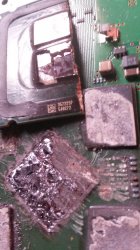
If anybody now could give an tip for how to rip the Real Silicon core from the bumps would help alot, im like an mason diging throught the Gpu now.

No Líving gpus were Warmed in that process, the gpu was with short/burned inside.
 

Attachments

  • 20220826_163209.jpg
    20220826_163209.jpg
    834.3 KB · Views: 71
  • 20220826_161230.jpg
    20220826_161230.jpg
    756.3 KB · Views: 66
But if you werent just cluttering, what were you even saying? You could have put it into a spoiler at least.

You just were going all against me for some reason, you want me to be wrong about something when actually you cant find anything wrong in any of what I said.
Because I didnt even make any statement! It was a question...!
But the only thing you want to see is me being wrong for some reason. The right way to repair? Where did I ever tell anybody what to do? Dont ask me about the right way to repair because I can answer about that too...
Sorry but actually I am right again if thats all you cared about.

Like somebody somewhwere said:

There are no silly questions.
Only silly answers (and rude people)

Edit: And no I dont like the "bump" stories enough yet no... Thats why I question them. Am I "wrong" about that too?

Full on off topic . I'm done explaining common sense to you and your mind tricks. You can think what tf you want , keep your b$llsh$t to yourself. It's because of people like you this community is a toxic environment . I'm done with this .
 
Man, They dont melt, my soldering iron is an 40w one Stardart and Bumps wont melt!!! I cant record vídeo cause my recording Quality is trash but thats it, if any body can remake the tests to comfirm will be scientific.

That's an 2005 3ghz PENTIUM Dual Core 90nm.
 

Attachments

  • 20220826_170404.jpg
    20220826_170404.jpg
    813.3 KB · Views: 73
Ah Sorry Felix I didn't see the Part where you say dont dont do it, But dont worry I didn't damage the board, I just have fear maybe for the pads but I just crash the gpu with an Heavy tool (pliers), and i was holding the board by the back in my hand and softning the Impact on the pads, that Rsx got losts of Smoker when shorted and every time I put the Tantalums there the board go Blackout so 100% short gpu, I Wonder if the Buckers from gpu were damage too, thanks my Lucky I didn't short Cell or damaged its trace but I will have to change my small Southbridge damn.

Its an Cok-002 CechC04.
 
BTW: I tend to agree with @DeadEnd and @squeept that there is a bump issue. But that's a belief I have only circumstantial evidence to backup (ATM). I would feel better having direct evidence. IDK about all the other comments, I haven't really been paying that close attention TBH. Kinda busy.
I keep hearing we have no "proof," as if it's our obligation to prove BumpGate. Which is something I don't think will ever be achievable (proof).

First the burdon of proof doesn't fall on us to prove BumpGate was a thing, the "evidence" wasn't provided by us, it was provided by Nvidia during a lawsuit they lost! It's a forgone conclusion that Nvidia produced defective chipsets during the time the RSX was produced. And at the same fab (TSMC). What isn't a forgone conclusion is that the is the RSX was also affected.

Is there circumstantial evidence, yes. Is that "proof"? No. Is there proof for most things? No. So how does the world function without all this proof no one seems to be able to find? It's because humans don't need proof to function. They choose to believe in either what they want to (confirmation bias) or in a "preponderance of evidence" that makes something to be more likely true, than not (reason). And they choose to abandon reason when emotionally charged. This psychological hack is exploited to great effect by politicians.

As a scientist by trade, I know it's important to identify these biases and mitigate them in the experimental design of the study. To limit the effect they have on the results.

As I said, we don't need to prove BumpGate. We just need to show it's likely, that there's an open question. Because if there's any reason to believe the 90nm is not as good as a 65nm or 40nm, then the frankenstein mod is clearly better. That's not even a contested topic...
  • The 65nm and 40nm produce less heat and less strain on the BGA. So for that reason alone it's better. Even if the Bumps weren't a thing.
  • SONY was able to remove the IHS from the 40nm entirely, going with direct die contact because it didn't need the IHS for stiffening anymore. We could leave it off too. That makes changing the paste easier. Another reason frankies are better.
  • Less heat overall in the case means less wear on heat sensitive components.
  • PSU runs cooler and more efficient, since it doesn't have to deliver as much power. Same story with the VRM. They see less current and heat = they last longer. Even tokins don't see as much ripple on the RSX, because the switching noise from buck converters is proportional to the current they deliver. Since the 65nm and 40nm require less current, the noise the tokins see is less. = tokins run cooler and last longer.
Those are facts.

So even if there isn't a bump issue, the entire point is still valid. Frankenstein Phat mods are superior to reballing. I'm not saying reballing is useless, I'm just saying you don't have to take the chance the bumps could be bad. And you get all these other upsides. If you have to reball anyway, why not frankie it? There's only a few more trivial steps.

Because you have to salvage a working 65nm or 40nm from a potentially working or easily repairable no-BC model? That's about the only fair criticism I've heard. And it'll be true when NOS 40nm RSX's dry up. But even then, there are so many more non-BC models that even if you had to kill the 4.6 million working slims to put 40nm on every BC model produced (you can't because lots of BC models were irreparably destroyed), then you would barely make a dent in the 28+ million 40nm RSX installed in slims alone. Or the 21+ million 65nm. Besides, we will never Frankie that many BC models. Not to sound crass, but BC lives matter more. F the slim!

We don't have to agree, but @Pacorretaco makes some useful counterpoints that caution against over simplifying the issue and assuming too much. That's useful to me, because when I present BumpGate theory in the video, it would be prudent to acknowledge the unknowns, so that people can't simply dismiss me as another fear monger pushing Bumps like the tokins were 2 years ago. If people have a reballed console or OG working one, they shouldn't fee discontent. Like they have to go out and prevent this from happening. I just need to be careful I'm not feeding that hysteria (paranoia, as he calls it).

He contends that simply mentioning the bumps will likely cause people to start murdering their slims to get a 40nm RSX and then murder a BC PS3 attempting a mod they have no business attempting in the first place. I contend that I don't want to leave out a legitimate subject "I believe" is an important part of the story. Yes it makes for a good narrative, and yes it may only be a story. But I don't believe it's hogwash and it's my video.

I'm not responsible for idiots with a heatgun that will kill their console trying something they don't understand. I warned them not to! If they disregard the warning, that's on them. They shouldn't believe everything they read or see on the internet anyway.

Even if I am trying my best and have built a measure of trust among the community, at the end of the day you still need to decide for yourself how to best diagnose and repair your consoles. Don't just take my word for it! There are no shortcuts!

The preponderance of evidence at this time and IMO tips toward BumpGate theory. If we're being objective, the only evidence I've heard Paco, Alty, and victor hugo alverez offer is that Alty is a very experience repair tech with satisfied customers. And that proves reballing works. Because if it didn't they would be unsatisfied.

I get it. Does it count for nothing...hell no! It's visually impressive. I'm sure it convinces lots of gullible customers. People used to care about that kind of thing, because back in the day people left honest reviews.

No offense intended, but I could make the argument that is BS and we need to hear it from a random sample of actual customers. Like a survey that called them up and asked if their PS3 kept working and how much time they've put on it since having it reballed. I could poin to the fact Alty doesn't have becounts to prove his claims that consoles lasted that long after a reball. But we've only had the SYSCON diagnostic for what..2 years? That's noit fair. I can point to the fact people don't like being blackballed for leaving bad reviews and instead of giving bad ones, they just don't (response bias). It's a quid pro quo system and everyone knows it. But that's not fair either.

These are not a practical request. It's criticism, but it's not constructive.

See, the burdon of proof can be applied both ways. I can say Ratings are BS. Prove to me that the consoles kept working, then dispute whatever you say next. And we can go back and forth forever never getting anywhere.

Have I asked you to believe me because I'm the great and powerful Felix? No! It's officious when people tells us to believe them credulously. Instead I present my theory and what led me to that conclusion. Then engage productively in the debate. If I'm wrong, I'm wrong. I value that feedback because my goal is the truth, not being right.

We can move the needle forward when we set our egos aside.

All this, "prove it's the bumps"..."no, you prove it's the BGA" stuff is nonsensical and won't lead anywhere but to a toxic counter productive culture.

Let's instead challenge our assumptions and see where that takes us. And in the future when I post the video presenting bump theory, you can take it with a grain of salt if you believe I'm wrong. Just don't say I'm trying to mislead people, because I have a body of work that proves the exact opposite. Very few people here have manned up to being wrong when presented with demonstrably false information like I have. That's my modus operandi. Blunder in, get corrected.

I don't claim to be an authority. Just a hobbyist interested in figuring this out. SONY or Nvidia could come in here and just just tell us what happened. But that don't. So instead of blaming each
other and back biting, why don't we instead place the blame where it belongs. With the multi billion dollar companies that left our beloved consoles out to die so they could upsell us the next one that isn't backwards compatible!

 
Last edited:
Back
Top