
You are using an out of date browser. It may not display this or other websites correctly.
You should upgrade or use an alternative browser.
You should upgrade or use an alternative browser.
PS3 Powering Launch PS3 w/ external power brick (D220P)
- Thread starter jacobsson
- Start date

sandungas
Developer
That ones for small form factors are the best, the shame is that are not much popular but some of them are standards and are becoming more popular, i dont remember the names but things like mini-TFX or things like thatit is not a backwards compatible model I have, but I am also using a pc power supply since I have done this to my ps3:
I am using a Supermicro 300w Server power supply, which has 29amps on 12v, which is more than enough. it is low profile format, which fits perfectly into the CELL, erm DELL VOSTRO pc case (modified the DELL logo to CELL, lul). btw, this DELL logo can be "switched" like the psx logo on fats. I have used two 4pin plugs for processor from pc mainboard and soldered them to the power "plungs"
this is still not finished though, but my PS3 runs fine with it and I can recommend anybody to use an external pc power supply. I first have used a 230w low profile original from the pc case, which has worked as well, but it had only about 18amps on 12v, which is no good I think, since L-models have a rating of 21amps on the original power unit
just wanted to leave my oppinion and not hook your thread

Specially because they have a single 12v power rail... you know... a typicall ATX PSU uses to have two 12v rails but the PS3 only needs 1
Also the total watts matches overall, are around 200w
Last edited:

blckbear_
Developer
it is not a backwards compatible model I have, but I am also using a pc power supply since I have done this to my ps3:
I am using a Supermicro 300w Server power supply, which has 29amps on 12v, which is more than enough. it is low profile format, which fits perfectly into the CELL, erm DELL VOSTRO pc case (modified the DELL logo to CELL, lul). btw, this DELL logo can be "switched" like the psx logo on fats. I have used two 4pin plugs for processor from pc mainboard and soldered them to the power "plungs"
this is still not finished though, but my PS3 runs fine with it and I can recommend anybody to use an external pc power supply. I first have used a 230w low profile original from the pc case, which has worked as well, but it had only about 18amps on 12v, which is no good I think, since L-models have a rating of 21amps on the original power unit
just wanted to leave my oppinion and not hook your thread
I love seeing this kind of stuff, it always surprises me the different ways people approach this stuff.
Do the USB ports and/or buttons on the PC case work or the case is only there to hold the PSU?
I'd love to see thread explaining all the stuff you've done to get to that point

Fin9ersMcGee
Senior Member
That ones for small form factors are the best, the shame is that are not much popular but some of them are standards and are becoming more popular, i dont remember the names but things like mini-TFX or things like that
Specially because they have a single 12v power rail... you know... a typicall ATX PSU uses to have two 12v rails but the PS3 only needs 1
Also the total watts matches overall, are around 200w
I belive mini-ITX is more of a motherboard form factor. I have a couple of mini ITX PC cases, but they can take full sized desktop power supplies.
I have one of those mini PSUs that comes in a typical OEM mini PC build. Use it to power HDDs with an E-SATA port on my PC so I don't have to open my case everytime I want to transfer data between PC and HDD without slow ass USB speeds
sandungas
Developer
I mean small form factors like this ones
https://graphicscardhub.com/tfx-power-supply-psu/
Some years ago was very hard to find a PSU with this TFX format, but nowadays are becoming more popular and there are several manufacturers selling them
Is just i think there are other PSU formats that are even smaller and still follows some standards, i mean... are not a PSU designed specifically for a PC model (like what some manufacturers like dell, or hewlett packard could do), but we are entering in a marketing segment where is going to be very rare to buy them locally... dunno, some formats used in servers, or the most time it passess and AMD continue improving his APUs they are going to become more popular other small PSU form factors
We are at that time where we are not sure which PSU format is going to be the winner for the small form factors (smaller than TFX)
Im not entering in the nano-ATX PSU's though, because thats a different league, are tiny circuit boards and are expensive
https://graphicscardhub.com/tfx-power-supply-psu/
Some years ago was very hard to find a PSU with this TFX format, but nowadays are becoming more popular and there are several manufacturers selling them
Is just i think there are other PSU formats that are even smaller and still follows some standards, i mean... are not a PSU designed specifically for a PC model (like what some manufacturers like dell, or hewlett packard could do), but we are entering in a marketing segment where is going to be very rare to buy them locally... dunno, some formats used in servers, or the most time it passess and AMD continue improving his APUs they are going to become more popular other small PSU form factors
We are at that time where we are not sure which PSU format is going to be the winner for the small form factors (smaller than TFX)
Im not entering in the nano-ATX PSU's though, because thats a different league, are tiny circuit boards and are expensive

jacobsson
Senior Member
@bigbadblo @Squiglemouse @Bakana
I'm so sorry for the long wait. I added an image of basic schematics now
NOTE: This guide should be equally efficient for a CECHA01 unit, since it's peaking around 205W.
I'm so sorry for the long wait. I added an image of basic schematics now
NOTE: This guide should be equally efficient for a CECHA01 unit, since it's peaking around 205W.
Last edited:

Yoshigu88
Member
Hi Jacobsson.
I recently found your post, I own CECHA01 fat PS3, bought quite long ago when it came out.
I had to fix YLOD twice, by the "reflow" method and adding paste to the outside, and adding these attachable USB fans.
This would be the 3rd time fixing YLOD, and I read tons and tons of threads, and found your solution most elegant!!!
Almost turning a PS3 into a PC, with the power brick.
You can say my electronic repair skill like a beginner-intermediate.
I really want to try ur method, because I have the 1st gen PSU, the metal one that get HOTTT
Im having trouble finding the exact buck converter in your picture, and that black housing.
https://www.amazon.com/gp/product/B07JZ2GQJF/ref=ox_sc_act_title_1?smid=AFHAE9RJVUMB&psc=1
Would something like that do the same thing?
Thank you for helping!!!
I recently found your post, I own CECHA01 fat PS3, bought quite long ago when it came out.
I had to fix YLOD twice, by the "reflow" method and adding paste to the outside, and adding these attachable USB fans.
This would be the 3rd time fixing YLOD, and I read tons and tons of threads, and found your solution most elegant!!!
Almost turning a PS3 into a PC, with the power brick.
You can say my electronic repair skill like a beginner-intermediate.
I really want to try ur method, because I have the 1st gen PSU, the metal one that get HOTTT
Im having trouble finding the exact buck converter in your picture, and that black housing.
https://www.amazon.com/gp/product/B07JZ2GQJF/ref=ox_sc_act_title_1?smid=AFHAE9RJVUMB&psc=1
Would something like that do the same thing?
Thank you for helping!!!
jacobsson
Senior Member
Hi, thanks for the kind words!Hi Jacobsson.
I recently found your post, I own CECHA01 fat PS3, bought quite long ago when it came out.
I had to fix YLOD twice, by the "reflow" method and adding paste to the outside, and adding these attachable USB fans.
This would be the 3rd time fixing YLOD, and I read tons and tons of threads, and found your solution most elegant!!!
Almost turning a PS3 into a PC, with the power brick.
You can say my electronic repair skill like a beginner-intermediate.
I really want to try ur method, because I have the 1st gen PSU, the metal one that get HOTTT
Im having trouble finding the exact buck converter in your picture, and that black housing.
https://www.amazon.com/gp/product/B07JZ2GQJF/ref=ox_sc_act_title_1?smid=AFHAE9RJVUMB&psc=1
Would something like that do the same thing?
Thank you for helping!!!
Have you delidded your CPU and GPU yet? I strongly suggest you do that first, since removing the PSU won't do a lot for temps.
The step-down converter in the link is really nice, maybe too nice even. You could grab something much more inexpensive like this instead: https://www.ebay.com/sch/i.html?_fr...esc=0&_odkw=12v+step+down+converter&_osacat=0
Yoshigu88
Member
Thank you for the quick reply! I have taken the PS3 apart, and just have been watching a lot of videos on how people do it. I swear I saw a Russian guy delid the CPU with a razor blade, then a wooden chisel to hold that blade, and he whacked it with a hammer. No joke, then the heat spreader came off.
This is the guide im trying to follow
https://quade.co/2017/ps3-delid-ihs/
I'm really nervous about this, especially the CPU, the GPU in every thread sounds a lot easier.
And I actually found an IHS Buster!!! After 30-40 pages of Google, Amazon, this is the only one on the internet
https://www.ebay.com/itm/IHS-Buster...rentrq:298021bd1750aadcc7831a04ffff8d38|iid:1
So I guess I'm really asking, is it worth it to get this tool? From your post, it sounds a lot easier, and safer.
Im not sure if you've used painting knives before, but I value your opinion [I really dont want to break my PS3]
Thanks again!! I hope you wont find my questions too bothersome.
This is the guide im trying to follow
https://quade.co/2017/ps3-delid-ihs/
I'm really nervous about this, especially the CPU, the GPU in every thread sounds a lot easier.
And I actually found an IHS Buster!!! After 30-40 pages of Google, Amazon, this is the only one on the internet
https://www.ebay.com/itm/IHS-Buster...rentrq:298021bd1750aadcc7831a04ffff8d38|iid:1
So I guess I'm really asking, is it worth it to get this tool? From your post, it sounds a lot easier, and safer.
Im not sure if you've used painting knives before, but I value your opinion
[I really dont want to break my PS3]Thanks again!! I hope you wont find my questions too bothersome.
jacobsson
Senior Member
Thank you for the quick reply! I have taken the PS3 apart, and just have been watching a lot of videos on how people do it. I swear I saw a Russian guy delid the CPU with a razor blade, then a wooden chisel to hold that blade, and he whacked it with a hammer. No joke, then the heat spreader came off.
This is the guide im trying to follow
https://quade.co/2017/ps3-delid-ihs/
I'm really nervous about this, especially the CPU, the GPU in every thread sounds a lot easier.
And I actually found an IHS Buster!!! After 30-40 pages of Google, Amazon, this is the only one on the internet
https://www.ebay.com/itm/IHS-Buster-Delid-Tool-with-spare-blade-Intel-LGA-CPU-PS3-Motorola-ARM/233738036619?_trkparms=aid=111001&algo=REC.SEED&ao=1&asc=225085&meid=077781c6fc0547a2816de82ee43a5078&pid=100675&rk=4&rkt=15&mehot=none&sd=184474797602&itm=233738036619&pmt=0&noa=1&pg=2380057&brand=Intel&_trksid=p2380057.c100675.m4236&_trkparms=pageci:30af3d95-0e77-11eb-bec8-9a21c5ef3867|parentrq:298021bd1750aadcc7831a04ffff8d38|iid:1
So I guess I'm really asking, is it worth it to get this tool? From your post, it sounds a lot easier, and safer.
Im not sure if you've used painting knives before, but I value your opinion
Thanks again!! I hope you wont find my questions too bothersome.
No problem at all!
Yeah, I can agree to that this procedure is not for the faint of heart, unfortunately so necessary though!
I've delided maybe 7 - 8 PS3s using the painters knife kit, it's very inexpensive and get the job done.
When it comes to the RSX the IHS pops of pretty easily after heating it up, they seem to have used some cement like glue here. Make sure to protect the board with sometong like a towel so when the IHS pops loose it doesn't land knock something off.
The cell has some silicone based glue I think. I recommend using something like a hairdryer to keep the glue warm under the CELL so it require less force. This is definitely a procedure you should take your time on. Before starting I'd recommend giving the tip of the painters knife a bend upwards so it never ever cuts the surface of the chip. When getting an entry in the corner the knife should then slide pretty smooth, otherwise restart and give it some more heat.
There should be videos of people doing this on youtube that might showcase this better. Good luck and take your time!
Last edited:
Yoshigu88
Member
Thank you for all the advice, I ordered everything, and going to try to attempt to delid the CPU and GPU next week.
I ordered a new more efficient PSU for now, I'm still practicing your cool custom set up.
I see a lot of people drill holes in their casing, either directly on the back to bring more air to the fan, or on top to release the hot air. Whats your opinion on that?
With deliding and Artic X both on top and bottom...would you consider drilling extra vents? Because that has to be done, around the same time.
I do plan on upgrading to your set up eventually btw. So i'm debating about vents, especially by the fan (because my model has the 15 blade).
Best
Ps. I ordered this CPU tool with different steel blade heads just incase. I dont know if you every tried this type of tools before.
Thanks
https://www.walmart.com/ip/Kritne-r...nife-Repair-Tool-Kit-Set-for-iPhone/606270754
I ordered a new more efficient PSU for now, I'm still practicing your cool custom set up.
I see a lot of people drill holes in their casing, either directly on the back to bring more air to the fan, or on top to release the hot air. Whats your opinion on that?
With deliding and Artic X both on top and bottom...would you consider drilling extra vents? Because that has to be done, around the same time.
I do plan on upgrading to your set up eventually btw. So i'm debating about vents, especially by the fan (because my model has the 15 blade).
Best
Ps. I ordered this CPU tool with different steel blade heads just incase. I dont know if you every tried this type of tools before.
Thanks
https://www.walmart.com/ip/Kritne-r...nife-Repair-Tool-Kit-Set-for-iPhone/606270754
Last edited by a moderator:
jacobsson
Senior Member
Hi Yoshi.Thank you for all the advice, I ordered everything, and going to try to attempt to delid the CPU and GPU next week.
I ordered a new more efficient PSU for now, I'm still practicing your cool custom set up.
I see a lot of people drill holes in their casing, either directly on the back to bring more air to the fan, or on top to release the hot air. Whats your opinion on that?
With deliding and Artic X both on top and bottom...would you consider drilling extra vents? Because that has to be done, around the same time.
I do plan on upgrading to your set up eventually btw. So i'm debating about vents, especially by the fan (because my model has the 15 blade).
Best
Ps. I ordered this CPU tool with different steel blade heads just incase. I dont know if you every tried this type of tools before.
Thanks
https://www.walmart.com/ip/Kritne-r...nife-Repair-Tool-Kit-Set-for-iPhone/606270754
So this is what I've found after years of modding and tinkering (especially w/ the PS3), sorry for this long reply.
Swapping PSU might be unnecessary
Below are my own opinions after achieving the following treatments to your system:
- A successful delid: see this thread for mixed techniques of delidding
- Even CPU mounting pressure: see this thread
- Proper internal cleaning of housing, PSU, heatsink and fan blades
Why I think drilling holes is a big no-no
Even if Sony failed in making proper contact between CPU/GPU die and heatsink of their fat models (uneven/warped heatsink surface in combination with poor IHS-to-die-contact) we can partly solve this by delidding.
One thing I'm certain of is that the Sony engineers designed the chassis in conjunction with the large bottom fan to achieve efficient air-flow for the components on both top and bottom of the mainboard.

Illustration of the air-flow for PlayStation 3 launch model
By drilling holes in the chassis you might disrupt the intentional air-flow, which can lead to some areas of the mainboard not being properly cooled... and yeah you can prob guess the end of this story

Air-flow vs Heat dissipation
Most blog post and videos I've seen of people drilling holes the chassis have not delidded their systems to begin with. It's easy to assume that the system getting warm is because of the bad air-flow (hence the drilling of holes) when in fact the underlying problem is compromised heat-dissipation from the CPU/GPU die to the heatsink. You could almost call it a classic "treating the symptoms but not the decease" -situation.
To sum up:
to me there's is no doubt that the intended cooling design is more than enough to cool off 200w of heat when properly aligned.
I hope my perspective helps you in your decision making. I'd advice read other threads for other perspectives too.
Last edited:
DoublesAdvocate
Member
I personally disagree with people attempting to delid their consoles due to how often I see threads like "I tried to delid my factory new CECHA that I paid $2000 for and now it doesn't boot, do you think this massive scratch on the RSX and CELL could have anything to do with it?"Hi Yoshi.
So this is what I've found after years of modding and tinkering (especially w/ the PS3), sorry for this long reply.
Swapping PSU might be unnecessary
Below are my own opinions after achieving the following treatments to your system:
If the above criteria's are meet you shouldn't need to make any adjustments to the PSU (even if it's the oldest model) since it wont give much in terms of improved temperatures. But for peace of mind I do understand those who want to swap their PSU to a newer efficient model to avoid it breaking down in the future.
- A successful delid: see this thread for mixed techniques of delidding
- Increased CPU mounting pressure: see this thread
- Proper internal cleaning of housing, PSU, heatsink and fan blades
Why I think drilling holes is a big no-no
Even if Sony failed in making proper contact between CPU/GPU die and heatsink of their fat models (uneven/warped heatsink surface in combination with poor IHS-to-die-contact) we can partly solve this by delidding.
One thing I'm certain of is that the Sony engineers designed the chassis in conjunction with the large bottom fan to achieve efficient air-flow for the components on both top and bottom of the mainboard.
Illustration of the air-flow for PlayStation 3 launch model
By drilling holes in the chassis you might disrupt the intentional air-flow, which can lead to some areas of the mainboard not being properly cooled... and yeah you can prob guess the end of this story
Air-flow vs Heat dissipation
Most blog post and videos I've seen of people drilling holes the chassis have not delidded their systems to begin with. It's easy to assume that the system getting warm is because of the bad air-flow (hence the drilling of holes) when in fact the underlying problem is compromised heat-dissipation from the CPU/GPU die to the heatsink. You could almost call it a classic "treating the symptoms but not the decease" -situation.
To sum up:
to me there's is no doubt that the intended cooling design is more than enough to cool off 200w of heat when properly aligned.
I hope my perspective helps you in your decision making. I'd advice read other threads for other perspectives too.
I would also recommend against increasing the mounting pressure due to the fact that this can also damage/warp the board over time especially since most people don't have any sort of torque measurment/mounting pressure tools.
I can absolutely confirm that the airflow design Sony used in the original CECHA/B/C/E units doesn't like modification.
Basically I removed the black plastic panel from the front of the heat sink and then cut out a small piece of aluminum that was behind that. The idea being to increase the overall area that air has to flow over the heatsink, what I noticed however was that although the temp of 1 chip dropped, the temp of the other chip increased. I used 2 CECHEs next to eachother with a barrier to stop any of the hot air from affecting the other unit, one unit had the cuts and one did not.
One thing I can say that did improve the results was removing the HDD door, which doesn't interrupt the original airflow design. I might also test removing the flash card readers and lifting the door that hides them, I noticed that a lot of dust tends to build up in that area meaning that there's airflow going through it even when the lid is closed.
jacobsson
Senior Member
You can't really disagree with delidding as an effective method if it's done correctly (obviously w/o cutting traces)?I personally disagree with people attempting to delid their consoles due to how often I see threads like "I tried to delid my factory new CECHA that I paid $2000 for and now it doesn't boot, do you think this massive scratch on the RSX and CELL could have anything to do with it?"
It's not for the faint of heart, but I still say it's an necessary procedure for overheating launch models that's already been properly cleaned and repasted. I think I've done 7-8 systems in total, all had great results and still works perfectly several years later.
If you look at the thread I linked about mounting pressure not about making the increased toque of the screws or bending back the screw mounting plates (I wouldn't deny that this could cause warping). The method I'm referring to is in simplified terms about putting a little piece of heat resistant material in the rectangular hole on backside of the CELL, this too give an reactive support from the back (I guess it could also be seen as a support for not let that part cave inwards during mounting).I would also recommend against increasing the mounting pressure due to the fact that this can also damage/warp the board over time especially since most people don't have any sort of torque measurment/mounting pressure tools.
Some of the launch models even got delivered with this fix by Sony themselves in the form of a rectangular teflon filler piece (it's documented on that thread too) so I don't really mind promoting this idea.
I appreciate you sharing your findings, especially about removing the HDD door! I hope I provided a more clear rationale on the points above.
Last edited:
DoublesAdvocate
Member
I don't disagree with the idea of delidding, I've done it to a number of my consoles. I disagree with the people doing it that have no experience or tools that ruin their consoles.You can't really disagree with delidding as an effective method if it's done correctly (obviously w/o cutting traces)?
It's not for the faint of heart, but I still say it's an necessary procedure for overheating launch models that's already been properly cleaned and repasted. I think I've done 7-8 systems in total, all had great results and still works perfectly several years later.
If you look at the thread I linked about mounting pressure not about making the increased toque of the screws or bending back the screw mounting plates (I wouldn't deny that this could cause warping). The method I'm referring to is in simplified terms about putting a little piece of heat resistant material in the rectangular hole on backside of the CELL, this too give an reactive support from the back (I guess it could also be seen as a support for not let that part cave inwards during mounting).
Some of the launch models even got delivered with this fix by Sony themselves in the form of a rectangular teflon filler piece (it's documented on that thread too) so I don't really mind promoting this idea.
I appreciate you sharing your findings, especially about removing the HDD door! I hope I provided a more clear rationale on the points above.
That teflon piece doesn't touch any of the capacitors on the rear of the chip and is there to help spread the rear mounting pressure, it has nothing to do with heat dissipation.
I don't disagree with the idea of increasing the surface area that heat is able to dissipate by putting something back there but it should be done properly so it applies as little pressure to the chip as possible.
you can clearly see people talking about doing risky stuff like putting washers behind the mounting brackets to increase the pressure which will do nothing but damage the console in the long run.
DoublesAdvocate
Member
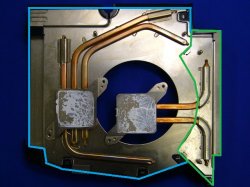
One other thing I've noticed when taking the PS3 apart, the RSX has very little cooling when compared to the CELL on all of the consoles, just look at the surface are dedicated to the CELL vs the area for the RSX (there's a seam that's covered up by the lines).
Attachments
jacobsson
Senior Member
To be fair, judging by the findings in the thread, it seems like spreading this mounting pressure of back actually can help with heat dissipation. Perhaps this teflon addition by Sony had heat dissipation as a bonus effect(?).That teflon piece doesn't touch any of the capacitors on the rear of the chip and is there to help spread the rear mounting pressure, it has nothing to do with heat dissipation.
I was kind of hoping I made it clear in the prior posts that I never advocate these kind of procedures, nor did the thread I mentioned, so it seem like we're on the same page.you can clearly see people talking about doing risky stuff like putting washers behind the mounting brackets to increase the pressure which will do nothing but damage the console in the long run.
DoublesAdvocate
Member
I don't think the teflon piece is actually touching the CPU at all, just the area surrounding the cutout. My worry about adding something to the rear of the chip is basically centered around the added mounting pressure if whatever is added is too large.To be fair, judging by the findings in the thread, it seems like spreading this mounting pressure of back actually can help with heat dissipation. Perhaps this teflon addition by Sony had heat dissipation as a bonus effect(?).
I was kind of hoping I made it clear in the prior posts that I never advocate these kind of procedures, nor did the thread I mentioned, so it seem like we're on the same page.
Yeah, I know you're not advocating the extra mounting pressure.
Yoshigu88
Member
Hey Jacobsson.


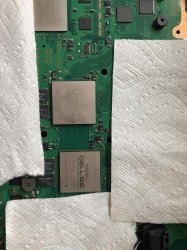
I just delid the GPU and well...the CPU. It didnt go as smoothly as I hoped. After all the prep.
I scratched the surface of the CPU in one corner when the force I used slipped.
Im attaching a picture. How bad do you think the damage is? and is it dead dead?
Thank you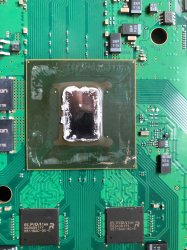
I just delid the GPU and well...the CPU. It didnt go as smoothly as I hoped. After all the prep.
I scratched the surface of the CPU in one corner when the force I used slipped.
Im attaching a picture. How bad do you think the damage is? and is it dead dead?
Thank you
Similar threads
-
PS3 DYN-001 No Standby Light / No Power - Pulled 3 Caps, Short Still Present (Need Advice)
- Started by Dreamlander097
- Replies: 0
-
-
 PS3 Error 8002f14e. My Blu Ray drive isn't functioning, no power to the BD Drive.
- Started by iVirtualZero
- Replies: 15
-