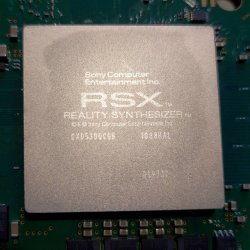
PS3 Project RSX Boost: Overclock your Retail PS3 RSX Speeds (ps3 cfw only)

Hello everyone, it's been a while since I posted here. Glad to see development and new testing

Already have firmware 750-950 beta 9?

Mine is still from the early betas
Consider it done !

I think we can use this homebrew by @jordywastaken as a benchmark tool, set it to 200 ducks and enable the FPS option, so we can have an environment to compare

Interesting, maybe I'll use it to make a big comparison video, with many different OC speeds.

For now, I made this :
 
i tried to make my own overclock thingy and i failed. i didnt find anything here so i ask someone have or can make 4.91 600/700?
 
VOLTAGE MOD UPDATE: SUCCESS!

CORE
Thanks to @M4j0r we know know what offset to change the RSX CORE Voltage ID (VID) on Mullion SYSCON.
It requires a write to the SYSCON EEPROM via UART (Serial). I do not want to explain how just yet. I'm still working on the details and I want a change to try it out a bit before writing up a tutorial. I only just today mapped the VID table on the NCP5318's data sheet to the EEPROM Bytes that select any VID you want. But I did prove it works.

VID432105 | Vactual | Vmin (-0.5%)
001011 | 0.926v | 0.9263
001101 | 0.901v | 0.9015
110001 | 1.223v | 1.2248
001010 | 0.937v | 0.9388

Proof of concept was on an A01 Frankie. The 90nm RSX was replaced with a 40nm pull that failed in such a way that it's the perfect test bed for this. It was artifacting in stress testing (bad RSX) but not dead completely. This means I can burn it out and it won't matter. It needs replaced anyway.

To be clear. This only works on Mullion SYSCON so far. We have not located the appropriate offset in Sherwood SYSCONs. Which means we can't use it on Slims yet. I've only tested it on a COK-001 (CECH-A01). These consoles unmodified do not overclock well at all! But frankies OC fine. I have one with a 40nm that does 800/950. Now that I know what I'm doing, I'm keen to try overclocking it to see if I can stabilize 850 Core.

VRAM
Thanks to @b_rob1 we were able to Potentiometer mod the VRAM voltage (FBVDDQ). I tested it in a console that was fine 25MHz earlier, and then almost bricked. I increased voltage from 1.8v to 2v and while it was hotter, it wasn't more stable. Not in the least. SO I have concluded VRAM voltage mods are pointless.
Awesome man. Just checked in after 3 weeks and we now have voltage stuff happening!
 
Hi all, been following along for some time but just now decided to reply to this forum.
I'm running a CECH-2104B (early 40nm, datecode 0B), had it running at 600/750 for over a year now with zero issues, and lately been seeing more news about much higher numbers. I'd like to try 650/800, 700/850 and maybe even 750 if I've got a great 21xx and 900 mem.

I was wondering what makes the 28nm RSXs non-suitable for Frankensteining, are they so different because of their GDDR5? Are their pinouts even the same as the 90/65/40s?
Additionally, speaking of Frankensteins, it may just be me being tired but I had an idea now that's probably crazy, unfeasible, unnecesary, etc. However, I'd rather mention it before I forget about it! Basically what if we made the motherboard like a PGA socket and soldered pins underneath the RSX so it's swappable without the horribly risky and time consuming BGA work? The pads on the board would have the same retainers that are on PGA boards and you could 3D print a plastic socket to locate the RSX, maybe even use the same clamping mechanism as a Pentium 4. I know there's a helluva lot of considerations, like how the hell would one even be able to place everything accurately, stencils for BGA might help there, and there's also heat expanding things at different rates and the chip would now sit higher so the heatsink would also need to be raised, etc.

But the end goal would be an RSX you could just remove like any old PC CPU, and you would solder pins onto another RSX so you could swap between them in like 1 minute. I know the idea is probably full of holes (no pun intended) but I just wanted to brainstorm and maybe it will at least spark some better ideas, or alleviate my concerns about the dangers of BGA reworking.
 
That's not going to be an issue. The Buck controller has a table of voltages that are encoded with a binary voltage ID (VID). The syscon reads the eFuse value from the RSX istelf, which is found in the RSX info of the LV1 dump - 1st value in the 2nd bracket. It converts that from Hex to binary and then sends the 6-bit or 8-bit VID equivalent to the Buck controller, depending on whether it's a mullion or sherwood syscon. I actually need to confirm there aren't more buck controllers out there using different VID tables. So far I know the COK-00X use the NCP5318, which uses the 6-bit binary VRD10 table, and the ISL6326 which uses the 8-Bit VRD11 table. If there are other's, I'm assuming they would use one or the other and not a completely different VID scheme...but that's probably TMI.

Point is, the Buck controller will not be able to output more than it can handle. It simply will not allow any voltages outside that table. Which is like 0.5v to 1.6v.

CORE Voltage UPDATE: Sherwood now figured out

Again thanks to @M4j0r I was able to confirm the location of the SYSCON EEPROM address that selects the RSX CORE VID. I was able to change it from the default 0.966v to 1.358v and 1.363 initially. I wasn't expecting it to jump that high! So I shut it down quick and went back to the VID table to figure out why my predictions were off. I found an explanation and created a new table to map the VID's to HEX and tried again. This time I got 0.947v, 0.953v, & 0.992v. And the correct 8-bit Binary my table said they should be! So tentatively, I now have the Sherwood VID table mapped.

I am a bit concerned because a few of the LV1 dumps I have from 40nm RSX have a Hex VID value that falls into the rang of 1.5v! But I'm quite sure they do not actually operate at that voltage. Which means there's still something going on in the conversion I don't understand and because of that I feel apprehensive to release these tables into the wild for people to begin VID hacking. We need to be able to predict the resulting voltage increase and while it seems to be working in the limited testing I'v done, I haven't triedall of the possable VID combinations to proove my table is correct.

I'm going to do more testing, try achieving some over/under clocks and get good sense of whether or not the table is working as expected. My goal is to achieve a 1GHz PS3, but to do that I think I would need a golden goose. Perhaps one of those January 2011 RSX @Tanzu15 keeps raving about.

The TL;DR
We can volt mod the RSX now, but it requires soldering and changing a byte in SYSCON EEPROM. That chnages the checksum and has to be fixed before each voltage change is applied. That makes this less accessable to the masses (a good thing IMO).

However, @M4j0r thinks there are places in the LV1 that can do it as well, and if so, then they can be built into MFW and applied with an update.

 
Last edited:
You're right, I didn't see it !
https://www.psdevwiki.com/ps3/CXD5300DGB


Because date codes aren't guarantees regarding the chip you'll get. Even the month of manufacture isn't an absolute guaranty.

The limits of your PS3 depends on your RSX model. Even in the 25XX series, you can have 4 different revisions :

• CXD5300A1GB : This one can do 700 on core easily, 750 if you're lucky. As for memory (VRAM), 900 or 925. Maybe 950 at best.

• CXD5300CGB : 800 on core stable, 850 freeze after some time in game. Up to 1000MHz on memory if you're lucky (stay cautious).

• CXD5300DGB : We don't know it well, the only report say 700/1000 stable max.

• CXD5300GGB : The greatest overclockers, 850 or 900 on core. 950 is EXTREMELY rare. Up to 1000MHz on memory.

Of course, there are always exceptions due to the silicon lottery.

While later date codes give you more chances to get a good chip, this is still a lottery (a triple lottery in fact. Month ? + Chip revision ? + Silicon lottery ?).
Where? Can I find these numbers, do I need to disassemble the machine? Or open a certain software in pS 3?
 
Where? Can I find these numbers, do I need to disassemble the machine? Or open a certain software in pS 3?
The only way to find it is to check directly on the IHS. IMG_20240522_212829.jpg
 
Where? Can I find these numbers, do I need to disassemble the machine? Or open a certain software in pS 3?
As I know LV1 has information about rsx revision. May be it's the thing

The only way to find it is to check directly on the IHS.View attachment 43300
what about LV1 rsx revision?

I mean
rsx40 a01 850/850 vpe:ff shd:7d [AP0022738:0:1:8:17:f:2:0:2][28:0:a:0:1:0:1][1:1:0]
 
Last edited:
As I know LV1 has information about rsx revision. May be it's the thing


what about LV1 rsx revision?
AFAIK, no. It contains many informations, but not the RSX model ID (Like "CXD5300CGB". I don't know how to name it exactly).
Maybe there is a part of this LV1 dump that can be associated with this though, but I'm not aware of it.
 
That's not going to be an issue. The Buck controller has a table of voltages that are encoded with a binary voltage ID (VID). The syscon reads the eFuse value from the RSX istelf, which is found in the RSX info of the LV1 dump - 1st value in the 2nd bracket. It converts that from Hex to binary and then sends the 6-bit or 8-bit VID equivalent to the Buck controller, depending on whether it's a mullion or sherwood syscon. I actually need to confirm there aren't more buck controllers out there using different VID tables. So far I know the COK-00X use the NCP5318, which uses the 6-bit binary VRD10 table, and the ISL6326 which uses the 8-Bit VRD11 table. If there are other's, I'm assuming they would use one or the other and not a completely different VID scheme...but that's probably TMI.

Point is, the Buck controller will not be able to output more than it can handle. It simply will not allow any voltages outside that table. Which is like 0.5v to 1.6v.

CORE Voltage UPDATE: Sherwood now figured out

Again thanks to @M4j0r I was able to confirm the location of the SYSCON EEPROM address that selects the RSX CORE VID. I was able to change it from the default 0.966v to 1.358v and 1.363 initially. I wasn't expecting it to jump that high! So I shut it down quick and went back to the VID table to figure out why my predictions were off. I found an explanation and created a new table to map the VID's to HEX and tried again. This time I got 0.947v, 0.953v, & 0.992v. And the correct 8-bit Binary my table said they should be! So tentatively, I now have the Sherwood VID table mapped.

I am a bit concerned because a few of the LV1 dumps I have from 40nm RSX have a Hex VID value that falls into the rang of 1.5v! But I'm quite sure they do not actually operate at that voltage. Which means there's still something going on in the conversion I don't understand and because of that I feel apprehensive to release these tables into the wild for people to begin VID hacking. We need to be able to predict the resulting voltage increase and while it seems to be working in the limited testing I'v done, I haven't triedall of the possable VID combinations to proove my table is correct.

I'm going to do more testing, try achieving some over/under clocks and get good sense of whether or not the table is working as expected. My goal is to achieve a 1GHz PS3, but to do that I think I would need a golden goose. Perhaps one of those January 2011 RSX @Tanzu15 keeps raving about.

The TL;DR
We can volt mod the RSX now, but it requires soldering and changing a byte in SYSCON EEPROM. That chnages the checksum and has to be fixed before each voltage change is applied. That makes this less accessable to the masses (a good thing IMO).

However, @M4j0r thinks there are places in the LV1 that can do it as well, and if so, then they can be built into MFW and applied with an update.
Yup one of my PS3s can already do 950 without any extra voltage. I'll be able to 1ghz it easy with the extra voltage. Glad you were able to find the tables for slims. But do you think an 850 fully stable PS3 can jump to 1ghz core with the voltage tables we have? Cause I can easily sell you one of the 850 core ones. It's interesting cause the 850 core can do 900 as long as it's 55c or below. Meaning it needs more voltage. But if the current voltage tables you discovered can add enough, I think 1ghz is easy to do then. At least for PS3s that can do 850 or higher by default fully stable. PS3s that can only do 700, 750 or 800 Max stable, will not be able to do 950 or 1000 stable. At least I don't think so since that would require crazy amounts of cooling and voltage.
 
Back
Top