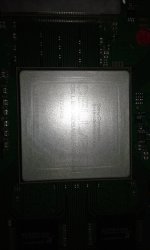
CECH2501A delid gone... bad

Sure thing, Was a sad day but Overall its a learning experience

156213909_3808866729227354_5871206566451533826_n.jpg
Yep, it sucks, completly broken without repair :/
I added your info to a table we was doing, is mostly an attempt to try to figure if we can deduce the presence of the thermal glue based in the PS3 model, serial numbers, etc...
https://www.psx-place.com/threads/a-new-method-for-delidding-the-cell.30265/page-2#post-284617
 
Obvious indication of CELL glued to IHS is that CELL in such cases won't have overheating problem. Delidding only makes sense in case you can't control overheating by all other means. Many users do unnecessary delidding and end up breaking the console.
Yeah this was sitting in my closet for A couple years was using it as a tester system for my fat assuming it suffered from the same issue , I've been delidding Computer processers for years Just this had already completely Gave by the time i realized it was thermal epoxy due to the resistance IE silicon is weaker than you'd think especially being that thin, Heard a slight crackle as the lid went to go off and that was the end
 
I had a dead PS3 motherboard so I thought I'd add my results.

PS3 Model: CECH-2502
Date Code: 0C
MB Model: JSD-001
MB serial: 1-882-770-11
CPU: CXD2992BGB
Plastic and Bumps: Yes
Material: Thermal Paste
 
Last edited:
PS3 Model: CECH-2502
MB Model: JSD-001
MB serial: 1-882-770-11
CPU: CXD2992BGB
Plastic and Bumps: Yes
Material: Thermal Paste
Are you completly sure about that, right ? (no typos or mistakes)
This is really interesting because i have a CECH-2504 with JSD-001 a bit different than yours, check this edit:
https://www.psdevwiki.com/ps3/index.php?title=CELL_BE&diff=58429&oldid=56319

There are many details that can be deduced from that comparison, but most important is at that point is when they started using that "black plastic spacer", and the "B" (located inmediatly before the "G" letter) seems to indicate the presence of the spacer
I cant tell if the CXD2992GB in my JSD-001 is using "thermal adhesive" in the center DIE because i have not delided it, but im sure that i dont have the black plastic spacer because i can see the green color of the substrate with the traces, etc... as usual
 
Last edited:
Pics added to my previous post.

Also all of my other three CECH-2502's have the CPU black plastic but I will not be de-lidding them.
 
Last edited:
Pics added to my previous post.

Also all of my other three CECH-2502's have the CPU black plastic but I will not be de-lidding them.
And i guess all them are the "BGB" variant, right ?. Which datecode (manufacturing date) have yours PS3 slims with the plastic spacer in the CELL ?
That "BGB" suffix seems to indicate the presence of the black plastic spacer... and the presence of the black plastic spacer seems to indicate a posible presence of the thermal adhesive

Take a look at the section "serial numbers @ SKU", the "alternative listing" at his bottom, and click in the page names for each CELL model, i been editing them today and i uploaded some of the photos from this thread
https://www.psdevwiki.com/ps3/CELL_BE#Serial_Numbers_.40_SKU

The difference in between your CECH-25xx, JSD-001, 1-882-770-11, CXD2992BGB (with the plastic spacer) and my CECH-25xx, JSD-001, 1-882-770-21, CXD2992GB (without the plastic spacer) is at some later point of the CELL manufacturing process they chooses either if applying that layer of green varnish and do the things in a "standard" way... or instead of applying the layer of green varnish they "glue" the black plastic spacer to the substrate

This is the first time sony started doing this with the CELL, it happened exactly in your CXD2992BGB, but there was not any mention about CXD2992BGB in wiki, is like the missing link, because is the first time sony used the "BGB" suffix. I thought that plastic spacer was something only used in later superslim models but it happened sooner than i could imagine in CECH-25xx

Now it makes lot more sense that exists a CXD2992BGB and a CXD2996BGB both with the suffix "BGB" and with the plastic spacer

--------------------
Sadly, it seems the presence of the plastic spacer is not a 100% indication of the presence of the thermal adhesive in the central DIE
But im in the same oppinion that you... plastic spacer = dont try to delidd it
Incase of trying... dont use the method using force to "pop up" the IHS


------------
Edit:
An interesting detail of this CELL models with the black plastic spacer is we are talking about up to 3 posible thermal compounds, from bottom to top (a.k.a. in assembly order)
1) In between the substrate and the plastic spacer (this should be a strong adhesive because the plastic spacer should not move at all)
2) In between the plastic spacer and the metal IHS (this is a standard silicone like in previous models)
3) In between the central DIE and the metal IHS (this is doubtful... it could be a standard thermal paste... or a strong thermal adhesive)

What im thinking is maybe in some CELL models they used the same thermal adhesive in 1) and 3)
 
Last edited:
Btw @finalman with this sentence i was not meaning you to open all your PS3 slims completly "for science" just to see if the CELL model names have the suffix "BGB", i mostly asked it incase you took note of it before
And i guess all them are the "BGB" variant, right ?. Which datecode (manufacturing date) have yours PS3 slims with the plastic spacer in the CELL ?
The datecode is easyer to check because is printed in the case, but im not so sure if the datecode alone (without the info about the "BGB suffix" of the posible CELL models) could help much, i mostly asked it because by now i think your PS3 models are a bit more newer than mine (and this is why you have the CELL with the plastic spacers under the IHS)
...but it could be related also with the world regions and the manufacturing plants, mine is region 04 and yours 02

Never minds, but now that you are activelly editing wiki, the next time you open a PS3 for repair or manteinance (change thermal paste, etc...) i suggest you to take a look at this tables and write a list with your info of that PS3 (for yourself mostly, otherway you are going to forget all that info)
https://www.psdevwiki.com/ps3/Talk:SKU_Models
I wrote a .TXT in my PC for each of my PS3's with a list of all that info (and some more, for unique ID's as SERIAL, IDPS, EID_root_key, etc...) :D
 
Last edited:
I had another PS3 motherboard from eBay that came roach infested that I didn't care that lived or died as I had plans for this motherboard if I killed it. Unfortunately for me it survived the process. Only knocked off one diode, one SMD cap and two electrolytic caps. After re-soldering them the motherboard booted up.

Here are it's details.

PS3 Model: CECH-2502
Date Code: 0C
MB Model: JSD-001
MB serial: 1-882-770-31
CPU: CXD2992BGB
Plastic and Bumps: Yes
Material: Thermal Paste

EDIT: Going by the serial number of this one it was 20 motherboards away from my previous one on the production line.
 
Last edited:
@sandungas probably wont help much but i dont see it listed in https://www.psdevwiki.com/ps3/Talk:SKU_Models
and in https://www.psdevwiki.com/ps3/CELL_BE#Serial_Numbers_.40_SKU appears with a different motherboard serial

CXD2996GB
KTE-001
1-884-749-31
June 2011
Thanks, it really helped :)
I been updating some wiki pages related, check them again and tell me if there is something more about your PS3 model that needs to be added in wiki

For me the most shocking detail from your report is the manufacturing date, not sure if you are used to it but is easy, to keep a record of the production sony divides the year in 4 quarters. In the PS3's for other regions like yours appears the year and month literally but in the PS3's for euro region appears the "datecode" with a digit + a letter (most people uses to mention the datecode because is shorter)
https://www.psdevwiki.com/ps3/Datecode

The point is... your PS3 is datecode 1B (1 is the year 2011, and B is the second quarter)
And as far i knew nobody reported a CECH-30xx manufactured so soon (it should be one of the first models)
As you can see in https://www.psdevwiki.com/ps3/Talk:SKU_Models... the 1B was reported for CECH-25xx (i dont remember who reported that)
The weird thing is this seems to indicate an overlapping in the production of CECH25-xx and CECH-30xx... i mean... it seems they was producing 2 different models at the same time
Is a bit unusual because is pointless, for them is a lot better to produce "the next one" and stop the production of "the old one" as soon as posible
Is just a curiosity, doesnt matters much :)

Btw, did you ever check your minimal firmware ?, the PS3 models with datecode 1B was reported to have firmware 3.65 installed from factory, and restricted to a minimal firmware of 3.60
I guess this aplyes to your PS3 too (but im not sure)

-----------
Btw @finalman check the photo, i guess this one doesnt have the plastic spacer because can be seen a couple of "dots" at the top-left and bottom-left corners
Is interesting because is newer than the other we was discussing (2996 > 2992) but is a "GB" (and the other older with the plastic spacer was "BGB")
So... im not completly convinced yet, but my theory about the "BGB" suffix indicating the plastic spacer still applyes. I dont think this same rule can be applyed to all them, but with the few info i have it seems it works in this ones
 
Last edited:
For me the most shocking detail from your report is the manufacturing date, not sure if you are used to it but is easy, to keep a record of the production sony divides the year in 4 quarters. In the PS3's for other regions like yours appears the year and month literally but in the PS3's for euro region appears the "datecode" with a digit + a letter (most people uses to mention the datecode because is shorter)
https://www.psdevwiki.com/ps3/Datecode

The point is... your PS3 is datecode 1B (1 is the year 2011, and B is the second quarter)
And as far i knew nobody reported a CECH-30xx manufactured so soon (it should be one of the first models)
As you can see in https://www.psdevwiki.com/ps3/Talk:SKU_Models... the 1B was reported for CECH-25xx (i dont remember who reported that)
The weird thing is this seems to indicate an overlapping in the production of CECH25-xx and CECH-30xx... i mean... it seems they was producing 2 different models at the same time
Is a bit unusual because is pointless, for them is a lot better to produce "the next one" and stop the production of "the old one" as soon as posible
Is just a curiosity, doesnt matters much :)
IMG_20210426_134515.jpg

Here is some proof, console had it's warranty seal still intact only thing that's been replaced is the hdmi port


Btw, did you ever check your minimal firmware ?, the PS3 models with datecode 1B was reported to have firmware 3.65 installed from factory, and restricted to a minimal firmware of 3.60
I guess this aplyes to your PS3 too (but im not sure)
IMG_20210426_164911.jpg

You're 100% correct

check them again and tell me if there is something more about your PS3 model that needs to be added in wiki
Unfortunately last time it was opened was in oct last year for the hdmi port replacement so for now I can't open it since I don't wanna put more wear and tear unnecessarily on the screw holes since I had a bad experience with the screw holes on a ps1 and psp. But whenever the time comes to do maintenance on it I'll try and get in contact with you and see if u need some specific ic info or something
 
Last edited:
So do all CECH-25xx PS3's CELL chips have the black plastic spacer with bumps?

UPDATE: No as NSC de-lids a JSD-001 with an old style CELL.

 
Last edited:
Hi Guys, long time, hope u all fine ;)

I see still peoples belive the PS3 IHS where soldered to the die, and i still need to say again and again:
Sony NEVER has glue or soldered a IHS to the Die!

I have open already ALL PS3 IHS that exsists in the market, PS3 Fat, PS3 Slim, PS3 Super Slim, i have removed them ALL, even the ones with the Dot socket and i also removed the latest PS3 Super Slim CECH-400x-430x, no one was soldered or glued to the Die!

Sure, some a more difficult and some are very easy to remove, BUT, i never had a soldered IHS on the CPU/RSX Die!

On the latest PS3 Editions it´s harder to remove the IHS, seems like Sony uses a higher Pressure while they glue the IHS with the Silicon around the Chip. This is also the reason why the IHS is harder to remove.

In this case the IHS sitts better over the Die, thats why it get´s dificult to remove it also for you guys, so thats why, you also need to take more care, otherwise you gonna break it!!! Cut the Silicon, and than Heat it up a bit, so it will come of better!

Im testing my IHS tool for a longer time, today i uploaded a video where i removed the IHS from a PS3 SS, there you can also see, that the IHS was very hard to get of, but if you take care, you gonna be able to remove it also just like all the other ones...

Would i have more time, i would be here more often for you guys, but i can be really happy if i can find some time for my self doing some videos and some more stuff, it´s not easy with 4 kid´s... hehe

If you have some questions ill be here for you, if not, you can find me on my YouTube channel.

I hope i could help some of you, and dont forget, the PS3 IHS where NEVER soldered or Glue to the Die! N E V E R !

The only one witch was glue with Thermal Glue is the RSX on the Ram Chips.

Even the Southbridge IHS was NEVER glue or soldered!

I have open them ALL :)

Best Regards and i wish you the best. Always work slowly and with a lot patience, than nothing can go wrong, practice makes the master guys...

Peace
NSC

 
I would probably make the same mistake in the near future, I stumbled upon this thread by chance. I have a Ps3 Super Slim that has never been repaired and never opened, I was thinking of cleaning the inside, I've given up for now.

Internal cleaning with a vacuum cleaner every 3 months is sufficient for now :very drunk:
 
I would probably make the same mistake in the near future, I stumbled upon this thread by chance. I have a Ps3 Super Slim that has never been repaired and never opened, I was thinking of cleaning the inside, I've given up for now.

Internal cleaning with a vacuum cleaner every 3 months is sufficient for now :very drunk:
The good thing of superslims is the RSX doesnt have a IHS (so there is no need to delid it), instead of that there is a heatpipe touching directly in the center of the RSX with a "squared shaped" piece of copper
The flatness of that squared piece of copper need to be checked, this is very important, but other than that there is no need to worry :)

The CELL in superslims have a IHS, but is a very flat package, very tricky to delid it, i suggest to dont try it unless there is a real need for it
And usually there is no need to delid the superslims CELL because the thermal performance uses to be fine, even when the factory thermal paste under the IHS gets old. The people that delided it didnt get much improvement as far i know from what i did read from people reports
Lets say... is not worthy because is a little reward (but a high risk)
 
Last edited:
Thank you for this good information, I guess I should ask this question to you :)

Temperature after 1 hour of gameplay and then idle.
Super Slim CECH-4204C (It stands vertically)
CPU: 67°
RSX: 62°
Fan %26 'Auto SYSCON' (I don't like to play with fan speed)
The device has never been opened and repaired for 7 years. Do you think its temperature values are normal for a 7 year old device?

Is everything normal in this scenario?
 
Last edited:
Thank you for this good information, I guess I should ask this question to you :)

Temperature after 1 hour of gameplay and then idle.
Super Slim CECH-4204C (It stands vertically)
CPU: 67°
RSX: 62°
Fan %26 'Auto SYSCON' (I don't like to play with fan speed)
The device has never been opened and repaired for 7 years. Do you think its temperature values are normal for a 7 year old device?

Is everything normal in this scenario?
The numbers looks fine, but you made me doubt what you mean with the sentence "1 hour of gameplay and then idle"
In this kind of test you need to take note of the highest temperature peaks along a time range, and the fan speed associated with that temperature peak

Lets say... if the PS3 was turned off for several hours (so you start the test from ambient temperature to have a better control of how it warms-up).. and then you start playing a game for 1:30 hours.... the highest temperature peaks are going to happen in the last 30 minutes of the test, and the temperatures are going to vary a lot up/down in that last 30 minutes
Basically, you need to find the highest temperature peaks ingame
 
Back
Top