
You are using an out of date browser. It may not display this or other websites correctly.
You should upgrade or use an alternative browser.
You should upgrade or use an alternative browser.
PS3 (Research/Experimental) - NEC/TOKIN Capacitors Replacement - YLOD
- Thread starter Naked_Snake1995
- Start date
@squeept ...could i ask, when you are doing your PS3 reflows and reballs, what kind of temps do you tend to reach in order for the CPU/GPU to desolder nicely off the board? And also what temps do you find are needed for the solder balls to reflow correctly?
Watching the temp at the chip, bottom heat only to a little above 165c. Keep bottom heat steady at that level and run the top heater until a little above 225c. Putting lead back on, you could probably stop top heat at around 210c, but I tend to just do both the same to account for the tiny bit of lead free that will be left on everything and any inconsistencies or uneven heating.

Workz_777
Senior Member
Watching the temp at the chip, bottom heat only to a little above 165c. Keep bottom heat steady at that level and run the top heater until a little above 225c. Putting lead back on, you could probably stop top heat at around 210c, but I tend to just do both the same to account for the tiny bit of lead free that will be left on everything and any inconsistencies or uneven heating.
Thanks for the info, that's surprisingly low temps, much lower than i would have thought. I was thinking it needed a much higher temp to get the CPU/GPU to come off the board. How long are your time profiles?
jupiterstar
Member
Yep so the wires were a separate issue from the tan caps themselves tho so just to make that clear.
Really we probably need to know if they are still working as we haven't heard any updates yet so mayb thats important.
Im not sure what gauge wire im using exactly but i bought some figure 8 wire that was for another job so just using what i have on hand but its rated at 50V 5A. consists of 50 strands x 0.12mm. this is more than enough.
@jupiterstar any chance u can update on the consoles??
Seems like they're still fine, but I haven't been using it much as my time is occupied with FF7 Remake. But where I left off was:
PS3A: My own CECHA purchased from Circuit City back in 2007. Would suddenly turn off during games when it seemed like there was high GPU usage with YLOD (but could still turn it back on). Had it professionally reballed in 2012, but had same failure within 2 years of light use.
PS3B: Purchased with PS3C as broken off eBay as practice. Replaced with B case tants. Tested by finishing TLOU prologue.
PS3C: Same as PS3B.
Where they are now:
PS3B: It's boxed up in storage.
PS3C: I practiced delidding (successfully!) both RSX and Cell, but it didn't make the temperature change that much (at idle XMB 67 CELL/62 RSX, at ~30-40% fan with Webman Mod max at 68). It's the one sitting next to my TV right now, but not getting much use. Every other day or so I turn it on and leave it on for 2 hours until it shuts off automatically and it's been staying up.
PS3A: I'm 99.9% sure it was a power supply problem. All the electronics in my media center are hooked up to an UPS (battery backup), which includes my TV and my PS4. After I added PS3C and was leaving it on idle, I noticed my UPS would start beeping ocassionally indicating that I was using more power than the battery could support (TV + PS4 + PS3 + Receiver/speakers). Interestingly enough, if I just hit the PS button and exited to the PS4 XMB, it would stop beeping, but the moment I went back into the game, it would starting beeping again. That led me to think that maybe my PS3A had power supply that couldn't produce enough power when things were getting busy on screen. I temporarily swapped the power supply on PS3C with PS3A and was able to complete both the TLOU prologue and the bar fight scene in Uncharted 3, both of which I couldn't do before. I ended up buying another really cheap CECHA with GLOD (PS3D) and used that power supply for PS3A. Tested again and it still works. I ended up not changing capacitors and put back in original box and into storage.
So long story short, the B case tants work for me. @squeept There aren't many option for B case capacitors that fit the specs we're looking for here so not surprised we converged on the same models.

Thanks for the info, that's surprisingly low temps, much lower than i would have thought. I was thinking it needed a much higher temp to get the CPU/GPU to come off the board. How long are your time profiles?
Dunno, probably about 7 or 8 minutes, I usually just control it "by hand" since my equipment can be temperamental.
Those temps are from a thermocouple in direct contact with the chip, so it barely has to go above the melting point. The heating plates themselves will be astronomically higher.

Grey Ghost
Member
They are 470uF 2.5v
So far, it runs perfectly. I've got GT5 running an continuous demo loop for the past hour and no YLOD. I do have TLOU somewhere but I'll have to dig that one up. I'll try playing Uncharted 3 soon to make sure this sticks, I may not need to do the other 4 NECs on the processor side.
By next weekend I'll be able to delid the CELL and RSX as the fan still gets very loud even just idling. If delidding doesn't work, well... I'll probably have to look into a damaged temp sensor
Edit: I ended up 'washing' the entire board in an alcohol bath. I forgot how messy flux can be. I used Amtech flux. I tried using No Clean flux but I needed A LOT of flux for these caps to make sure I can get them to stick with solder on the pads. Plus the board was also a bit dusty and remnants of the destroyed NECs were everywhere
Last edited:

cfreddykrueger
Member
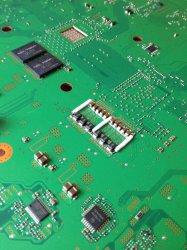
View attachment 25674 After quite a time trying to get these caps to sit straight, I've managed to get all 4 NECs replaced with 4 Panasonic 2R5TPE470M7 Tantalum Capacitors.
They are 470uF 2.5v
So far, it runs perfectly. I've got GT5 running an continuous demo loop for the past hour and no YLOD. I do have TLOU somewhere but I'll have to dig that one up. I'll try playing Uncharted 3 soon to make sure this sticks, I may not need to do the other 4 NECs on the processor side.
By next weekend I'll be able to delid the CELL and RSX as the fan still gets very loud even just idling. If delidding doesn't work, well... I'll probably have to look into a damaged temp sensor
Edit: I ended up 'washing' the entire board in an alcohol bath. I forgot how messy flux can be. I used Amtech flux. I tried using No Clean flux but I needed A LOT of flux for these caps to make sure I can get them to stick with solder on the pads. Plus the board was also a bit dusty and remnants of the destroyed NECs were everywhere
Nice clean work. Looks great! [emoji106]
Sent from my iPhone using Tapatalk

wrx884
Member
Yeah you are totally on point, and i thought to do that when i was soldering them in, and after too, just to check they were correctly positioned / aligned because i was worried at the time they were slightly off center. Also when i was soldering them in they would move slightly, and it only takes them to move out of position a little bit to then potentially make contact with the other side.
If someone is soldering size B caps using solder wire, then i'm sure the risk isn't very high to create a short under the caps. But for me i used solder paste and it doesn't take much for the paste to touch both sides at melting point and join as one solder, because of the capillary effect, and also it's easy to add too much paste sometimes (at least for me lol) then it ends up joining both sides when it melts.
And with 64 solder points like that (32 Tans x 2 solder points each), there is more room for a mistake short circuit when using size B caps (at least for me anyway using solder paste). So when using size D caps, if there is still a YLOD after full replacement, then i would be able to check better if it's due to a short on 1 of the caps, or not, because the gap between the (+) and (-) under the the D size caps is fairly large.
Ive never used paste so i cant really say how good it is but id imagine u would just treat it the same way and only put it on one pad 1st and solder it on so u can get the positions right? u have plenty of room to add paste on the other side after so as long as u have flux and get both the board and tants to the right temp the solder will do its own job will flow and form on and around the tant caps so id imagine u still shouldn't have issues. just tweaking ur technique mayb all thats needed.
Grey Ghost
Member
Nice clean work. Looks great! [emoji106]
Sent from my iPhone using Tapatalk
Hey, thanks! I thought I could've done worse

cfreddykrueger
Member
Here's a few more hours in the Last of Us on my A01.
This game is hard to put down [emoji23]
I'm not trying to gloat here. I'm just trying to give confidence for anyone that wants to try this repair.


Sent from my iPhone using Tapatalk
This game is hard to put down [emoji23]
I'm not trying to gloat here. I'm just trying to give confidence for anyone that wants to try this repair.
Sent from my iPhone using Tapatalk
View attachment 25674 After quite a time trying to get these caps to sit straight, I've managed to get all 4 NECs replaced with 4 Panasonic 2R5TPE470M7 Tantalum Capacitors.
I can't even begin to describe how angry it makes me that you oriented the top 2 on the far right differently than the rest. I hope you get a paper cut.
Workz_777
Senior Member
Dunno, probably about 7 or 8 minutes, I usually just control it "by hand" since my equipment can be temperamental.
Those temps are from a thermocouple in direct contact with the chip, so it barely has to go above the melting point. The heating plates themselves will be astronomically higher.
Ahhh i see, many thanks for the info.
Workz_777
Senior Member
Here's a few more hours in the Last of Us on my A01.
This game is hard to put down [emoji23]
I'm not trying to gloat here. I'm just trying to give confidence for anyone that wants to try this repair.
Sent from my iPhone using Tapatalk
Nice one bro, helps us (YLODers) to keep going when seeing these types of photo results


Workz_777
Senior Member
Yeah i was wondering the same, does it even turn on, or does it produce an instant YLOD? I was thinking about testing this myself just to see.Just out of curiosity, what do you get when you run a ps3 without the jumper wires? instant ylod?
Workz_777
Senior Member
I can't even begin to describe how angry it makes me that you oriented the top 2 on the far right differently than the rest. I hope you get a paper cut.
 Well we all love symmetry, but that might be going a bit far
Workz_777
Senior Member
Ive never used paste so i cant really say how good it is but id imagine u would just treat it the same way and only put it on one pad 1st and solder it on so u can get the positions right? u have plenty of room to add paste on the other side after so as long as u have flux and get both the board and tants to the right temp the solder will do its own job will flow and form on and around the tant caps so id imagine u still shouldn't have issues. just tweaking ur technique mayb all thats needed.
Yep, maybe i should have only put the paste on the outside edges, but i put it on both contacts under the cap, then placed the cap in position (at that point i guess the paste could have spread and touched together in the middle when i pushed down on the cap too much) then i soldered the cap in one go. Once done it's impossible to see if the solder bridged under-neath, because it's soldered so flat, there are no gaps. Which makes me think once the solder melted under the cap it could easily have traveled to the other side because of Capillary effect, and because i prolly applied far too much paste. Texture wise, before it melts, it's like a firm thermal cpu paste.
Regardless of my results this time, i think solder paste is amazing, and it's what production-line factories use when soldering components on boards. I've been using it for a long time, and never bridged the contacts under the components (to my knowledge), even when working with small (0805) MLCCs / Resistors, or small SOP ICs. But here i have a gut feeling it's what happened.
Anyways, i'm not bitching on the size B caps, it's just for me i think i'd prefer the size D caps in this case, even though from a glance it would seem like the size Bs would work better, because they fit perfectly onto the main (+) and (-) contact strips.
But on another note with the size B caps, i noticed their ESR is 1.1 ohm, whereas the ESR on the size D caps is 0.2 ohm. I think @squeept was talking about how the ESR might make a difference, and trying to match the ESR of the original Tokins was preferably.
Last edited:
Hi I would like to know if this makes a difference as I am in the same situationHiya, good question ElGris, well after seeing the recent video from @cfreddykrueger (just after your question), i would say it's exactly the same as in cfreddykrueger's video. The YLOD starts at about 1-2 secs. Yep the fan test seemed to work fine, before and after replacing all NEC/Tokins.
I think you're right, there could be a short somewhere, because the contacts on those small size B caps aren't very far apart, so it could be the solder is making contact (bridging) where it shouldn't under the caps.
This is why, since that photo, i de-soldered everything so i could try with some size D caps like 99% of other people's success stories here. Also, after chatting with you guys about what AWG size you used for bridge wires, i decided to order some 16 AWG soild copper and see how that goes.
Will aim to update again soon, just have to wait for parts to be delivered, hopefully this week.
Hi do you have any update on this pleaseWell, maybe that's the end for me? I've finished replacing all my tokins tonight on both sides of the board, tested continuity, checked all my solder points with a magnifying lens and... Nothing. Still getting a ylod. I'm going to get an oscilloscope soon so I can do some more investigating, but in the meantime I'm at a total loss. Any suggestions? Anything I missed?
Thanks
HiHey don't give up. My only suggesting is adding one more jumper for the RSX and for the CELL like I did for mine.
Also... really look over both sides of the boards and all of the components. Make sure everything's still there.
It can be so easy to knock off one of those little tiny fuses, capacitors etc. Trust me I've done it before and it sucks.
I tried my hand at delidding one of my perfectly working A01's before and accidentally knocked some of these off. This was my second delid and my first one was successful so I was pretty confident.
I'm not saying this is your problem but it's always a possibility.
https://gamesx.com/wiki/lib/exe/fetch.php?media=schematics:sony_playstation3_service_manual.pdf
Sent from my iPhone using Tapatalk
Please can you let me know sometihng
Do you know if it makes a difference to the ylod if using one jumper wire for the CELL and one for the RSX compared to using 2 wires for the CELL and two for the RSX
Will this make a difference for a 2-4 second ylod where the fan turns on for about 2-4 seconds
Please will really appreciate your input and everyone's input in this
Thanks
Similar threads
-
 PS3 Interesting PS3 Errors (1802, 1701, 1601) and Capacitor Replacement
- Started by Cheshire UK
- Replies: 2
-
PS3 CECHA00 with several SYSCON errors (3004, 1001,1002, 2120,3011)
- Started by LSL
- Replies: 7
-
PS3 A0801002 after 4 nec/tokin replacement (maybe Felix or anyone help me)
- Started by Swhalegod
- Replies: 3
-
Hello newcomer to the ps3 modding scene, needing help with syscon diagnostic
- Started by ascendantprime
- Replies: 1