PS3 (Research/Experimental) - NEC/TOKIN Capacitors Replacement - YLOD

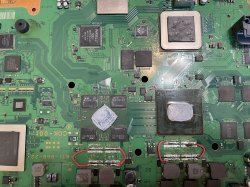
Hey Everyone, i replaced all NECs with 470uf 2.5v from Slim systems, on a CECHA00. this system would YLOD crash when having high fanspeeds exiting apps, i decided to bite the bullet and remove all NECs with 20 tantalums, 10 for each chipset, i found the method from this user on reddit THE REDDIT LINK and this seemingly fixed it. the photos on this users post is what i did to my CECHA00, and so far i havent had issues. im going to stress this system soon here and make a follow up post.
This time I can be glad. An instance where the "NEC/Tokin fix" wasn't taken out of context!

There is hope for that system being actually fixed by the capacitors. It didn't have a typical YLOD... It was shutdown under heavy load like in the original post, so this time no bullshit. You have my blessings.

Not sure if those capacitors will be enough though. Maybe they are suffering a bit if there's only 10 of them per array. The ESR is surely being compromised to a certain extent.
Time will tell. I think @ElGris found out after some time their capacitors were burnt to a crisp hehe. Not sure if it were for the same reason but you know...

I'll ask again about the mileage of this console if you can check with WebMan (btw I'm still genuinely interested on the other one touched by squeept like I asked before)
Because to me, it sounds like this Famous NEC/Tokin fault is typically only developing on the systems that were used a long time without problems. The systems where for some reason, their RSX didn't fail first, way earlier.
So I'm willing to bet this tokin fault is more common to find on systems that are thought to be still "working" than those that got the YLOD long ago.
 
would also like to mention that i never used a heatgun when removing the old NECs no heat was applied to the board. so far GT6 runs perfectly fine
 
here's my embarrassingly bad work. i had alot of trouble with solder not sticking. even with flux unfortunately. eventually i'll perhaps fix this job up, but been playing GT6 for 10 ish minutes now no problems at all.
 

Attachments

  • E8D75B6C-188E-445D-95FF-777B556EFAF7.jpeg
    E8D75B6C-188E-445D-95FF-777B556EFAF7.jpeg
    4.5 MB · Views: 429
  • 9A8E5AE0-3633-4FEA-B01D-D32659CEAC5C.jpeg
    9A8E5AE0-3633-4FEA-B01D-D32659CEAC5C.jpeg
    4.5 MB · Views: 795
This time I can be glad. An instance where the "NEC/Tokin fix" wasn't taken out of context!

There is hope for that system being actually fixed by the capacitors. It didn't have a typical YLOD... It was shutdown under heavy load like in the original post, so this time no bullshit. You have my blessings.

Not sure if those capacitors will be enough though. Maybe they are suffering a bit if there's only 10 of them per array. The ESR is surely being compromised to a certain extent.
Time will tell. I think @ElGris found out after some time their capacitors were burnt to a crisp hehe. Not sure if it were for the same reason but you know...

I'll ask again about the mileage of this console if you can check with WebMan (btw I'm still genuinely interested on the other one touched by squeept like I asked before)
Because to me, it sounds like this Famous NEC/Tokin fault is typically only developing on the systems that were used a long time without problems. The systems where for some reason, their RSX didn't fail first, way earlier.
So I'm willing to bet this tokin fault is more common to find on systems that are thought to be still "working" than those that got the YLOD long ago.
here's the total uptime. the system appears to be working flawlessly tbh. nothing bad so far
 

Attachments

  • A7DD89AC-FDBD-40EE-BF9D-E4B82B06CAB2.jpeg
    A7DD89AC-FDBD-40EE-BF9D-E4B82B06CAB2.jpeg
    30.9 KB · Views: 66
here's the total uptime. the system appears to be working flawlessly tbh. nothing bad so far
Over 300 days.
Looks good. And fits the conjecture if it's indeed the tokin fault.
These machines tend to fail way sooner sadly.
Yours lasted enough for the tokins to get a chance to fail. So it may be one of the lucky ones.

I bet the other one has about half as many days though. (Funny way to bet I know)

As for the soldering, I think you should simply get a bigger tip.
P.S.: I see you removed the old tokins with knife. Good. The fact that you didn't use hot air decreases the chances of a false positive, even if not eliminating it completely.

Cheers
 
Over 300 days.
Looks good. And fits the conjecture if it's indeed the tokin fault.
These machines tend to fail way sooner sadly.
Yours lasted enough for the tokins to get a chance to fail. So it may be one of the lucky ones.

I bet the other one has about half as many days though. (Funny way to bet I know)

As for the soldering, I think you should simply get a bigger tip.

Cheers
thanks for the reply, i have another A01 right now with faulty NECs also, flashing red light when it shuts off, ps2 mode doesnt work, crashes 24/7 taking the casings off the NECs reveal burnt like coloring in the white part of the NECs also, reason i bring this up is because this A00 had discoloration also as if it was burnt, usually thats a sign i lookout for when attempting to replace the NECs. time will tell if the tantalums i added are enough or if i need more of them. i know the RSX isnt at fault here for sure, the A00 only crashed YLOD style when using high fanspeed on 3.55fw i didnt even do testing beyond this, i just said F it and went ahead and tried it, again no heat was involved with removing the NECs just prying lol
 
thanks for the reply, i have another A01 right now with faulty NECs also, flashing red light when it shuts off, ps2 mode doesnt work, crashes 24/7 taking the casings off the NECs reveal burnt like coloring in the white part of the NECs also, reason i bring this up is because this A00 had discoloration also as if it was burnt, usually thats a sign i lookout for when attempting to replace the NECs. time will tell if the tantalums i added are enough or if i need more of them. i know the RSX isnt at fault here for sure, the A00 only crashed YLOD style when using high fanspeed on 3.55fw i didnt even do testing beyond this, i just said F it and went ahead and tried it, again no heat was involved with removing the NECs just prying lol
Hmm, if you are doing that many, I strongly suggest doing the SYSCON diagnosis and checking error logs.
Even on the ones you already got working for now.
Maybe there's a characteristic error code for this.

No need to do things the brute way, and will be helpful for the future.
 
here's my embarrassingly bad work. i had alot of trouble with solder not sticking. even with flux unfortunately. eventually i'll perhaps fix this job up, but been playing GT6 for 10 ish minutes now no problems at all.
figured i'd give another update, so i played GT6 for about 30 minutes then i let the system sit in a PS2 game for probably 2 hours. runs perfectly fine so far
 
Sounds like a general communication problem with the CPU. Not necessarily a CPU BGA defect, the GPU and CPU are co processors, so an RSX BGA defect (much more likely) can probably trigger this kind of error. What do you think @squeept? Reball and see candidate?

That's my guess.

EDIT: I would stick with you're original plan though. Replace that HDMI encoder and see if the DI/DO SPI error evaporates. I could be related to that. If so, cool. If not take it from there.
 
Last edited:
here's my embarrassingly bad work. i had alot of trouble with solder not sticking. even with flux unfortunately. eventually i'll perhaps fix this job up, but been playing GT6 for 10 ish minutes now no problems at all.
@squeept so doing all Tantalums will drastically reduce the lifespan of the PS3? could you explain more? (i read that via your ebay listing also) so this will end up frying my CPU/GPU long term? sorry if this was mentioned before, i couldnt find anything you said about that on this forum
 
@RIP-Felix @patricksouza472 yeah, with so many data lines going directly between the RSX and CELL, and just the general complexity of the system, that just kind of un-narrows your diagnosis. I'd still swap the encoder and check for bad chokes, but I wouldn't have as much faith in it.

@Revak3115 funny story, I'm revisiting all of that right now...

I got kind of paranoid about the tiny waveform showing through on the last fix for the CPU, and when under load on GT6 it got a little funkier than I was happy about, so I swapped all the TOKIN out (I swapped cases and the serial # will change, suck it). The GPU looked pretty much identical after with the same voltage and noise, but the CPU was a straight damn line with zero noise while idle. It still got a little funky under GT6 load, but it led me to reconsider a few things and I think the caps might have actually been dying. I was kind of upset with myself for being so unscientific with the TOKIN column in my spreadsheet just being "perfect, slightly not perfect, ugly, or fail" and now I want to fix that. I haven't put the next one in the spreadsheet yet, but it was another 3 second YLOD 3034 except heatgunned. The caps looked a little fuzzy, so I changed them out first just for a sanity check. No change in faults, and they looked identical to the originals on the scope. So I think the specific fault and state of the console may actually affect the 'scope reading. There are just so many different components and inrush currents and crosstalking in stages, so who knows...

Anyway... TL;DR - Gonna save more TOKIN images from now on and add more sheets with a few images to my spreadsheet so I can just put something like "GPU image #2" in the column instead of "good".

edit: and I need to figure out my capture triggers, cause felix already showed there are some discrete voltage changes as it tries to boot.
 
Last edited:
here's my embarrassingly bad work. i had alot of trouble with solder not sticking. even with flux unfortunately. eventually i'll perhaps fix this job up, but been playing GT6 for 10 ish minutes now no problems at all.

what tantalum you used and how about you do a video tutorial for more knowledge
 
@RIP-Felix @patricksouza472 yeah, with so many data lines going directly between the RSX and CELL, and just the general complexity of the system, that just kind of un-narrows your diagnosis. I'd still swap the encoder and check for bad chokes, but I wouldn't have as much faith in it.

@Revak3115 funny story, I'm revisiting all of that right now...

I got kind of paranoid about the tiny waveform showing through on the last fix for the CPU, and when under load on GT6 it got a little funkier than I was happy about, so I swapped all the TOKIN out (I swapped cases and the serial # will change, suck it). The GPU looked pretty much identical after with the same voltage and noise, but the CPU was a straight damn line with zero noise while idle. It still got a little funky under GT6 load, but it led me to reconsider a few things and I think the caps might have actually been dying. I was kind of upset with myself for being so unscientific with the TOKIN column in my spreadsheet just being "perfect, slightly not perfect, ugly, or fail" and now I want to fix that. I haven't put the next one in the spreadsheet yet, but it was another 3 second YLOD 3034 except heatgunned. The caps looked a little fuzzy, so I changed them out first just for a sanity check. No change in faults, and they looked identical to the originals on the scope. So I think the specific fault and state of the console may actually affect the 'scope reading. There are just so many different components and inrush currents and crosstalking in stages, so who knows...

Anyway... TL;DR - Gonna save more TOKIN images from now on and add more sheets with a few images to my spreadsheet so I can just put something like "GPU image #2" in the column instead of "good".

edit: and I need to figure out my capture triggers, cause felix already showed there are some discrete voltage changes as it tries to boot.

So, I guess I've narrowed it down to the C4001 cap. While other caps with same specs give around 1.1 ohm resistance, this one gives me over 6k ohm. Will replace it asap and report back, hopefully with good news
 
Well at least to have a perspective on the NEC/TOKIN failure point, it would be great if someone used the internal WEBMAN timing to determine the total days from the point the console YLODed and after the repair, but usually the NECs die within 3 to 6 years range, depending on the conditions of the machine and if there is more heat than usually, it degrades the NECs faster.

For me, i use both combinations of Tantalums and NECs, so there its an increased reliability, but nothing wrong on using the original specification NEC/TOKIN OE128E from the factory, its just they aren't particularly reliable, and you may have to switch them at some point.

Sent from my G8141 using Tapatalk
Too bad I only found this post and read about the syscon script way too late. My system YLOD'd last year (bought it second hand) and yesterday I found out it didn't even had 100 DAYS of use. CECHA01 in great condition, opened only once for cleaning (bought it sealed) and it had almost no dirt.. Buuut as I didn't know any of that beforehand, I destroyed my Tokins only to find they weren't my problem
 
here's my embarrassingly bad work. i had alot of trouble with solder not sticking. even with flux unfortunately. eventually i'll perhaps fix this job up, but been playing GT6 for 10 ish minutes now no problems at all.
Hello, I'm happy to see this repair.
I'm thinking of doing a little different from your method.
5 caps for RSX 5 for CELL and on the other side 5 for RSX and 5 CELL.
I think it will be well balanced, than putting all the caps on one side only.
Would it work the same as your method?
 
Hello, I'm happy to see this repair.
I'm thinking of doing a little different from your method.
5 caps for RSX 5 for CELL and on the other side 5 for RSX and 5 CELL.
I think it will be well balanced, than putting all the caps on one side only.
Would it work the same as your method?
i don't really see the difference in putting 5 on each side as their doing the same thing, this was just more convenient
 
@squeept If I were you, I'd just measure the Vpp using the cursor and record (not the automatic math). It's a hard number that can help us define what noise is permissible and what is not. Also, don't use high-res mode for this as that is an average, not the true data.

And yes, there is a normal bootup voltage profile the CPU goes through. I have noticed there is a region (on A models anyway) that is roughly the same. Note the pictures below (CPU=yellow, RSX=Blue). Everything left of the blue line is the same. And then, either the YLOD occurs (shutdown signal is a High voltage state just before PWR off) or the console passes the PWR up sequence and lowers the voltage to the Idle state plateau. That's when the the menu loads and the GPU changes to a squarewave signal. If a YLOD occurs it happens after the blue line. Notice that the working PS3 drops to the final idle state voltage. Then notice that PS3#4 doesn't. It just sits there on the second to last plateau until the YLOD (shutdown High state). That's where I would trigger, right on the blue line, because it seems to be when the signal and noise are stable, not jumping around doing things. Also the RSX seems to start the squarewave at idle, so you want to measure it before then. It's transfering data or syncing, IDK what that squarewave is about.
Startup Behavior.png
Working_NEC_RSX&BE.png
Working_Idle_RSX&CPU.png
Working_Idle_RSX&CPU2.png
Working_Idle_RSX&CPU3.png
 
Last edited:
Back
Top