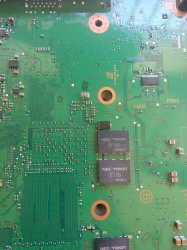
PS3 (Research/Experimental) - NEC/TOKIN Capacitors Replacement - YLOD

The TaPol the person who made the PCB recommends is 25mOhms, so don't use that one. The height is a problem. The PCB adds 0.8mm to the height of the caps. So we have to get 2mm caps so the combined height will fit under the RF shield. So we can't use the same TaPol caps SONY used, either. I think the most suitable alternative is the 2R5TPE470M7. Some of you have already ordered the M9, but the M7 is 7mOhms instead of 9. Even with 7mOhms/12caps, the combined ESR is 0.583mOms. It should be 0.375 or less. That's not ideal, but should be okay.

However, the AlPol that SONY used (EEFSX0D471E4) should be adequate. The ESR would be the same as a tokin (0.375mOhms). The capacitance would be a bit higher, but not significantly so. AlPol high frequency ESR performance isn't as good as TaPol, but both have their disadvantages using that PCB.

I love me some perfect purple PCB's, so I just ordered 18x on 0.8mm double thick copper (only $8.40), 24x TaPol and 24x AlPol (~$100 from mouser). I'll test them on the oscilloscope to see if there is any measurable difference compared to the Tokins on PS3#4.
If you haven't been following my PS3s, #4 was a sealed A01 with a 2s YLOD. It presents a single 3034 SYCON error, which I have concluded by process of elimination is "most likely" a BGA defect. Until this point I have been using it as a control console. I have been using the Oscilloscope to characterize it's tokin noise and I have not yet removed the tokins.

I also have not bent the HS tension springs either. If I did, the extra pressure could reconnect the BGA defect and I don't want that. I have assembled/dissassembled this A01 several times and it always gives a 2s YLOD, so I'm confident that the BGA defect is not so sensitive that it would reconnect just by assembling it.

For this test I will remove all the tokins WITHOUT hot air. I'll use flush cuts to remove the tokins, desoldeing braid + T12 C4 tip to clean the pads. That is the LEAST amount of heat possible. Heat can cause the board to flex microscopically and a BGA defect to reconnect mechanically. I am trying to avoid this kind of false positive. I will install the TaPol/AlPol capacitors to the PCB separately, to keep the heat away from the motherboard and make soldering easier. Then I will use minimal heat to properly install the populated PCB to the MB. This should result in the least warping on a 2s YLOD motherboard attempted on this thread yet. The only attempts that resulted in less heat applied to the MB are the piggyback method. That method does not remove the tokins from the equation, this way does.

What I hope to accomplish with this test:
  1. Silence that irrational inner voice asking, "but what if the 470uF caps are doing something you don't understand." Mostly this comes from a place of insecurity. I tried using B case tantalum caps, not the ones the OP suggested. This shouldn't make any difference, and my oscilloscope measurements agreed, but "what if?" I want to shut up that inner idiot! Basically, I want to prove that our Oscilloscope measuring method works. That there's nothing my scope isn't picking up or something hiding in a way that we're not understanding. If there is some way the tokins can be bad and not show up on a scope, this test will rule it out.
    • If the console boots: First, I'd be shocked. Next, I would of course test it thoroughly and over multiple thermal cycles to rule out a BGA false positive. If it continued to work and prove stable, then I'll be converted. Cult me up, the world is flat, the kool-aid is salvation, pass the mic so I can sing @Naked_Snake1995's praises.
    • If it doesn't boot, that's good because it supports the BGA defect hypothesis and proves our o-scope measuring technique works. All the physics and engineering actually equates to reality, all is right with the world. Reballing is not a con, and you all are cultists if you keep ruining your consoles thinking a 2s YLOD is likely to be revived by replacing the tokins.
  2. I want to see how the noise changes. How well does the PCB+TaPol caps (5,640uF | 0.583mOhms ESR), and PCB+AlPol caps (5,640uF | 0.375mOhms ESR) compare to the verified good tokins?
As somebody already mentioned, there's no way for us to thank you enough for the dedication.
I mean, you of all people know full well that it shouldn't work. You'd just be destroying a working set of tokins on a perviously untouched board. But for science!
And you of all people are the most skeptical of the tantalum being good replacement for the tokins, and yet you go will go ahead and dive in. And not precisely with cheap capacitors.

But if you want my opinion it is not going to be a total disaster. Those capacitors should surely be within the tolerances of the circuit. You'd be breaking working tokins but at least replacing them well enough.

And of course I'd also wish all the rational thoughts are wrong and the Myths are somehow true.
Who knows, maybe theres some evildoing gnomes that hide inside of the NEC/Tokins and keep bullying the RSX out of operation for error 3034.
Or something
 
That A00 is the one that would turn on fine, but had YLOD under load and you only used knife yes? That's nice

It's not the one that had the squeept signature right?

It's easy to mix systems when there are so many
yeah this isnt the one squeept worked on, and yes knife only no heat was used in the removal or install of the Tantalums, this is the one where it only YLOD before when on 3.55 exiting TempMon with 100% fanspeed. no further testing was done i just bit the bullet and did it
 
...it only YLOD before when on 3.55 exiting TempMon with 100% fanspeed. no further testing was done i just bit the bullet and did it
Random instability or instability in demanding games is what the OP originally recommended this fix for. So yours was the use case for this mod. I wish we had scope images of your before/after Vout (PP). Too bad, it might have helped define the noise threshold for interference.
what is the different between them...i found them in this site is that what the ps3 slim 3000 use
The thought of answering your question gives me Deja Vu. So let's pretend I already have, because I already have.
 
Random instability or instability in demanding games is what the OP originally recommended this fix for. So yours was the use case for this mod. I wish we had scope images of your before/after Vout (PP). Too bad, it might have helped define the noise threshold for interference.
The thought of answering your question gives me Deja Vu. So let's pretend I already have, because I already have.
speaking of OP, where did he go? hes active on reddit but here i haven't seen him in a long long time lol
 
Been here,didn't go nowhere
Might I trouble you for an update on your C04 and L04? For those following along, the C04 (pg1 )is the "OG" console he fixed and the L04 (pg58) was a Guinea Pig he removed 4 tokins off and it kept working. The L04 was first reported working on 1/15/20, but there were no updates after that, but I might have missed it.

Also, you mentioned you have tried this on other consoles too, but never provided details. I would like to know the models, caps used (preferably model# so I can lookup the datasheet), approximate date they first started working, if they failed how long it was after first working, did you eventually get them working and how. I'm keeping track of these details in a spreadsheet.
 
Hiya All, hope everything at your end is doing very well.

:D...take 2, so i re-did the Tantalum + MLCCs combination (just on the bridge wire only), this time i doubled checked the (+) and (-) lol, so far the PS3 is running great!

For this build i added another MLCC to the array from before, so now total capacitors = 72.

Each NEC has been replaced with:-
Tantalums (Vishay size B):
4 x 470uF - 2.5V
MLCCs (Murata, Taiyo Yuden, Vishay, size 1206)
1 x 22uF - 10V
1 x 10uF - 10V
1 x 1uF - 10V
1 x 0.1uF - 10V
1 x 0.01uF - 10V

Using thin card, wrapped in Kapton tape, with "slug (copper) tape" to make the traces, also the traces are wrapped around under touching the board on the contact strips. Here's the (B) side of board...
View attachment 26426

Here's the (A) side of board...
View attachment 26427

And the PS3 running...

View attachment 26428


:very drunk: Again thanks so much for spotting my silly mistake on my last build. I'm gonna aim to test this latest working set up and update you guys soon all being well, just need to run some intensive games. Unfortunately i don't have an o-scope to measure anything, i wish i did though, maybe soon.
Hey, this is some beatiful piece of art there. Can you tell me, why you use the MLCCs? For smoothing out? And, as my english is not that good, I mean, it is the third language I learned, I did not fully understand, how you build these basements with the copper strips. Mind to explain? I reaaaly want to rebuild this, is just looks to clean and my OCD kicks in XD

BTW: My analog oscilloscope is on the way, it should arrive today (monday). I hope to get some interesting results, if possible :)
 
Might I trouble you for an update on your C04 and L04? For those following along, the C04 (pg1 )is the "OG" console he fixed and the L04 (pg58) was a Guinea Pig he removed 4 tokins off and it kept working. The L04 was first reported working on 1/15/20, but there were no updates after that, but I might have missed it.

Also, you mentioned you have tried this on other consoles too, but never provided details. I would like to know the models, caps used (preferably model# so I can lookup the datasheet), approximate date they first started working, if they failed how long it was after first working, did you eventually get them working and how. I'm keeping track of these details in a spreadsheet.

Regarding both consoles the C04 and L04, the L04 was "semi-working" on the original NEC, but only when heated it from behind, it wouldnt last more than 30min to 1h depending on the circumstances, i used it as my guinea pig to make Tantalum place adjustements, the board became scrap, didnt plan to fix it, just try to find paths for easier Tantalum placements, which eventually figured it out how the rails work to make instalation more seamingless, but the problem was that i scratched too much of the PCB layer-coat and didnt proceed any further and made a big mess out of it.

The C04 was still working, until was in my possession, eventually 5 months ago, ive got a mint C04 with only 40 days clocked use in 14 years, and sold the C04 that i had been worked on previously, as i didnt want to keep two consoles, since then ive been less active on the NEC topic and out of sync on the thread, ever since last year ive barely even touched the PlayStation3, as ive been more involved in personal projects.

In terms of the Tantalums ive used, giving the exact model or datasheet, is quite difficult on the Tantalums you buy off AliExpress, but the ones ive used were 470uF at 6.3V each, information on these are quite scarce to none, as they dont provide any datasheets like the branded ones do, but at the time, i didnt know where to get and how to get branded tantalums, as AliExpress was my only choice, perhaps this can be a bit of use, if i recall right, these are the exact same ones ive used intially in 2019 for the C04, eventually i ordered another similar set for the remaning NECs in 2020, and only used to replace one on the Broadband Engine, and never moved from there.

https://www.aliexpress.com/item/328...earchweb0_0,searchweb201602_,searchweb201603_
 
I have a nice working Japanese PS3 that is almost 100% but some games like The Last of Us will YLOD 5min into gameplay. So I'm thinking it needs some new caps. I order some new NEC/TOKIN for now but once they go bad, I'll try the ETPSF270M6E way.
The tamps never go over 68c at just 25% fan speed. Most are under 65c and at the lowest it can 50~56c.

Well, it's updated time. I tried to use the new old NEC/TOKIN on two of the RSX caps and was just having a hell of a time trying to use it. In the end, I was thinking I killed my PS3 trying to use them. If you don't have the right tools for me or don't know how to use them the best for the NEC/TOKIN. Don't use them at all, the lower price vs the work is a no-no.

Now for the good news, I used 12 ETPSF270M6E on the 2 NEC/TOKIN I removed (maybe too much but the other two are old), and now its been revived and is working 100% so far. All the games that YLOD like 10min into the gameplay are working now.
 
The TaPol the person who made the PCB recommends is 25mOhms, so don't use that one. The height is a problem. The PCB adds 0.8mm to the height of the caps. So we have to get 2mm caps so the combined height will fit under the RF shield. So we can't use the same TaPol caps SONY used, either. I think the most suitable alternative is the 2R5TPE470M7. Some of you have already ordered the M9, but the M7 is 7mOhms instead of 9. Even with 7mOhms/12caps, the combined ESR is 0.583mOms. It should be 0.375 or less. That's not ideal, but should be okay.

However, the AlPol that SONY used (EEFSX0D471E4) should be adequate. The ESR would be the same as a tokin (0.375mOhms). The capacitance would be a bit higher, but not significantly so. AlPol high frequency ESR performance isn't as good as TaPol, but both have their disadvantages using that PCB.
[/spoiler]

So now that I know Sony didn't always use Tantalum caps in later revisions, I was curious if a capacitor such as this would be adequate ?
https://www.mouser.com/ProductDetail/Panasonic/EEF-LX0E331R/?qs=APoVD1cryDLtPjbZTVuFyw==

It's 330 uF, 2.5V and has an ESR of 6 mOhms. I was planning on soldering 4 in place of each NEC Tokin.

Or what if I went with these and soldered 3 per NEC Tokin? https://www.mouser.com/ProductDetail/Panasonic/EEF-LX0E471R4/?qs=%2BDuH%2Bf4iL6TYzjEQj0FCOA==

These are 470uF with an ESR of 4.5 mOhms
 
Last edited:
Well, it's updated time. I tried to use the new old NEC/TOKIN on two of the RSX caps and was just having a hell of a time trying to use it. In the end, I was thinking I killed my PS3 trying to use them. If you don't have the right tools for me or don't know how to use them the best for the NEC/TOKIN. Don't use them at all, the lower price vs the work is a no-no.

Now for the good news, I used 12 ETPSF270M6E on the 2 NEC/TOKIN I removed (maybe too much but the other two are old), and now its been revived and is working 100% so far. All the games that YLOD like 10min into the gameplay are working now.
What models PS3 was that again?

Be sure to give it plenty of thermal cycles, to relax the heat strain that got pent up from the hot air you used while trying to install new old stock tokins. This first few weeks is the most precarious! Keep us informed of your progress.
 
So now that I know Sony didn't always use Tantalum caps in later revisions, I was curious if a capacitor such as this would be adequate ?
https://www.mouser.com/ProductDetail/Panasonic/EEF-LX0E331R/?qs=APoVD1cryDLtPjbZTVuFyw==

It's 330 uF, 2.5V and has an ESR of 6 mOhms. I was planning on soldering 4 in place of each NEC Tokin.

Or what if I went with these and soldered 3 per NEC Tokin? https://www.mouser.com/ProductDetail/Panasonic/EEF-LX0E471R4/?qs=%2BDuH%2Bf4iL6TYzjEQj0FCOA==

These are 470uF with an ESR of 4.5 mOhms
0.375mOhms ESR is the magic number. So with the 330uF 6mOhms you need 16x (5280uF total). Whereas with the 470uF 4.5mOhm you need 12x (5640uF total). Either way should work, but it's still experimental.
 
I've got wonderful bad news! The CECHA01 I reballed last night is crashing during stress testing with GT6! I'll hold off on replacing the caps for a day or so to see if anyone (@RIP-Felix) comes up with any kind of relevant non-destructive (for the board, not the caps...) testing that they want to see, but I'm afraid I'm not willing to attempt to remove them intact on this one. The board has already been through 2 rework cycles, and it will take 4 more to remove them all. Combine that risk with the fact that I recently popcorned a warranty sealed system so I suspect uneven heat on my bottom plates that I may need to investigate soon, I'm not willing to risk this one when it just needs a simple fix.

Anyway, it was what is now the standard 3 second YLOD A0403034 with the normal amount of noise and fixed by a reball, however, the GPU caps had a very clear sawtooth waveform visible prior to rework.

Here's CPU idle at system menu, looking totally normal:
u9qBl8y.jpg


GPU idle at system menu, showing a very clear sawtooth wave, but notice when comparing it to the "bad" image in my signature, it doesn't have any "stuttering" to it and the amplitude is MUCH smaller. This image is pretty much identical to what I observed prior to rework:
uxiIHMq.jpg


CPU playing GT6, showing a very clear sine wave just like the bad image from my signature:
siGDTUY.jpg


GPU playing GT6, the sawtooth is beginning to gain the "stutter" from the "bad" image:
5Nd9s6e.jpg


And, more importantly, since most of you don't have oscilloscopes, the error log is now flooded with A0801001 and A0801002. The interesting thing about that, though, is that I only crashed it twice.... but it filled the error log with those two codes at all different times.

Anyway, this kind of confirms to me that capacitance and noise aren't really in play at all.... you're looking for that underlying waveform to swap over to looking like the images in my signature, and the amplitude of the sine or sawtooth wave is what really indicates the health of the caps, noise be damned. And we have confirmation that 1001 and 1002 error codes can come up from verified bad caps.

I'm now on board for switching out any caps that show a sawtooth or sine wave of ANY amplitude, or that give any 1001 or 1002 error codes. Let me be clear, though, for those that are reading this thread and don't have the means to perform any of this testing: your odds are still super, super low (4 in roughly 150 here now). Please, for the love of god, get the USB serial adapter that's like $5 and check the syscon thread before you start destroying things.

edit: yes, the Vpp doesn't match my spreadsheet. I'm still being sloppy and only do one freeze frame when filling out the sheet, so it can vary by a good bit depending on the spikes I catch.

edit 2: one other interesting thing of note - this board made my testing power supply whine like crazy. It has never done that before.
 
Last edited:
I've got wonderful bad news! The CECHA01 I reballed last night is crashing during stress testing with GT6! I'll hold off on replacing the caps for a day or so to see if anyone (@RIP-Felix) comes up with any kind of relevant non-destructive (for the board, not the caps...) testing that they want to see, but I'm afraid I'm not willing to attempt to remove them intact on this one. The board has already been through 2 rework cycles, and it will take 4 more to remove them all. Combine that risk with the fact that I recently popcorned a warranty sealed system so I suspect uneven heat on my bottom plates that I may need to investigate soon, I'm not willing to risk this one when it just needs a simple fix.

Anyway, it was what is now the standard 3 second YLOD A0403034 with the normal amount of noise and fixed by a reball, however, the GPU caps had a very clear sawtooth waveform visible prior to rework.

Here's CPU idle at system menu, looking totally normal:
u9qBl8y.jpg


GPU idle at system menu, showing a very clear sawtooth wave, but notice when comparing it to the "bad" image in my signature, it doesn't have any "stuttering" to it and the amplitude is MUCH smaller. This image is pretty much identical to what I observed prior to rework:
uxiIHMq.jpg


CPU playing GT6, showing a very clear sine wave just like the bad image from my signature:
siGDTUY.jpg


GPU playing GT6, the sawtooth is beginning to gain the "stutter" from the "bad" image:
5Nd9s6e.jpg


And, more importantly, since most of you don't have oscilloscopes, the error log is now flooded with A0801001 and A0801002. The interesting thing about that, though, is that I only crashed it twice.... but it filled the error log with those two codes at all different times.

Anyway, this kind of confirms to me that capacitance and noise aren't really in play at all.... you're looking for that underlying waveform to swap over to looking like the images in my signature, and the amplitude of the sine or sawtooth wave is what really indicates the health of the caps, noise be damned. And we have confirmation that 1001 and 1002 error codes can come up from verified bad caps.

I'm now on board for switching out any caps that show a sawtooth or sine wave of ANY amplitude, or that give any 1001 or 1002 error codes. Let me be clear, though, for those that are reading this thread and don't have the means to perform any of this testing: your odds are still super, super low (4 in roughly 150 here now). Please, for the love of god, get the USB serial adapter that's like $5 and check the syscon thread before you start destroying things.

edit: yes, the Vpp doesn't match my spreadsheet. I'm still being sloppy and only do one freeze frame when filling out the sheet, so it can vary by a good bit depending on the spikes I catch.

edit 2: one other interesting thing of note - this board made my testing power supply whine like crazy. It has never done that before.
This is fantastic.
You finally caught the elusive tokin fault, on a Backwards compatible system!

Since I guess the "heat test" is already quite debunked...
What I'd be interested to see tested is, just before you go ahead and remove the tokins, adding an additional capacitor in parallel, see what effect it has.

I did this, initially as a non-intrusive test on a L model that I'm 99.9% sure had some kind of tokin fault, but I decided to leave it like that until it failed. It's still working since November with regular use.

So to me it's not that clear that the fault is always because of a "bad tokin" that must be removed.

Thank you so much in any case.
 

Attachments

  • IMG_20201110_120833.jpg
    IMG_20201110_120833.jpg
    2 MB · Views: 848
I've got wonderful bad news! The CECHA01 I reballed last night is crashing during stress testing with GT6! I'll hold off on replacing the caps for a day or so to see if anyone (@RIP-Felix) comes up with any kind of relevant non-destructive (for the board, not the caps...) testing that they want to see, but I'm afraid I'm not willing to attempt to remove them intact on this one. The board has already been through 2 rework cycles, and it will take 4 more to remove them all. Combine that risk with the fact that I recently popcorned a warranty sealed system so I suspect uneven heat on my bottom plates that I may need to investigate soon, I'm not willing to risk this one when it just needs a simple fix.

Anyway, it was what is now the standard 3 second YLOD A0403034 with the normal amount of noise and fixed by a reball, however, the GPU caps had a very clear sawtooth waveform visible prior to rework.

Here's CPU idle at system menu, looking totally normal:
u9qBl8y.jpg


GPU idle at system menu, showing a very clear sawtooth wave, but notice when comparing it to the "bad" image in my signature, it doesn't have any "stuttering" to it and the amplitude is MUCH smaller. This image is pretty much identical to what I observed prior to rework:
uxiIHMq.jpg


CPU playing GT6, showing a very clear sine wave just like the bad image from my signature:
siGDTUY.jpg


GPU playing GT6, the sawtooth is beginning to gain the "stutter" from the "bad" image:
5Nd9s6e.jpg


And, more importantly, since most of you don't have oscilloscopes, the error log is now flooded with A0801001 and A0801002. The interesting thing about that, though, is that I only crashed it twice.... but it filled the error log with those two codes at all different times.

Anyway, this kind of confirms to me that capacitance and noise aren't really in play at all.... you're looking for that underlying waveform to swap over to looking like the images in my signature, and the amplitude of the sine or sawtooth wave is what really indicates the health of the caps, noise be damned. And we have confirmation that 1001 and 1002 error codes can come up from verified bad caps.

I'm now on board for switching out any caps that show a sawtooth or sine wave of ANY amplitude, or that give any 1001 or 1002 error codes. Let me be clear, though, for those that are reading this thread and don't have the means to perform any of this testing: your odds are still super, super low (4 in roughly 150 here now). Please, for the love of god, get the USB serial adapter that's like $5 and check the syscon thread before you start destroying things.

edit: yes, the Vpp doesn't match my spreadsheet. I'm still being sloppy and only do one freeze frame when filling out the sheet, so it can vary by a good bit depending on the spikes I catch.

edit 2: one other interesting thing of note - this board made my testing power supply whine like crazy. It has never done that before.
Yes, why yes I do have a test for you good sir...@squeept old buddy...old pal. It's kinda harder than before and I've been thinking about this more and more. The problem with this circuit and the way we've been measuring the tokins is that we're not looking at the switch mode ripple, instead we've been zooming in on the HF sawtooth charge/discharges. I'm not sure if that's from the converter or MLCC bypass caps noise coupling. However, I have noticed that the ripple we're interested in, switch mode ripple, is close to 100KHz in wavelength and easier to see at 2-5us/Division, not at 1us/Division. And it gets obscured in the noise from the HF sawtooth. So in order to see it more clearly, we need to employ a differential probing technique.

First please watch this:
Just got my scope out to iron out a test procedure:
  • Plug in 2 probes set to slider sw 1x (BTW, this is WAY cleaner than we've been seeing at 10x. So this is definitely the way to go from now on, even for the normal probing techique):
    • Press CH1 --> Change "Coupling" to AC or leave on DC. If the console stays on for an extended period of time, then AC might be easier, just so you don't have to offset the voltage to find it around 1.3v. Mine YLOD in 1.5s so I used DC coupling and triggered when the voltage rose above 1v. AC will work but you have to be quick with the stop button.
    • Change -->"BW" to 20M, "Probe" to 1x, and "Volts/Div" to Coarse.
    • Do the same for CH2.
    • Be sure both are illuminated.
  • Differential Probing technique:
    • 2 probes w/ground spring. 1 on tokin +Vout/GND and the other on the +Vin/GND.
    • Press Math --> Choose "Math" --> Change "Operator" to A-B, "Operation" to ON, SourceA to CH1, SourceB to CH2
    • This will reduce the HF switching noise and allow you to see the LF ripple that the NEC/TOKINs are supressing. Note that you will need to set the horzontal time scale to 2us/Div - 5us/Division in order to see LF ripple, because the wavelength of the LF ripple is different than the HF sawtooth you see at 1uS/Div!!!
    • As for the vertical axis, you're going to need to be on the 1x scale so you can get down to the 2mV/div range (for good tokins). Mine measured about 2mV/div. It took forever to offset to -1.3v to get them in view!
    • Set Triggering to +1v if using DC coupling and press single so the scope will wait to be triggered. Set to 0v and leave on run if using AC coupling (easier, but console needs to be stable. Doesn't work well for capturing YLOD events. You have to be quick with the stop button).
  • Press Acquire --> Change Mode to High Res.
  • Note: each channel's probe scale have to match or it messes up the math. So if CH1 is at 2mV/Div, set CH2 to 2mV/Div. Keep adjusting until until the noise on each CH is large enough to full 2-3 divisions on screen, the difference calculation is more accurately measured this way. Both CH waveforms need to be completely in view on the screen or the Math calculation won't work. Digital scope limitation.
  • Press Math --> Choose Math and now you can control the mV/div of the calculation and position it onscreen.
  • Once you have the LF waveform in view, use the cursors to measure the switch mode output ripple.
    • Press "Cursor" --> choose "Manual" --> choose "Select" to change to the horizontal cursors --> choose "Cursor A" (solid line) and use the knob to place CursorA it at the bottom of the noise/peak --> choose "CursorB" (dashed line) and use the knob to place CursorB at the top of the noise/peak --> then record the BY-AY measurement.
I know this is a PITA, but it's been a long time coming. Here is my RSX for comparison and reference for what you're looking for"
RSX Differential Probing Technique / 1x Probe / DC coupling / High Res Aquire mode / 20MHz BW limit:
1x_Diff_DC_Coupled_sw_mode_Ripple (RSX_at_Boot_YLOD).png


RSX Differential Probing Technique / 1x Probe / AC coupling / High Res Aquire mode / 20MHz BW limit:
1x_Diff_AC_Coupled_sw_mode_Ripple (RSX_at_Boot_YLOD).png
I was getting about 2.5 - 3.0mVpp of switch mode ripple. I'm pretty sure that's what it is, because there is about 8us wavelength (PP). That equates to 125KHz, which is right where expect to see DC-DC switching frequency. Note: had I just used the vertical cursors to place AX and & BX cursors on peaks of the sinewave, 1/|dX| = frequency. I eyeballed it and looked it up online, but the function is right there in the scope, so it's better to use it.
 
Last edited:
@RIP-Felix I been up with some beers now, so I'll have to go back over this tomorrow and see if I still agree with myself, but right now my concerns are threefold: Imma not follow directions right, whatever I find you'll have more questions, and if we're talking a single millivolt gonna make a difference it should probably all be done at the same bench all at once for comparisons.

If tomorrow me still agrees with tonight me, I'll just trust you to return the board when you're done and I'll PM you for the address.
 
@squeept Sir, im sorry for spam in this thread but i cant find other way to contact you, dm messages not available. im looking for ps3 repair service and looks like you are the best hands to hire for the job. please dm me how i can contact you. thanks.
 
Come on, man up! When written out in procedure form, it looks more daunting than it is. That's because I wrote out all the specific settings needed. Just work through it one step at a time and you'll see what I mean on screen. Basically you are just using 2 probes instead of one. You already know how to get good pics with one probe. So plug in a second, copy the settings to set it up the same. Now you should have 2 images of the same waveform on screen. Now just pres the Math function and choose A-B. Tell it A is CH1 and B is CH2. Then it displays the difference on screen. In a nutshell that's all we're doing.

That is the poor man's differential probe. They make dedicated differential probes, but they are expensive. This way works well enough (actually better on an analog scope). Play around with it for a bit and you'll get the hang of it. It took me maybe 20-30 minutes to setup right and make sense of it. More complicated than a single probing technique, but not rocket science. It was actually a fun way to get familiar with the math function and the scope. Also I suggest you get used to measuring with the cursor. Set the Y cursors to the ripple high/low and the X cursors on the peaks to measure the frequency of the noise. Then hit print and you have a saved pic that's way more useful to analyze later. I love this RIGOL!

The trick here is to use 1x mode (slider on probe and settings to match in the scope). 1x has 90% less noise compared to 10x mode. YOU WILL BE BLOWN AWAY BY THE DIFFERENCE IN NOISE. You won't want to go back to 10x after seeing the difference. Also, by using 1x mode you can now go down to 500uV/div instead of being limited to 10mV/div. We need High Res Acquisition to help remove more noise. These measurements are done by standard using 20MHz BW limiting. So that's why the procedure is long. I just wanted to make sure you have the scope set up right or you won't get similar results.
 
Yeah, yeah, I'll get to it in a bit. It's new tool day here, y'all gotta wait. Took my Gamestop profits and finally upgraded from my old NiCad Black & Decker stuff and started a new Ryobi collection. If you don't hear from me by tomorrow, I got trigger happy with the trim nailer and lobotomized myself.
 
Back
Top