PS3 (Research/Experimental) - NEC/TOKIN Capacitors Replacement - YLOD

Hmm. I havent had GLOD though, mine just shuts off with the three beeps and flashes red. Upon booting again, it can work for hours with no problems.

I actually ordered original necs a while ago, but they havent arrived due to the pandemic, however my original plans were to simply heat all of the necs and lift them off, and place these new ones down. But ultimately, ended up with going for the tantalums. So do you think I should remove and replace all top side Necs when my replacements arrive? I'm just worried i'll make it worse than it already is.

Do my symptoms sound like the remaining necs OR, do they sound like...

X.X
i think you should. if it was expanding solder balls it wouldnt work for hours as you say.
 
i turned on my ps3's motherboard after i took all the neces and give instant ylod does that happned because there are not neses or there is another problem


i guess you have to take it to someone who knows how to soldering is much better
i know how to soldering and no problem..please just give some information about how can i replacing NEC with electrolyte caps in external mode..please explain and upload some photo..
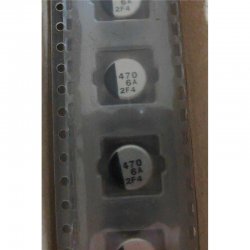
and also can i replace NEC with these 6.3v 470uf smd caps?
c470uf63ves.jpg
 
Last edited:
i know how to soldering and no problem..please just give some information about how can i replacing NEC with electrolyte caps in external mode..please explain and upload some photo..
and also can i replace NEC with these 6.3v 470uf smd caps?
View attachment 26045
all i know you mast use 2.8v 470uf tantalum and about how to soldering you mast see youtube

View attachment 26048 View attachment 26049 View attachment 26050
All these pics are on the first page off this thread!!!!!!!!!!!!!!!!!:sang banghead::troutslap:

thanks so much
 
I solder one 6.3V 2200UF electrolyte capacitor to one of NEC and PS3 BOOT UP..:encouragement:
But its better to replace tantalums.
first time when i open the ps3,i saw the heatsink of RSX was not fixed on RSX and i attach it to RSX with silicon Glue.its good or not?what is the best way to attach this heatsink to rsx?
i think the heat is not transfer from rsx to heatsink..20200528_114206.jpg
 
I solder one 6.3V 2200UF electrolyte capacitor to one of NEC and PS3 BOOT UP..:encouragement:
But its better to replace tantalums.
first time when i open the ps3,i saw the heatsink of RSX was not fixed on RSX and i attach it to RSX with silicon Glue.its good or not?what is the best way to attach this heatsink to rsx?
i think the heat is not transfer from rsx to heatsink..View attachment 26051

that is so good but you mast add tantalum as they said but tall me does it run from the first and how is the gaming with and about rsx ihs you mast use gasket maker who is the best
 
Bitter sweet success story:
Working with a CECHH system that had a 4.5 second YLOD, replaced 1 Tokin with 3x 470uf 2.5V and the thing fired right up. But several minutes after turning on and now every time, the system freezes and i see artifacts across the screen, no matter if it's in a menu or a game. The guy i bought this from did say he heat gunned it, so i guess the only solution would be a reflow or reball? Let me hear your opinions.
It's similar to this video here:
 
I solder one 6.3V 2200UF electrolyte capacitor to one of NEC and PS3 BOOT UP..:encouragement:
But its better to replace tantalums.
first time when i open the ps3,i saw the heatsink of RSX was not fixed on RSX and i attach it to RSX with silicon Glue.its good or not?what is the best way to attach this heatsink to rsx?
i think the heat is not transfer from rsx to heatsink..View attachment 26051

Yikes! that's bad... heat transfers won't be good, no. I would NOT use glue. The glue will melt overtime, and will get everywhere, and make a massive mess. You will need to find the correct screw...
 
Yikes! that's bad... heat transfers won't be good, no. I would NOT use glue. The glue will melt overtime, and will get everywhere, and make a massive mess. You will need to find the correct screw...
Hi..correct screw?which type of screw?i just use a bit little silicon glue to fix heatsink on RSX..and now i want remove it again but i think the silicon paste can not fix the heatsink on RSX..
if you know the best solution please tell me..thanks alot
 
Hi..correct screw?which type of screw?i just use a bit little silicon glue to fix heatsink on RSX..and now i want remove it again but i think the silicon paste can not fix the heatsink on RSX..
if you know the best solution please tell me..thanks alot

Once your RSX heats up all the way, it'll soften up the glue, which might then leak and attach to other components, or even the heat shield. Good luck removing it after that.

Here's an ebay link for a set of brackets and screws. Sounds like all you need is the screws.

https://www.ebay.com/itm/PS3-Origin...131361?hash=item1ceb1561e1:g:PFIAAOSwTsNexl6k
 
Bitter sweet success story:
Working with a CECHH system that had a 4.5 second YLOD, replaced 1 Tokin with 3x 470uf 2.5V and the thing fired right up. But several minutes after turning on and now every time, the system freezes and i see artifacts across the screen, no matter if it's in a menu or a game. The guy i bought this from did say he heat gunned it, so i guess the only solution would be a reflow or reball? Let me hear your opinions.
It's similar to this video here:
Try all 32 tantulum's and maybe delid?
 
Bitter sweet success story:
Working with a CECHH system that had a 4.5 second YLOD, replaced 1 Tokin with 3x 470uf 2.5V and the thing fired right up. But several minutes after turning on and now every time, the system freezes and i see artifacts across the screen, no matter if it's in a menu or a game. The guy i bought this from did say he heat gunned it, so i guess the only solution would be a reflow or reball? Let me hear your opinions.
It's similar to this video here:
Try pressing the CELLs clamp with your finger using your body weight. Then see if the console boots and plays fine. Ask for help to test that. I have the same problemwith the same model. Sony's enginner fu%&ed good on this one, since those heatsinks attach like glue with the IHS, so what you need is a rework. I tried to fix it with a reflow without sucess. BGAs are really deformed I guess..
 
I just made an interesting discovery... I've been spending a lot of time getting familiar with my new, cheap-o scope and how it behaves. Since its output doesn't quite match higher-quality scopes, I decided to create my own "apples to apples" comparison. I removed all the caps from the cell (both top and bottom), but I left just the bridge in place. I also left all the RSX caps in place. Once i did all that, I did a ton of measuring between the two sets, until I was pretty sure I came up with my own set of "good signal" (the ones taken from the RSX) and "bad signal" (the ones taken from the Cell, because there weren't any caps :) ). All measurements are taken at 500mV/div, and 1uS/Div.

So here's the baseline "bad signal" from the Cell. You can see how jagged it is
FIIyJyM.jpg

FIIyJyM


And this is a baseline RSX signal. I'm calling this "Good" (the assumption being that my scope just doesn't have the resolution to read it any better than that). It looks very clean... it goes up, stays there and then goes back down.
6bSDGW2.jpg

6bSDGW2


Once I had those signals all documented (and I measured them at least 50 times over the last few days, just to ensure consistency), I proceeded to add caps back into Cell. For every cap installed, I mounted the power supply back on, and did a read with the same parameters.

Here's the "cap map"
BZZo2xE.jpg

BZZo2xE


So here's 1 cap added. The signal looks mostly like the baseline, but it's slightly cleaner -- those gaps between the peaks are mostly gone, and that's with just one cap
6Y4kf0u.jpg

6Y4kf0u


And then, from caps 2-8, the waves were pretty much the same! The gaps and the Peak to Peak are very consistent.
2rvLJ4U.jpg

2rvLJ4U


By this point, I ran out of space on the "near" side of the Cell, so then I added cap #9 (see the map cap above). Much to my surprise, once I added #9, the signal was almost as clean as the RSX baseline! Huge difference between #9 and #8
OXlPyaX.jpg


OXlPyaX


Adding caps 10-12 cleaned it even further. Every time I booted it, there was a little bit of noise that was difficult to capture. Probably adding another cap will fix it. My RSX has 15 caps 470uf caps, and the Cell has 12. Either one goes well above the 4800uf provided by the tokins.

11 caps -- even cleaner! but it has a bit of noise at the beginning
QnBnLfH.jpg

QnBnLfH


12 caps -- has a bit of noise at the beginning also, but it's just as clean as with 11

9Mkd7AI


Here's the link to the entire collection -- https://imgur.com/gallery/0xeDIRL
9Mkd7AI.jpg


So what's my conclusion? I don't think adding a 9th cap "made all the difference", because there was no difference whatsoever between having 2 and 8 caps (which is why I didn't bother posting them, but I can if anyone is interested). I think the difference is that I placed #9 on the "far" side of the rails, along with the caps that were on the "near" rail. I think that we need caps on both sides for us to get "clean" signals. That's just one theory, though! here's some others

* I reached a "minimum" amount of capacitance, and the signal "normalized". The tokins originally provided 4800uf between the four of them (4x1200uf). 8 caps at 470uf each adds up to 3760uf, and the 9th brought it up to 4230, which is not quite the original 4800uf, unless the "normalization magic" threshold is 4000uf. I highly doubt this theory, though.
* It's also possible that my baselines are meaningless!
* I might repeat this experiment later, but this time placing the caps on evenly on both near and far rails until I get clean signal... This would prove if the distribution of the caps is as important as this experiment suggests. This is tricky, though, I murdered 2 caps during removal because they're so freaking tiny and I don't have a heat gun.

 
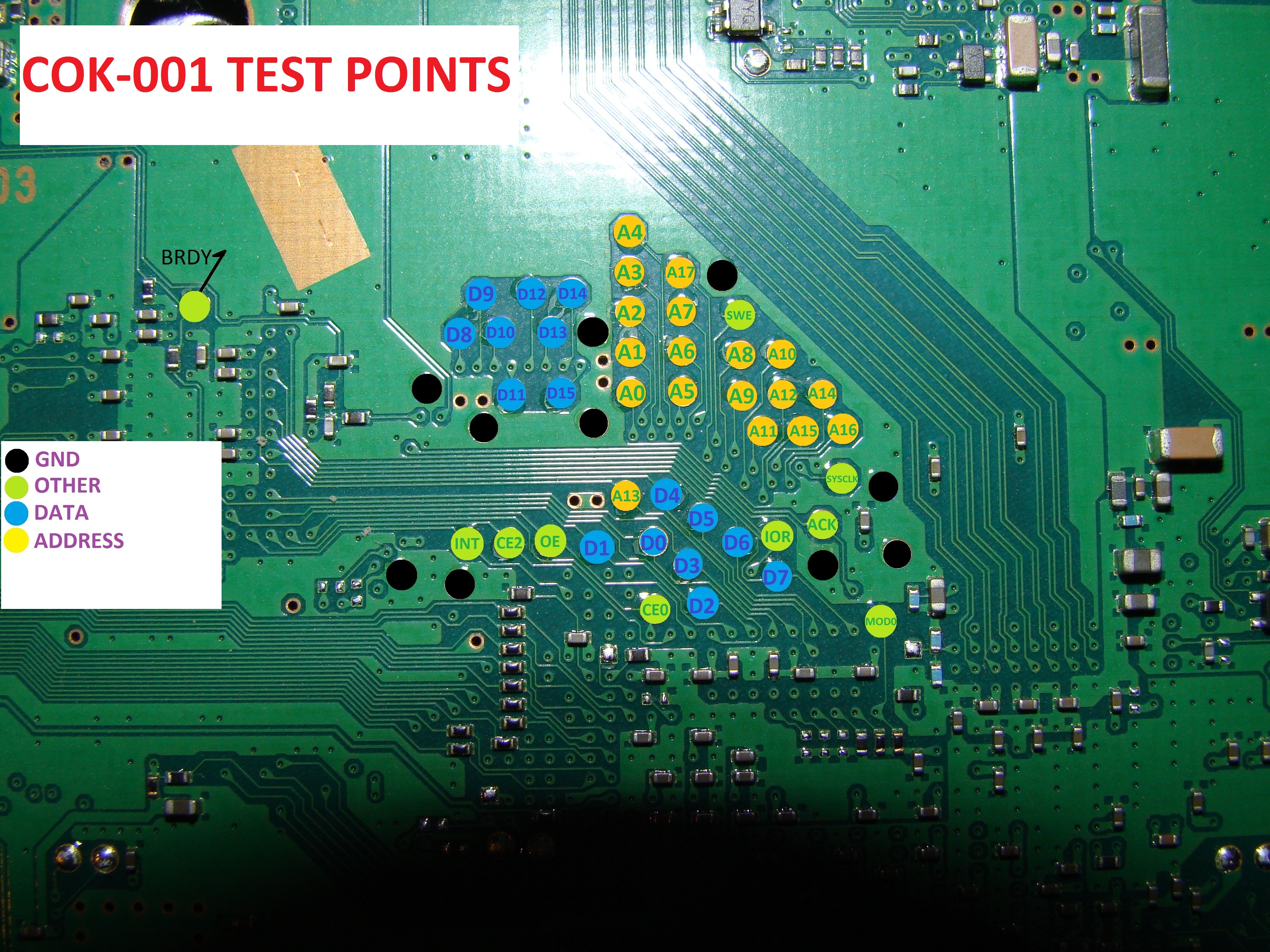
Update on a previous experiment -- after much digging around psdevwiki, I found the documentation on where the tristate can be set on a nand board (surprise! turns out you can) -- https://www.psdevwiki.com/ps3/Hardware_flashing#TriState_on_NAND_consoles, and here's the direct link to the image. According to the site, brdy is the tristate point
File:COK-001-NOR_1.jpg


COK-001-NOR_1.jpg


Sadly, however, this did not go help me. I verified I get signal out of it (3.3v, to be exact), but tying it to ground did not disable the south bridge. I'm guessing my device is failing before it gets to this particular point in the boot process.
 
Update on a previous experiment -- after much digging around psdevwiki, I found the documentation on where the tristate can be set on a nand board (surprise! turns out you can) -- https://www.psdevwiki.com/ps3/Hardware_flashing#TriState_on_NAND_consoles, and here's the direct link to the image. According to the site, brdy is the tristate point
File:COK-001-NOR_1.jpg


Sadly, however, this did not go help me. I verified I get signal out of it (3.3v, to be exact), but tying it to ground did not disable the south bridge. I'm guessing my device is failing before it gets to this particular point in the boot process.

I think we need an older type of down grader to chime in here, (Might need to post in another section so the question doesn't get lost?). I recall when i was 1st learning to down grade with hardware this tristate trick wouldn't work with NANDs, i cant tell u the reason why not since its been so long but i can tell u i have tried these on NAND consoles in the past and it hasn't been able to get the console to boot normally either. Can confirm that with a reball on said consoles that did revive, did rule out bad flash tho simply because it booted fine with no issues. Only NOR console ive been able to use this method but since the new methods have come out now on how to down grade i dont know if theres been any developments or other means to get it to bypass the system checks b4 it fails.

I tried using DC on my cheap O-scope and like u i wasn't getting any readings to capture, the line would be flat then disappear off screen so i went back to AC to at least get some sorter results. This was tested on a working console with working NEC tokins too. I also had a look to try set my meter at 500mV and i dont have that option sadly. i either have 2, 5,10, 20 and 50mV then it skips to 0.1V and up but the further i go up the less signal i can see and capture.
 
Try all 32 tantulum's and maybe delid?
Try pressing the CELLs clamp with your finger using your body weight. Then see if the console boots and plays fine. Ask for help to test that. I have the same problemwith the same model. Sony's enginner fu%&ed good on this one, since those heatsinks attach like glue with the IHS, so what you need is a rework. I tried to fix it with a reflow without sucess. BGAs are really deformed I guess..
Yep, the artifacts respond directly to me pressing on top of the blu-ray drive, which is pressing down on the board. So i guess that means the guy before me just ripped the heatsink of the board.
When you did the reflow, did you try bumping the chips to make sure they were loose? I think i'll try reflowing it myself, when i buy a reflow station.
Also, i'd like to clarify that it goes back to normal if i let the system cool off, i get the artifacts every time after 3-5 minutes.
 
Hiya All, hey-hey success!! :triumphant:

Finally!! ...so after trying many combinations of Tantalums (as you guys know) i was still getting ylod, so i decided (like a few others here) to try with some new NEC/Tokins (0E128) that i got from China. They seemed "new" looking ;) ...and they all measured slightly above their 1200uF ratings.
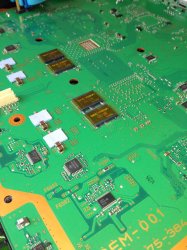
1st, i tried with nothing but 4 x NECs to see (2 x NECs for CELL and 2 x NECs for RSX) that gave ylod.

2nd, i tired with all 8 x NECs = success!!

Now the PS3 has been running great, been testing games, all seems good so far.

I want to experiment and take the 'new' NECs off again, as i have an idea for a working Tantalum solution i wanna try. I already did some tests and it also worked, but it needs re-working before i can post some results here, all being well soon.

Here are the photos, (both sides are the same with "new" NECs, soz i didn't take the other board side photo, i had already put the PS3 back together before i tested it), i also wrapped the NECs in some kapton tape with the aim to remove them again (at a later date) with a little more ease.

PS3_New_NEC-Tokins_1.JPG

PS3_New_NEC-Tokins_2.JPG
 
Last edited:
Back
Top