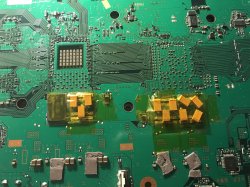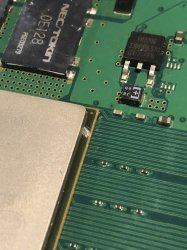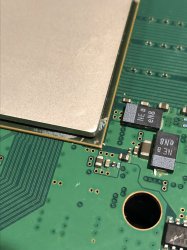
PS3 (Research/Experimental) - NEC/TOKIN Capacitors Replacement - YLOD

Sorry for not reading all the pages in this thread and possibly asking a question that has already beeing answered.

I have a CECHA that is working ok except for loud fan noise, since I'm going to delid and apply new thermal paste I figured I would already change the nec caps.

I can't find 270uF, 2.5v, 6mOhm Tantalum capacitors here in my country but I can find the 470uF ones described in the first post of this thread.

So a few quick questions:

1. Keep or remove the original NEC?
Removing all requires the bridge to be done with thick wire.
Leave all NEC in place and solder in parallel?

2. Is the 470uF tantalum caps not a good choice anymore for the CECHA model?

3. If I remove 3 from each side, I don't need to bridge the positive poles, right?
 
So the BGA will just fail eventually and there's no way to stop it? That's kind of discouraging, lol. I'm trying to find 18 awg wire in my area for the bridging since I replaced the NEC tokins on the underside next to the RSX, I don't have high hopes so I'll probably be back. I've seen a lot of people saying that you should always delid, is that true? Thanks

Where did you get that "BGA will eventually fail"? BGA problem is a myth at this point.
 
And the BGA can and will still fail eventually!

That's just wrong, BGA will not "fail eventually". There is a number of chips with bad BGA and it MAY break, IF the temperature is constantly above 75c on the RSX, that's why you should always de-lid and keep the console as cool as possible.
 
Hello everyone, I just did the cap replacement but still got the YLOD on my PS3. When I check the caps for short it all was shorted to ground. Then I desoldered all the tantulum caps I soldered and figured that every single NEC caps and small caps going forward to the chips are shorted to ground. The Vin and Ground pins on each chip is shorted to ground and cannot find the source of the short. Does anyone have a clue of what may be causing the short?
5BCB0346-939C-4CA0-8896-E4FC065603F7.jpeg
 
Where did you get that "BGA will eventually fail"? BGA problem is a myth at this point.
Good on you for questioning! Don't take it from me, a hobbyist. You should seek credible information from better sources than random dudes on the internet. So, here's a good paper on the subject by Reza Ghaffarian, Ph.D. at Jet Propulsion Laboratory. This is a rather dry technical video on one computer simulation method. Those were helpful to me when I was trying to figure out why everyone initially assumed it was the BGA instead of looking into other causes, such as the Decoupling capacitors. I now believe the reason is because BGA fatigue is so a common failure mode in the electronics industry that is just where they start looking first. It's confirmation bias. Overheating leads to a failure, it must be the BGA. "It's always the BGA." Only it's not always the BGA. It's just very common.

This is a known engineering failure and it can be predicted down to the number of thermal cycles on average it will take given a specific temperature range. I don't feel like boring you with the physics and talking about the coefficient of thermal expansion for different materials and delta T's, but suffice it to say that Engineers model and simulate these thermal stresses routinely and there's noting controversial about the physics. In fact it's my opinion that the electronics industry now engineers consumer electronics to fail as part of a planed obsolescence marketing strategy. It's not like they put C4 in there in a timer. They don't need to. They know how many thermal cycles it'll last. They engineered it that way! If they didn't, then SONY should hire me! I'll make their profits shoot through the roof...lol!

...There is a number of chips with bad BGA and it MAY break, IF the temperature is constantly above 75c on the RSX, that's why you should always de-lid and keep the console as cool as possible.
I get where you're coming from. Your heart's in the right place, but it is literally true. Eventually the BGA will fracture due to thermal fatigue. You are right that lowering the Delta T will increase the number of thermal cycles until failure, but it will never be infinite. You can reball the motherboard side, but can't reball the die. When the BGA in the Flip-Chip fatigues, it's game over! Hopefully that'll be a long time from now. Like you say, if you delid to bring the temps down and jailbreak to install custom fan controls then it'll last much longer than it otherwise would. Less heat means less stress. That's pretty obvious.

Hello everyone, I just did the cap replacement but still got the YLOD on my PS3. When I check the caps for short it all was shorted to ground. Then I desoldered all the tantulum caps I soldered and figured that every single NEC caps and small caps going forward to the chips are shorted to ground. The Vin and Ground pins on each chip is shorted to ground and cannot find the source of the short. Does anyone have a clue of what may be causing the short?
View attachment 28183
Ignore the buzz, read the ohms. Set your multimeter to resistance and if it reads <0.5Ω, you have a short. If you used the continuity buzzer on your multimeter it will read a short for these caps. That's because the normal resistance you should get between +/GND is 2.5Ω -3.5Ω (based on my measurements). I initially thought my work was shorting, but that's because I used the continuity buzzer. Multimeters read a resistance that low as a short and buzz, in this case it's completely normal.
 
I successfully got the RSX IHS off, I'll be getting the tool needed to delid the CELL and the 18 awg wire to bridge my tantalums that I put on the back side of the mobo under the RSX. I have a YLOD that takes about 2 seconds to appear after startup, so I'm hoping all this stuff I'm doing fixes it. I have a question about the deliding. How do I go about reattaching the IHS after I've carved all the glue off the RSX and CELL chips? From what I understand the only thing you do after a delid is put some new thermal paste on the chip in the middle and the 4 other chips on the RSX. Is that really all that's holding it in place? Thanks. I haven't actually gotten the glue off yet, lol
 
@veggav don't touch the NECs until you get a proper delayed YLOD. Beware with the delidding, you could kill that A.

@YLODslave funny name haha. Delayed YLOD means NECs problems, so before doing the delid, fix that and make sure the console boots up. After removing the IHS' you just can attach them to the heatsinks with good thermal paste, then you won't need to removed them every time you open the console. And like I said to the other user, beware with the delid on CELL.

P/S: watch NSC videos for that matter.
 
Last edited:
That's just wrong, BGA will not "fail eventually". There is a number of chips with bad BGA and it MAY break, IF the temperature is constantly above 75c on the RSX, that's why you should always de-lid and keep the console as cool as possible.
They can break even when de-attaching the heatsink. Those are 14 years old pretty awful bgas, so there's no point in saying YOU WILL have no problems with the bga in the future. The anormal thing would be not having bga issues at all.

And BTW @RIP-Felix the bgas on CELL can produce freezing and glitches on screen too. You better use the pressure trick before going with the reflow.
 
Working with an IR preheater or hot air to preheat the area will limit bad welds.

To answer your question, the smaller the capacitance the easier it is to find sufficiently low ESR caps. Low ESR is important for better efficiency and heat performance. 3.5mm caps don't require removing solder mask or soldering at an angle, but you can't find them above 330uF or perhaps 470uF. Also, ESR follows the Parallel Resistance Equation only for capacitors of equal value.

NEC/TOIKINs for example:
= 1 / [(1/R)+(1/R)...]
= 1 / [(1/1.5mΩ)+(1/1.5mΩ)...]
= 1/(4/1.5mΩ)
= 4800uF 0.375mΩ

So for example an equivalent ESR using 270uF 6mΩ ESR would be:
= 1/(18/6mΩ)
= 4860uF 0.333mΩ

You can't use the Parallel Resistance Equation like this unless you use identical caps. ESR can be calculated for dissimilar caps, but it gets more complicated. It's not just easier to use the same capacitors, but they will perform the same and last the same amount of time (on average).
Ok thanks
 
Ignore the buzz, read the ohms. Set your multimeter to resistance and if it reads <0.5Ω, you have a short. If you used the continuity buzzer on your multimeter it will read a short for these caps. That's because the normal resistance you should get between +/GND is 2.5Ω -3.5Ω (based on my measurements). I initially thought my work was shorting, but that's because I used the continuity buzzer. Multimeters read a resistance that low as a short and buzz, in this case it's completely normal.
So I checked it again today and you're right, between the +\GND rails there is 3.0Ω of resistance. So I continued with replacing the Tokins and so far I replaced 3 Tokins (2 on RSX and 1 on Cell side) and still I get immidiate YLOD, there is not even a second of a delay.

Then I thought that some repair shop might've tried to reball the chips and screwed the job but the surroundings of the chips look pretty clean and the BGA looks good when I look at it at an angle. It looks like I am the first person to tinker with the machine

I am in a loss at this point on what could be the problem.

image.jpg
Ps. I am aware that the right most recap job is not good but they are not shorting eachother (3Ω resistance is present on the rails)
 
So I checked it again today and you're right, between the +\GND rails there is 3.0Ω of resistance. So I continued with replacing the Tokins and so far I replaced 3 Tokins (2 on RSX and 1 on Cell side) and still I get immidiate YLOD, there is not even a second of a delay.

Then I thought that some repair shop might've tried to reball the chips and screwed the job but the surroundings of the chips look pretty clean and the BGA looks good when I look at it at an angle. It looks like I am the first person to tinker with the machine

I am in a loss at this point on what could be the problem.

View attachment 28193
Ps. I am aware that the right most recap job is not good but they are not shorting eachother (3Ω resistance is present on the rails)
Those caps look like just like the 470µF 6.3v 65mΩ KEMET caps I originally bought to try this. They didn't work for me and I thought this "fix" was all hype. I revisited it this summer after another user on SHUMPS forum inspired me to get smart about the capacitors I chose and use low ESR caps. First I tried 330µF 2.5v 9mΩ ESR. They did work, but required 24x (7920µF) to achieve the same ESR (0.375mΩ) as the NEC/TOKINs they replaced (per chip, RSX/CPU). 18x 270µF caps (I would link, but the spam filter prevents me) beat the ESR (0.333mΩ), but match the Capacitance of the NEC/TOKINS they replace (4860µF). Spec-for-Spec they should be a closer match to the original design (if that matters, which it might even if it doesn't "appear" to). I just think it's better to replace with the closest match as possible.

EDIT:
Looking at your work, I'll bet you have cold solder joint. Also, you missed at least one of +rail strips from the NEC/TOKIN. Cleaning that up will help you get a better contact. Be sure to use Hot air and flux to get a properly wetted joint. That really made the difference for me. Otherwise, try different caps.
 
Last edited:
Sorry for not reading all the pages in this thread and possibly asking a question that has already beeing answered.

I have a CECHA that is working ok except for loud fan noise, since I'm going to delid and apply new thermal paste I figured I would already change the nec caps.

I can't find 270uF, 2.5v, 6mOhm Tantalum capacitors here in my country but I can find the 470uF ones described in the first post of this thread.

So a few quick questions:

1. Keep or remove the original NEC?
Removing all requires the bridge to be done with thick wire.
Leave all NEC in place and solder in parallel?

2. Is the 470uF tantalum caps not a good choice anymore for the CECHA model?

3. If I remove 3 from each side, I don't need to bridge the positive poles, right?
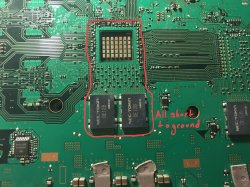
1) CECHA's CPU runs hotter than the RSX. So most likely the CPU is overheating. A loud fan noise is a sure sign of future overheating shutdowns and eventually a YLOD. SONY prioritized acoustics over thermals. That means your CPU must be like 75-85C for the fan to be so loud! At that temp, something is bound to fail. Your CPU needs a delid and new thermal paste! Make a tool and do so carefully! As mentioned before NSC videos will help you.
eGXWbUm.jpg

Please note that the tip of the nail file is thin. I ground mine down to 0.4mm, but it probably should be even thiner. This is very important, or it wont fit! The delid is all you need to do. If you don't delid then the excess heat will hasten the failure of the NEC/TOKIN proadilizers causing a YLOD. It could also cause BGA fracture that requires a reball to fix, although that does seem to be less likely from the "anecdotal" evidence gathered by members of the forums and others. In my case, 2 hard YLOD consoles were revived by the cap replacement, even though I botched the first one while learning what I was doing.

2) IMO, 270uF 2.5v 6mΩ ESR caps are the perfect choice for COK-001 motherboards (CECHA01). However, it doesn't sound to me like you need to replace the NEC/TOKINs yet. My advice is to not fix what ain't broke. The thermal paste is your priority!

3) Start with 1 on each the CPU & RSX. Clean, assemble, test. I only needed to remove 1 to restore function to my hard YLOD CECHA01. The other 3 are providing a very solid + rail bridge that I trust can handle the current. I wouldn't trust forcing all the current through just 1 or 2 of the NEC/TOKINs. Two would probably be finel, but it' a good Idea to add bridge wires and you loose nothing by doing so (just be sure the bridges can't short to GND).
37Ts10z.jpg

clip_image004.jpg
 
I cannot for the life of me delid the cell. I'm really afraid I'm gonna scratch it so I'm just going to replace the paste on the RSX and test now that my positive rails on the nec tokins I replaced on the back are bridged. Hopefully it works, I had a slightly delayed YLOD before.
 
4F415C14-C481-4829-8D14-035D30E3507B.jpeg B0041733-80DF-4F41-B940-E9AC77BBCEEF.jpeg
Did you make the special tool? The trick is grinding down the thinness of the metal so that it can fit underneath the edge of the IHS. Watch "NSC Modz" videos on youtube. He has a good tutorial that will explain everything you need to know.

I've just watched his video, looks like a great idea. In my attempt to delid I scratched the chip a bit around the borders, but I think I may be ok after comparing the locations of the scratches to images of the chip without the IHS. I remember reading that there are non visible traces under the surface, so I'm afraid I fucked up. I got hasty when the tool arrived that I had bought, and should have researched more before trying something so dangerous.
 
Yeah, if it were just some white scratch marks I'd have said it's probably just solder mask. But I can see copper! Some of those scratches look like they may very well have annihilated the traces. :confusion:

May as well practice getting it off. Replace the thermal paste, reassemble and hope for the best. Oh, and don't feel too bad, I borked my first board too. Learning curves!
 
Every mod or repair I do I break the original then succeed on my second try. Kinda wish this one had worked out though, the other stuff I've done is way easier than this
 
Back
Top