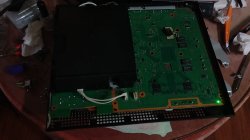
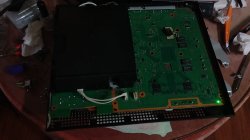
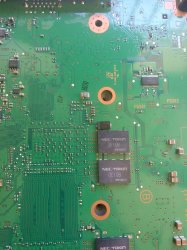
HDMI port isn't the problem imo, it's the same if is soldered or not, a PS3 that doesn't boot has a more important problem than just an output port, also you should get video via A/V otherwise. If the CELL isn't booting, as I think it is, then you most likely have bga issues, I never heard of a "fried" CELL, maybe broken die (instant ylod), 'cause the CELL is pretty strong in terms of temperatures.
A PS3 with bga problems could do something like this, or give you glod.
But since I suspect the CELL isn't running (you can touch it if it is getting warm or not during boot), most probably the problem is there.
That's kind of what I'm thinking too. I live in Naperville, IL and Best Inc. is right by me (solder.net) and they provide almost any motherboard repair. I'm hoping it's just a BGA reball repair on the cell. Since they are a very credible company, I might just have them replace the RSX as well with a brand new old stock from China. I'm just hoping the cell is okay. I collect consoles and I'd rather use my fat PS3 to play PS1-PS3 vs opening my brand new PS1 and PS2 but can't do that without guaranteed working COK-001 board. I have another board (YLOD) that I swapped capacitors but the board warped about 0.5mm so I'm guessing that might be harder for a repair company to overcome, especially since the warpage is dead center.
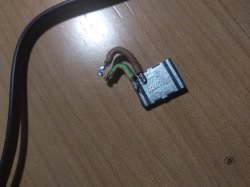
Yes, i must admit that mobo treatment seems very bad but before reassembling the ps3 i cleaned it and put new thermal paste. But the fact is that, assuming the old defective nec tokins on the mobo doesn't go sometimes shorting the circut, if they lose capacitance respect to nominal value the extra capacitance caming from 4 added nec tokin (2 x face on the piece of board) is more than sufficient to compensate. The only problem could be only about extra current at startup. The advantage is that there is no risk damaging your motherboard trying to remove the nec tokins and if you don't have nec tokin you can choose to add 9 x470uf=4200uf tantalum on that piece of board without touching the mobo. So i think this fix for the retarded ylod or retarded rlod is enough reliable and durable
Open question for the group. Say you purchase a brand new in box PS3 day 1 console. What mods would you do the minute you open it to have the console not fail with any of the LODs?
...if they lose capacitance respect to nominal value the extra capacitance caming from 4 added nec tokin (2 x face on the piece of board) is more than sufficient to compensate. The only problem could be only about extra current at startup. The advantage is that there is no risk damaging your motherboard trying to remove the nec tokins and if you don't have nec tokin you can choose to add 9 x470uf=4200uf tantalum on that piece of board without touching the mobo. So i think this fix for the retarded ylod or retarded rlod is enough reliable and durable
Just an FYI, the socially acceptable term is "long" or "delayed" YLOD. In the US anyway, "retarded" has lost it's "slow" definition and taken on a derogatory meaning. Unless your purpose is to trigger people, I would avoid using it.
I like your "farkinstein monster", a parasitic daughter board for the Caps. One of the biggest problems when evaluating a fix is knowing if the "fix" was due to the caps and or a BGA reconnection. This is an intriguing solution for testing different caps without warping the board. However, I wouldn't consider it a long term solution without further testing/engineering.
You need to use sufficiently large conductors, or multiple, to avoid overheating them. What gauge did you use?
The motherboard has a large copper ground plane that sinks heat and prevents it from building up. The daughter board doesn't have any kind of cooling solution. The caps need to be kept under 105C. Perhaps it won't heat up as much, since it's not connected to other hot running components, like the CPU and RSX, but the inductance of the caps and daughter board itself will heat up with all that current running through. How much? IDK. Maybe it's not enough to matter, maybe it'll decrease reliability. It would need a heat analysis if you intend to use this for more than just testing.
I would remove all the NEC/TOKINs before doing this. You may have heard that capacitance doesn't matter - that you can increase capacitance without ill effect. In this case, that's not true. 4800uF determines the resonant frequency of the RLC filter, thus the frequency and bandwidth of noise it'll most efficiently decouple. The noise is fixed, determined by the switching DC/DC VRM. Using more capacitance, like you've done, decreases the filter's efficacy. It'll work, but it'll let more noise through. Clean power is very important. It may work with "dirty power," but everything will work harder and die sooner. So reliability will suffer.
Open question for the group. Say you purchase a brand new in box PS3 day 1 console. What mods would you do the minute you open it to have the console not fail with any of the LODs?
Delid CPU/RSX and replace TIC with something good/new. I like MX-4. Repeat every 5 years or as soon as you hear the fan ramping up to a loud level.
Keep the console vertical. It has better thermal performance in this position than when mounted horizontally. In my testing I got about 3-4C cooler just by mounting vertically.
Buy another working console and store it (or buy 2 or 3 or 5)! When the YLOD rears it's ugly head, dig out the replacement console, do #1 again and enjoy. Repeat until you run out of working consoles or die.
Optional:
Jailbreak and install webMAN MOD so you can use custom fan control and not SONY's sound prioritized hellfire profile (SYSCON). If you want to use it stock and get onto PSN without worry of getting banned, you can install a potentiometer on the fan to increase it's speed.
There are other mods, like cutting a hole in the bottom shell near the fan, so it deaws cool air direcly in. The RSX and CPU will run much cooler. However, this does mess with the airflow design. One drawback is that it prevents suction that draws air over the RF shielding and through the PSU, potentially causing local hotspots that weren't there before. You can add a fan over the PSU to mitigate this and that combos really cuts down on heat, but it's hard to know if there are any other hot spots generated. Because of this I would not recommend modifying the console shell.
Instead of the above, or perhaps in addition to, there are 3rd party fans that plug into the front USB ports and force cool air into the front of the console.
Open question for the group. Say you purchase a brand new in box PS3 day 1 console. What mods would you do the minute you open it to have the console not fail with any of the LODs?
that is off-topic. it is related but it is best in its own thread. this thread is about repair. any discussion about prevention should be in a new thread.
Hello, first timer here... Im working on a CECHK 01 fat ps3... i have a friend whos very handy with the soldering iron and a very steady hand..
Did the nec/tokin replacement on the side of the RSX chip on the face of the board where u cant see the RSX chip... did both caps on that side....
Yes there are 8 nec/tokin caps and i only replaced 2.
And im afraid to go even further because most of the post talks about the CECH_ models but not the K models....
After replacing the 2 mentioned caps the YLOD still exist...
Im really asking for your help since this PS3 got me through my depression because of the GT5 prologue game i played countles hours in... very big emotional and sentimental value for this particular console...
Just an FYI, the socially acceptable term is "long" or "delayed" YLOD. In the US anyway, "retarded" has lost it's "slow" definition and taken on a derogatory meaning. Unless your purpose is to trigger people, I would avoid using it.
I like your "farkinstein monster", a parasitic daughter board for the Caps. One of the biggest problems when evaluating a fix is knowing if the "fix" was due to the caps and or a BGA reconnection. This is an intriguing solution for testing different caps without warping the board. However, I wouldn't consider it a long term solution without further testing/engineering.
You need to use sufficiently large conductors, or multiple, to avoid overheating them. What gauge did you use?
The motherboard has a large copper ground plane that sinks heat and prevents it from building up. The daughter board doesn't have any kind of cooling solution. The caps need to be kept under 105C. Perhaps it won't heat up as much, since it's not connected to other hot running components, like the CPU and RSX, but the inductance of the caps and daughter board itself will heat up with all that current running through. How much? IDK. Maybe it's not enough to matter, maybe it'll decrease reliability. It would need a heat analysis if you intend to use this for more than just testing.
I would remove all the NEC/TOKINs before doing this. You may have heard that capacitance doesn't matter - that you can increase capacitance without ill effect. In this case, that's not true. 4800uF determines the resonant frequency of the RLC filter, thus the frequency and bandwidth of noise it'll most efficiently decouple. The noise is fixed, determined by the switching DC/DC VRM. Using more capacitance, like you've done, decreases the filter's efficacy. It'll work, but it'll let more noise through. Clean power is very important. It may work with "dirty power," but everything will work harder and die sooner. So reliability will suffer.
Ok, first i used sufficiently large conductors only for reducing parasite resistance, i don't think i need multiple wires. the gauge problem is related to the fact that if i remove all nec tokins on the motherboard i need a thick wire to bridge the source positive with the rsx(or cell) positive but that is not the case because i left the old nec tokins on the motherboard( better let at least one on rsx side and one on the cell side for bridging purpose avoid conductors overheating and isolant melting and avoid working on the motherboard directly). Second my was an experimental work, i supposed it will work and it worked, so i don't think there are resonance bad effect or too much noise added because now i have my ps3 working since a week and i played too without problems, if there were resonance or ripple problems it wouldn't have worked since the first reboot. I think the extra capacitance with 4 nec tokins or 9 x 470 tantalus on the piece of board that double the nominal capacitance on the rsx side is a posittive stabilization factor for the ripple, i tried only on the rsx side and no extracurrent problem at startup don't know about the cell side but i don't needed a cell side fix. Last thing it only works for delayed rlod or ylod, i don't think it will ever work on istant ylod or glod you need a reball or good reflow
Hehe, remember my first introductory post in this thread?
Well as a matter of fact I did
And as @RIP-Felix says, the least we can do is state the model (In this case L)
The symptom (delayed! 5+ second long YLOD)
And the time it's been working (in my case over a month now. Playing all kinds of games, including demanding ones regularly)
It was indeed capacitors. I never said the capacitor fix itself is bullshit. I said the original post full of bullshit. And it still is.
These consoles don't have the 90nm RSX. So it is actually is common to get capacitors fail first. And get delayed YLOD, which we may be conjecturing it is indicator for this fault.
Now... From there to claiming 90% YLOD is because of NECs... It's where most of the bullshit is.
I've had 8 older consoles with problems, (C models) and in 0 it is the capacitors.
Granted, none had this 5+ second long YLOD (Normally 2or3 sec). I'd be curious to find a backwards compatible ps3 with one of these delayed YLODs and I would be happy to see them actually fixed (and running for long).
But so far... I think it's fair to say this long YLOD symptom itself is rare in BC consoles. And we are just hypothesizing that this is a good indicator of the capacitor fault. Which honestly it might as well be true. But I wouldn't know.
If it is, what I did is an easy diagnosis (For this simple lack-of-capacitance fault). Just put an additional capacitor in parallel (I'd bet the requirements aren't even strict). No need to damage anything or do super crazy frankenstein crap. (But I did too at first hehe, even if not as crazy as friend @fark)
Mostly because Ideally you'd want to close the darn thing afterwards if it's actually working hahaha. Mine's been running like that for over a month. Just with 1 330uf 2.5v aluminum polymer (Yes, also borrowed from another ps3) All good until it fails.
See pictures of my crazybutnotsocrazy alternative for diagnosis. Which worked for me.
Hi..what is the enough capacitance of each NEC OE128 to prevent ylod?
i mean how much is the minimum required capacitance of each NEC OE128 for booting console?
Hello, first timer here... Im working on a CECHK 01 fat ps3... i have a friend whos very handy with the soldering iron and a very steady hand..
Did the nec/tokin replacement on the side of the RSX chip on the face of the board where u cant see the RSX chip... did both caps on that side....
Yes there are 8 nec/tokin caps and i only replaced 2.
And im afraid to go even further because most of the post talks about the CECH_ models but not the K models....
After replacing the 2 mentioned caps the YLOD still exist...
Im really asking for your help since this PS3 got me through my depression because of the GT5 prologue game i played countles hours in... very big emotional and sentimental value for this particular console...
But... I would understand if you find that "guide" to be more trouble than it is worth. Still, if you want to give the most adequate treatment to your board, then yes that would probably be the best step to take.
Now also first of all, It also costs nothing to see how long exactly is the YLOD. Or it was initially.
There's an ongoing discussion as to how much this matters or not, but a long (5s+) YLOd may indicate a higher chance of capacitors being indeed the simple problem.
Also since it's your console, maybe helps to remember how it failed, or when was last working.
In any case if you say you started removing tokins, then you'll have to go forward with that and replace them adequately.
The method you used for removing the tokins is also relevant. Hot air will make troubleshooting more difficult, if maybe make the job appear easier. I'd recommend only using mechanical means, like the knife but with patience so as not to slip and knock some smd away. Scratching the big planes shouldn't be a problem.
So I hope you have some directions now. I'm no proper technician and I don't know your console, but I would say your K model should at least have a chance of being fixed with the capacitors.
Hehe, remember my first introductory post in this thread?
Well as a matter of fact I did
And as @RIP-Felix says, the least we can do is state the model (In this case L)
The symptom (delayed! 5+ second long YLOD)
And the time it's been working (in my case over a month now. Playing all kinds of games, including demanding ones regularly)
It was indeed capacitors. I never said the capacitor fix itself is bullshit. I said the original post full of bullshit. And it still is.
These consoles don't have the 90nm RSX. So it is actually is common to get capacitors fail first. And get delayed YLOD, which we may be conjecturing it is indicator for this fault.
Now... From there to claiming 90% YLOD is because of NECs... It's where most of the bullshit is.
I've had 8 older consoles with problems, (C models) and in 0 it is the capacitors.
Granted, none had this 5+ second long YLOD (Normally 2or3 sec). I'd be curious to find a backwards compatible ps3 with one of these delayed YLODs and I would be happy to see them actually fixed (and running for long).
But so far... I think it's fair to say this long YLOD symptom itself is rare in BC consoles. And we are just hypothesizing that this is a good indicator of the capacitor fault. Which honestly it might as well be true. But I wouldn't know.
If it is, what I did is an easy diagnosis (For this simple lack-of-capacitance fault). Just put an additional capacitor in parallel (I'd bet the requirements aren't even strict). No need to damage anything or do super crazy frankenstein crap. (But I did too at first hehe, even if not as crazy as friend @fark)
Mostly because Ideally you'd want to close the darn thing afterwards if it's actually working hahaha. Mine's been running like that for over a month. Just with 1 330uf 2.5v aluminum polymer (Yes, also borrowed from another ps3) All good until it fails.
See pictures of my crazybutnotsocrazy alternative for diagnosis. Which worked for me.
Oh, didn't know you used an OG NEC too haha, it was bought from China or took from another console? Doing something like that it's even better than replacing a couple of NECs just because you think which is the fault, is smarter too. I might do the same from now on, but using tantalums only
Indeed, Ks, Ls and so on, are cooler consoles, so NECs suffer less than older models, but that doesn't mean NECs will last long, nope, it will be slighty better on later models, just that. A very long YLOD like yours it's rare on BCs, and that's due the power both RSX/CELL need on boot (always imo btw). So in later models RSX needs less current to run than in older models, plus is cooler, the whole mobo is cooler and the NECs are cooler too, this could explain the long YLOD, but those are my thoughts only.
I revived only two BCs, an A and C, I ran out of tantalums for the rest, but I can say that most of the ones I have, have other problems, most of them due people screwing around with them, and it's true, you have plenty of issues with these consoles, and almost all of them will result in a YLOD.
Percentages are opinions/experiences, about mine, NECs are responsible of screwing millions of units, most of them due making believe people that the problem was in the bgas, not on the caps, there for people took a heatgun or whatever they had and made they own reflow, doing what you all know, so there's no surprise that most of the consoles I bought are fu%$# up, and that's a shame, really. I'll see what I can do when I have enough tantalums and a proper rework machine, until then, they are in a coffin.
About tantalums, you always will need them, and a good tool for a delid, sadly.
Lastly, a delayed YLOD is most of the time "short", not long, so you have to hear good. Put your ears next to the cooler's rack and compare with a instant YLOD, cooler spins a little more if the console has a caps issue. And also see the green light, "look for the light" Well, at least it works for me ^^
Oh, didn't know you used an OG NEC too haha, it was bought from China or took from another console? Doing something like that it's even better than replacing a couple of NECs just because you think which is the fault, is smarter too. I might do the same from now on, but using tantalums only
Indeed, Ks, Ls and so on, are cooler consoles, so NECs suffer less than older models, but that doesn't mean NECs will last long, nope, it will be slighty better on later models, just that. A very long YLOD like yours it's rare on BCs, and that's due the power both RSX/CELL need on boot (always imo btw). So in later models RSX needs less current to run than in older models, plus is cooler, the whole mobo is cooler and the NECs are cooler too, this could explain the long YLOD, but those are my thoughts only.
I revived only two BCs, an A and C, I ran out of tantalums for the rest, but I can say that most of the ones I have, have other problems, most of them due people screwing around with them, and it's true, you have plenty of issues with these consoles, and almost all of them will result in a YLOD.
Percentages are opinions/experiences, about mine, NECs are responsible of screwing millions of units, most of them due making believe people that the problem was in the bgas, not on the caps, there for people took a heatgun or whatever they had and made they own reflow, doing what you all know, so there's no surprise that most of the consoles I bought are fu%$# up, and that's a shame, really. I'll see what I can do when I have enough tantalums and a proper rework machine, until then, they are in a coffin.
About tantalums, you always will need them, and a good tool for a delid, sadly.
Lastly, a delayed YLOD is most of the time "short", not long, so you have to hear good. Put your ears next to the cooler's rack and compare with a instant YLOD, cooler spins a little more if the console has a caps issue. And also see the green light, "look for the light" Well, at least it works for me ^^
The extra NEC has a story of its own. But for now let's just say It was also borrowed from another funny (C model) ps3 of mine. Not chinese bought.
And yes it worked for me for this test. But remember this will only work if the fault is indeed a simple lack of capacitance. Still is very worth doing first because it's very easy and non intrusive. And if it works, then you have scientific proof that your console actually had the capacitor problem, and not other problems. Otherwise the door for myths is always open.
Because this is the saddest part. You mention for example heat, and how newer fat models are running cooler and therefore fail less... Somehow attributing the failures to heat.
In my eyes this is just another sad myth.
Not only the newer fat consoles run "hotter!" than the old ones by design... They are failing less, and more often with the now funny but easy Tokin fault.
I think I mentioned this in page 153 or something. Citing sandungas findings.
Because heat cannot be blamed for all hardware problems. Sony probably knew this when they decided to relax the fan even more with the 65 nm revisions, letting the system run happily about 10 degrees hotter and still knowing the machines would last longer than the old ones. And they were right.
This is the sad truth nobody is happy to accept (because it's sad of course).
The 90nm RSX, which is present in the fancy Backwards compatible PS3s is causing all the problems in most cases. Because of design issues. Running it cooler will only delay their eventual but still premature demise.
This wasn't even just limited to ps3s...
And of course the NECs weren't perfect either. This is another industry wide fact, but they were never the weakest link on the chain.
That's what I think, and I'd love to be convinced otherwise. But until then, this is why the only real cure I see is adapting the newer RSXs in the older boards.
And great people are onto it, so there's that.
I called it a cult for a reason, seriously not trying to be an asshole. Everyone that has showed up to this thread with the tools and experience to diagnose the issue properly has called bullshit, but it just keeps being ignored. The fix is temporary, even if it's measured in years like when people replaced Xbox 360 x-clamps with bolts and torqued the Jesus out of it.
I understand that nobody wants to think it's a BGA issue because that's not cheap or easy. I understand that nobody wants to think it's a failed GPU because that's currently unfixable. But the reality for most of these consoles is that it will be something expensive you can't do on your own or they're toast.
Hi..what is the enough capacitance of each NEC OE128 to prevent ylod?
i mean how much is the minimum required capacitance of each NEC OE128 for booting console?
If you have the energy of asking twice, (in writing) maybe you can also get to your answer after all. But maybe you (and now I) are just burying it more.
Speaking of buried there are reports of 14 year old consoles running with half of the NEC tokins missing. Which I can confirm myself.
Slightly off topic, but I've mentioned before how easy it is to nudge these consoles back to life from failed BGA connections while dicking around with the TOKINs. I opened the mail today to find a deliciously warranty sealed CECHA01 with a hilariously sensitive RSX BGA failure:
Hi..what is the enough capacitance of each NEC OE128 to prevent ylod?
i mean how much is the minimum required capacitance of each NEC OE128 for booting console?
No one knows for sure, it depends on the console model, and there is no reason to care. The amount SONY put on is the amount the console needs. As I have said multiple times in previous posts (and will again later in this post), the RLC filter is optimal "tuned" to reduce noise and maximize reliability. Just because the console can run with more or less capacitance doesn't mean it's good to do so.
...But remember this will only work if the fault is indeed a simple lack of capacitance. Still is very worth doing first because it's very easy and non intrusive. And if it works, then you have scientific proof that your console actually had the capacitor problem, and not other problems. Otherwise the door for myths is always open...
In general, the less you do the fewer the variables. The idea is to reduce experimental variables to capacitance only. I agree with you that using a parasitic daughter board, and/or a single NEC/TOKEN with just a few wires to solder, is a better way to "reduce" the variables, but it doesn't eliminate all the variables. So I wouldn't say it "proves" anything, but instead it's a good indicator that the caps may be at fault (without an Oscilloscope that would tell you right away).
Getting sciency:
"Proof" is a dirty word in science, because almost nothing can meet the requirements to be "proven." You may have a Hypothesis that explains some observation. For example, YLOD is caused by NEC/TOKINS. So you devise an experiment to get evidence. If that evidence supports only one conclusion (that the YLOD was caused by the NEC/TOKINs), then you have a valid Hypothesis. If after many repeated experiments the evidence still only supports the same conclusion can it progress to a working theory.
Say we test the tantalum fix on 10 more YLOD consoles, over multiple console models, with better controls to eliminate all the variables, and using better equipment to get more data - eg, an oscilloscope to show the ripple on bad NEC/TOKINs before, no ripple on tantalum array after, have a robust testing methodology to adequately show console stability and reliability after the fix. Then we have to address valid competing hypotheses and theories, like BGA defects. If they account for some percentage of YLODs then we can't claim the tantalum fix is a 100% fix. We'd need to investigate the % of YLOD's that can be fixed with this method, and any varibles that affect it. For argument sake, maybe only 1-5% of A & B model PS3's NEC/TOKINs cause a YLOD whereas 95-99% are other causes. Perhaps H models have a higher percentage and L models a different %. Then, how do you know what is causing your console's YLOD. Which competing theory explains it? Clearly there is alot that goes into developing a robust theory.
Right now, we're still squarely in the valid Hypothetical stage. I'd say we're in the competing theory stage, but no one has compiled the number of YLODs by model, cause, and confirmed the cause through reliable long therm stability testing. So long as valid doubt about the true cause of a console's YLOD exist, we cannot get a true picture of the percentages (tokin vs BGA defects). Also, even if you follow the same experimental method, we're still getting different results. One of the tests for a theory is if it's repeatable. So that's why I'd say we're still in the hypothetical stage.
Getting back to general science, if no competing theories arise and all evidence seems to support the same conclusion, it might become a law. Even scientific laws aren't set in stone. It only takes new evidence to readjust the prevailing thinking. Some people often equate "science" with truth, as if there is no room for conclusions to change. By contrast, others say, "it's just a theory," as if theories are easy to obtain (they should say, "it's just a Hypothesis"). The hierarchy is this:
Hypothesis (doesn't require evidence)
Theory (requires supporting evidence and repeatability. You will get the same result if you follow the same experiment.)
Law (No competing theories and all evidence supports it)
Science is a just a systematic approach to critical thinking. A "model" is an intermediary between what we think we know and the fundamental truth we're trying to understand. Science is one approach to building valid "models" of fundamental truths, but those models may change as new evidence require us to modify/abandon them. And good science will allow us to recognize when a model no longer fits the evidence and needs to be modified or replaced.
This is why we should avoid using words like "proof." The convey too much finality, when few things are ever so straightforward.
I agree with most of the rest of your post. The fan curves and design changes SONY implemented clue us into their priorities when it came to balancing reliability with "other considerations," like sound, liability, support, and profits. I haven't looked at the SYSCON fan curves for the different models, heat analysis, and reliability data either, but they certainly would dial those factors in a way that's consistent with past behavior (unless it lead to a recall). So relaxing the fan curves to reduce reliability might actually makes sense from their perspective. Sucks for us, shouldn't be legal, but we're not going to boycot. They know we'll buy what ever they s#!t out, so why fix what ain't broke.
Ok, first i used sufficiently large conductors only for reducing parasite resistance, i don't think i need multiple wires. the gauge problem is related to the fact that if i remove all nec tokins on the motherboard i need a thick wire to bridge the source positive with the rsx(or cell) positive but that is not the case because i left the old nec tokins on the motherboard( better let at least one on rsx side and one on the cell side for bridging purpose avoid conductors overheating and isolant melting and avoid working on the motherboard directly). Second my was an experimental work, i supposed it will work and it worked, so i don't think there are resonance bad effect or too much noise added because now i have my ps3 working since a week and i played too without problems, if there were resonance or ripple problems it wouldn't have worked since the first reboot. I think the extra capacitance with 4 nec tokins or 9 x 470 tantalus on the piece of board that double the nominal capacitance on the rsx side is a posittive stabilization factor for the ripple, i tried only on the rsx side and no extracurrent problem at startup don't know about the cell side but i don't needed a cell side fix. Last thing it only works for delayed rlod or ylod, i don't think it will ever work on istant ylod or glod you need a reball or good reflow
First:
That's not how it works. If they are connected correctly (in parallel), they will heat up. They'll divide the current evenly, and heat up according to the number of tokins on the parasitic daughter board. Since that board isn't connected to the motherboard (which is cooled), it'll heat up. Perhaps it's not going to be a problem, but perhaps it will. If it overheats, the caps on it will dies sooner than they would otherwise.
Second:
If there is sub-optimal capacitance (< or >4800uF), ripple increase. It may not be enough for the console to YLOD. It might cause weird problems as it interferes with the CPU/RSX signals. Or it may not be noticeable at all. It's like using those cheap noisy SNES/NES power supplies. You could get jailbars, or audio buz, or not notice anything wrong, but to put it simply, ripple is AC. Feeding AC to a DC circuit is bad for it. A console that would otherwise live for 30 years might only live 15. But yeah, it'll probably live a week and make you think you got a good deal.
Adding capacitance shouldn't have a "posittive stabilization factor for the ripple" on a RLC (Resistor - Inductor - Capacitor) circuit! The inductor introduces resonance to the equation. The capacitance determines the resonance frequency, the "sweet spot" which maximizes the decoupling effect (lowest ripple). And the resistor determines the bandwidth. For this circuit, the sweet spot is 4800uF. It's an iterative process, to arrive at the optimal balance. SONY's engineers knew what they were doing and optimized this crucial bit. The more I look into this, the more respect I have for them.
Last Thing:
I'm hesitant to buy into the "Long YLOD = Tokins" vs "Instant YLOD = Reball" hypothesis. It sounds plausible enough to become a red herring if it turns out to be untrue. Having said that, I don't want to discount the opinions of those of you that have non-BC models that have been fixed in high percentages. That certainly could indicate you're on to something. So keep going.
TO EVERYONE:
If you ever hope to convince the skeptics, you need to backup your results by fully documenting your console before/after the fix, complete with measurements & graphs. You need to show incontrovertible evidence of bad tokins. Even then, it's hard to know for sure there were no BGA defects, since they can cause all kinds of false positives.
@squeept is right (dammit!), the best method is to reball first! It eliminates BGA defects as a possibility. If the YLOD is still there, then you know the caps were at fault to begin with (for sure). Then we could get an accurate assessment of the percentage of consoles that have bad tokins, by model. Since, @squeept and other reballers do this on a regular basis, I tend to weigh their opinions more heavily. They're in a position to know WTF they're talking about. It's not anecdote, it's volume. That and he has oscilloscope measurements to back it up.
Unless you eliminate BGA defects up front, which few want to do or are capable, I'm not sure there is a reasonable way to convince stanch skeptics. Oh, and FFS people, stop saying the tantalums are an easy or cheap fix. They're not! It's called the YLOD for a reason. If it were easy to fix, it would just be called the yellow light. Those cheap tantalum caps on e-bay and ali express are junk. Buy from Mouser, Digikey, Arrow, or another reputable distributor. You're looking at $30-50 in caps, & another $50 for a good soldering station (unless you already have it). Then there is no guarantee it'll even work (in fact it probably won't if you have a BC console). So at this point you're in $70-100 with nothing to show for it. So you do have something to loose by trying! Alternatively, you can have your console reballed or buy a new working console. I got lucky and found a factory sealed A model that just had a bad laser for $89. If you watch e-bay closely for a few weeks, these deals are out there. And your chances of getting lucky like I did are probably better than this "fix" working out for you!
To you Long YLOD'ers:
Not that I particularly benefit from it, since I only care about BC models, I am cautiously optimistic that you're on to something. So carry on.
It's been awhile since I worked on this console. If you recall, I had previously installed 4860uF worth or 270uF TaPol caps (18x) on it with 6x 22AWG solid core conductors to bridge. That is, 18x cap array per chip (CPU/GPU). Oscilloscope confirms that the ripple is sufficiently decoupled (better than working tokins) for both chips. Everything was identical, except it still had a YLOD. So that signaled to me I needed a reball. And operation "reball attempt #2" (I know, the name sucks) commenced on Saturday.
It took me hours trying to get those LEADED B@ST@RDS to stay in place when trying to heat affix them to the lifted chip! I used the proper amtech BGA flux and wiped the excess off so they wouldn't squirm, but a few of them still bridged. With fine forceps, shaky hands, breath held, curse words flying off the walls like a drunken sailor, and after 2 hours, I finally managed to manually remove and affix the solder balls to the RSX. The chip was probably thoroughly fried by then, but so was I! I even forgot to ohm test it before placing on the board and flowing. That part went quick, leaded solder was much easier to flow than the led-free stuff was. However, afterwards I could see that some of the balls on one side of the chip had fused and ruined the entire day - because that's how long it took me...the entire f@%king! Grrr.....
At least I didn't tear any traces this time. So as far as I can tell the motherboard is probably fine. There is some minor warping, but I don't think I can improve that much without changing up my whole setup/procedure. Which won't happen, because after this attempt I decided reballing is to DAMED tedious and I'd rather pay some one to do it for me. @squeepts you listening?
So I went ahead, cleaned and assembled it fully. I knew it had a zero percent chance of working. So I was wasting my time when I plugged it in. I wasted my time when I reached around back and I flipped the PWR rocker to the "I" position. The red LED that illuminated was wasting my time, my finger touching the PWR sensor was a waste of time, and what inevitably happened next was also a waste of time.
I'll bet you can guess what happened next. Seriously try and guess. If you thought I was going to say:
"It fired up no problem and the YLOD was gone," you are...
wrong! Of course it didn't work! It has bridged solder balls under the chip!
"It YLOD just as expected," you are...
Paying attention. 0% chance of working means there is no hope. The empire wins, the Jedi are dead. the Sith rule the galaxy! Whatever story got it into your head that miracles happen, forget it. We don't live in that reality. No one is that lucky.
So I placed PS3#2 back in it's bubble wrap and box. It's ready to ship out! I think I'll do the same with PS3#4 (which was a sealed YLOD too). It hasn't had any work done that wasn't documented thoroughly by me on this thread. I'm considering bundling them with the parts from PS3#1 which I killed beyond repair. 3x A models with parts for someone more capable than I. @squeept you interested? PM me, we can work out the details. I'd like to get the results documented on the forum for posterity. But at this point I'm tired of killing consoles. I think #2 can be salvaged. #4 is prime candidate for a reball and #1 has most of it's parts, even though the MB is toast.
EDIT (Future me here): This was the darkest point in my reballing adventure. I nearly gave it up! There was a steep learning curve and I was learning at break neck pace while tumbling head first into every pitfall. It got easier after this.
In general, the less you do the fewer the variables. The idea is to reduce experimental variables to capacitance only. I agree with you that using a parasitic daughter board, and/or a single NEC/TOKEN with just a few wires to solder, is a better way to "reduce" the variables, but it doesn't eliminate all the variables. So I wouldn't say it "proves" anything, but instead it's a good indicator that the caps may be at fault (without an Oscilloscope that would tell you right away).
Ahh, I appreciate that you become picky when I use strong words such as "proof". After all what this whole thread was needing from the beginning was precisely this: scientific rigor.
The reason I say this is as close as it gets to a "proof" is, among other things, that by its unintrusive nature it can be undone and done again to watch the YLOD come back and disappear. Repeatably, in the same system and keeping the rest of the variables to a minimum (or 0?). Because the board is untouched, save from exposing copper in the 2 points where the additional capacitor is placed. And no hot air or otherwise exposing the board to any meaningful heat or warping. Heck, the test can even be done with no disassembling/reassembling steps in between. The PSU then sit there plugged while this operation is being done as well.
So even this skeptic (me) was convinced after repeating this test for the third time. Hehehehe. My L model (with a 5+ second long YLOD) had indeed the famous capacitor problem. I think I even took some videos of all this along the way.
@squeept is right (dammit!), the best method is to reball first! It eliminates BGA defects as a possibility. If the YLOD is still there, then you know the caps were at fault to begin with (for sure). Then we could get an accurate assessment of the percentage of consoles that have bad tokins, by model. Since, @squeept and other reballers do this on a regular basis, I tend to weigh their opinions more heavily. They're in a position to know WTF they're talking about. It's not anecdote, it's volume. That and he has oscilloscope measurements to back it up.
Unless you eliminate BGA defects up front, which few want to do or are capable, I'm not sure there is a reasonable way to convince stanch skeptics. Oh, and FFS people, stop saying the tantalums are an easy or cheap fix. They're not! It's called the YLOD for a reason. If it were easy to fix, it would just be called the yellow light.
Hehehe, this is quite the irony because now it seems I'm trying to "convince the skeptics" of the Tokin fault.
But it's not even that easy. Eliminating BGA defects doesn't leave the tokins as the last suspects, or even prime suspects I would say. I wish it was that simple. We are jumping most notably over failed GPUs and the rest of other possible odd problems that can exist. I'm not trying to be an asshole either but... I think
This movie has more than just 2 bad guys. At least it's The Bad, The Worse, and The Worst&Ugly.
So that's why The Bad (NECTokins) I consider it to be the easy of the three.
It may not be "easy" in the common sense of the word. But considering its company...
The Worse (BGA defects) you can agree it's way more difficult and out of reach of most people. But it's still fixable.
And our Ugly... it's pretty ugly. Ugly enough for people to not want to talk about it. For now let's just say it has nothing to do with Eli Wallach, sadly.
I called it a cult for a reason, seriously not trying to be an asshole. Everyone that has showed up to this thread with the tools and experience to diagnose the issue properly has called bullshit, but it just keeps being ignored. The fix is temporary, even if it's measured in years like when people replaced Xbox 360 x-clamps with bolts and torqued the Jesus out of it.
I understand that nobody wants to think it's a BGA issue because that's not cheap or easy. I understand that nobody wants to think it's a failed GPU because that's currently unfixable. But the reality for most of these consoles is that it will be something expensive you can't do on your own or they're toast.
Hey, squeept, I didn't want to bring a missunderstood like this one, maybe you people didn't catch where I was aiming to.
I didn't experience anything of what you did (speaking of the fat PS3s' era) as a technician, so I don't even want to know how many you were getting at your workshop during that time when the YLOD was starting to be something for all of us. Sure they were a lot.
You already have proved that you know what are you doing and that's what we all need, your college degree and years of experience are important too, so all the info you brought into this forum is rich.
Having said that, I must say that I'm not ignoring all of you said, actually, we all are learning something in this thread, and situations like reballing or dead RSX as conclusions are a fact that nobody is saying is a lie, or are a minimum percentage of a YLOD issue. I never said that and it's obvious that a PS3 has millions of problems apart of those two. And this is where the NECs go in action as a third possible common issue (along as CELL overheating, I'm gonna just counting it as fourth).
When I'm saying "percentages", "NECs", "experience", I'm always talking from my side, nothing more, nothing else, and this has not be taken as law or the only truth, because is not. Also, I'm not saying you or anyone else is lying about all of this.
I'm more than agree that bgas and dead RSXs are a common fault when we talk about any PS3 model, even 4xxx, so there's no point in discussing that, but imo NECs were and are a really common symptom of YLOD, since this issue is known appeared only a year after the console was released, and all of that is documentated. I think (and it's my opinion) a big percentage of these issues were NECs related, and for that many consoles were reballed with no success in a short period of time, or reflowed damaging the board, like people also did following this thread. (Also see the Toshiba post a few pages back, this whole tutorial started there with those laptops)
NECs are bad quality caps that degrade fast, when you did your tests with your PS3 (don't remember it was a working one or not) and the scope, we could see how these caps behave on normal operation and while yloding, but we can't see how old they are and how much operation time they still have. This is something we can't know, and we won't, and I think you agree that these caps will fail some day. Like some people say, they're a time bomb. So it's pretty clear for me where these consoles fail with this particular issue. I have proven myself how to detect this problem, and how to solve it, but as we all saw, this fix is not something so reliable. But, when a fat PS3 was reliable?
I have many that are yloding due NECs, a few that are already fixed and working normally, and I even have two 2xxx that were yloding due the NECs on RSX. This is only my experience, and I believe millions of PS3 suffered bga problems, another millions dead RSXs, and other millions of fats/slims, NECs problems. Sony sold more than 85 millions of PS3, btw.
P/S: One guy that is good with the scope a few months ago told me that you don't have to flash a laptop's bios directly, even if you know how to do it without problem and have the correct bin, 'cause most of the times the corrupted bios is not the main issue, and I'm talking of different issues that can be provoked by a corrupted bios: blank screen/no image, laptop not charging, not booting, only logo, etc. He said, you first have to test the bios chip using the scope (I don't know how to use it so I won't explain it), then you choose different ways, it's negligent if you don't. Even though I fixed many different problems just by flashing a bin in good state, but what I mean is that he's right, you need to do some testing first before going to touch the board, that in this example is just writing the chip, but in the PS3's case, could be the replacing the NECs by tantalums or a common RSX/CELL rework.
In my case I would do a reball only if I don't know what else to do, or discard any other fault like a dead RSX, and this is where the SYSCON method comes to play. Adding a tantalum or two to the NECs isn't more dangerous than doing a rework, right? Many things can go wrong, apart of the time you lose, but I think you Squeept know this better than me.
YLOD are not only bga problems or NECs, it's anything. These consoles can have a lot of problems and most of them will result in YLOD: like any kind of short in the mobo, a fuse that for some reason is damaged, some fried chip due electric failures in the PSU, external current or provoked for this tantalum fix, etc. Also, a broken die RSX/CELL will directly launch an instant YLOD. That's why I always see what's going on with the green light.


 but before reassembling the ps3 i cleaned it and put new thermal paste. But the fact is that, assuming the old defective nec tokins on the mobo doesn't go sometimes shorting the circut, if they lose capacitance respect to nominal value the extra capacitance caming from 4 added nec tokin (2 x face on the piece of board) is more than sufficient to compensate. The only problem could be only about extra current at startup. The advantage is that there is no risk damaging your motherboard trying to remove the nec tokins and if you don't have nec tokin you can choose to add 9 x470uf=4200uf tantalum on that piece of board without touching the mobo. So i think this fix for the retarded ylod or retarded rlod is enough reliable and durable