PS3 (Research/Experimental) - NEC/TOKIN Capacitors Replacement - YLOD

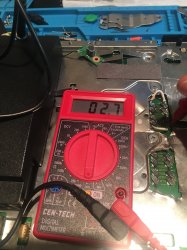
Okay, so the resistance +/GND is 0.0029 Ohms? If so that means you have a bridge. Remove the caps and start over, being extra carful not to bridge.

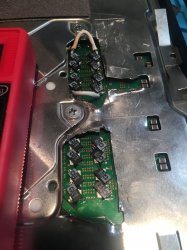
If I may make a suggestion. Try flipping the caps upside down and soldering a restor leg across the tantalum pads. Then bend the resistor legs to make contact with the rails. This reduces the amount of heat you have to dump into the motherboard and makes it MUCH EASIER to install/removed the caps. Also it's easier to prevent bridges and to make the bridge wires fit. Just a better idea all around.

Here's what I mean, only you would do it with 3x470uF instead of the 270uF I used. By the way, to anyone I would reccomend this is the way you should install the caps. This is the safest, easiest, and most reversable way...
c6232-jumper-jpg.31199

Just make sure when you put the RF shield back on that the contacts don't short to it! Electrical tape or low profile caps work.
I think he just meant 2.9 "Ohms". He mentioned his multimeter being set on the "200" ohm setting, so looks to me he just messed with the units when reading 02.9... probably on the screen of one of those generic DT830 multimeters. Which may or may not be too reliable when looking at resistances close to 1 ohm anyway. Let alone milliohms.


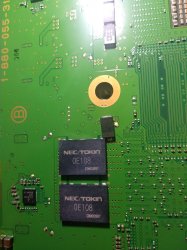
About the capacitors, yeah the original NEC Tokins were pretty high end (Sony quality, they wanted to make a machine that lasted long time)
So it's not that easy to match their performance as you already have talked about.
No surprises there. Quality capacitors are definitely needed.
I still would have thought that your B type should be good enough. Those weren't precisely bad either right?. I can't shake the feeling that maybe the resistor legs could have had some negative impact?
I wouldn't know, but normally manufacturers always try to cram as many capacitors as close as possible to the chip. After all, a fraction of a miliOhm could make a meaningful difference?

In any case I'm very sad to hear that the RSX problems came back. Hopefully it's just a broken solder ball as you say and the story can end well... But this should remind people that they should forget about finding just a tokin fault on a 90nm backwards compatible system with YLOD.

Don't beat yourself up thinking you broke the ball or whatever, that board could not have possibly gotten better treatment anyway.
I have a suspicion that these things can very much degrade while sitting there unused for years. It's not about heat either.
 
...I still would have thought that your B type should be good enough. Those weren't precisely bad either right? I can't shake the feeling that maybe the resistor legs could have had some negative impact? I wouldn't know, but normally manufacturers always try to cram as many capacitors as close as possible to the chip. After all, a fraction of a miliOhm could make a meaningful difference?
Yeah, they are top quality Panasonic caps from a reputable distributor. I even kept them sealed tight in a bag with desiccant and a moisture indicator to prevent pop-corning during installation. Definitely not dodgy.

Yes, they add a small parasitic inductance/resistance/impedance, but I doubt the resistor legs had that much of a detrimental effect. Sure at 10GHz the signal might have unacceptable signal degradation at 0.1mm, but we're concerned with signals in the KHz to Mhz range, so I would ballpark anything less than 10cm should be ok. This is getting into transmission lines a bit, and like @squeept was saying if your parasitic cap array wires are too long, then it's like they aren't even in circuit anymore. Similar idea. EDIT: actually after re-watching some EE videos and reading about the construction of the tokins again, maintaining a similarly low ESL with the replacement array is probably one of the most important parameters here. It prevents Inductance mismatch from signal source to the destination. Matching these inductance was probably the function of the inductors and RLC portion of the filter (It's tuning). The tuning was based on the ESL of the tokins and matched to the load to reduce reflection and noise. So yeah, adding a bunch of extra inductance through bridge wire and resistor legs could detune the array, in much the same way that using the wrong capacitance can. It's not like I calculated the transmission line effects, I was just assuming they wouldn't matter. However, the oscilloscope measurements of the noise don't lie. Perhaps that's evidence of an ESL mismatch due to reflection noise. The way I previously tested those caps was to directly solder them to the rails, not using resistor legs. There would be some difference in ESL, but if it has that much an effect on the outcome then we have to be super scrupulous about choosing the right caps and installation method. I really don't think it should matter that much, but it could.

Part of a possible explanation could stem from the fact that the tokins rely on transmission line characteristics to improve their frequency response curve. The layered plates inside the tokins literally are a symmetrical stripline transmission line. I'm not going into EM theory to explain what's going on, but the signal traveling down the transmission line creates electromagnetic field lines that can couple into, and be coupled into by, other components. By sandwiching the signal between GND planes they create a noise free conduit for HF signals to pass without degradation of a fairly long distance. It's how they achieve a flat impedance vs frequency curve whereas all other capacitors have a V shaped curve. They really are a great idea! The stripline efficiently propagates the signal across the capacitor without degradation and ultra low inductance. The multilayered motherboard probably employs some advanced techniques like a "coplanar waveguide" to also prevent signal loss between the switch mode regulatrors and the processor. I'll bet that explains the VIAs. They're not just thermal vias.

Remember this?
my-array-proposal-jpg.30388

That was my purposed Array on page 168:
  • 10 x 470uF 2.5V (lowest ESR TaPol cap KEMET Makes) Note: I chose 10 because it's 4700uF, as close to the tokins 4800uF as possible without going over.
  • 30 x 10uF 10V X7R MLCC
  • 36 x 0.1uF 10V X7R MLCC
My thinking there was based on the idea that Tantalum wouldn't be enough on their own. They probably wouldn't be for higher frequency noise that the NEC/TOKINs would otherwise have filtered out:
I don't think the 0.01uF/1000pF add much to the overall curve. At least not enough to justify the added complexity and expense of all the other caps...If one has to account for the Higher frequencies, then I think that it's really only practical to use 10uF in addition to the TaPol.

Does anyone have a slim model that is willing to remove one MLCC bypass capacitors near the AlPol/TaPol caps? I need to know what value capacitance they are. SONY used 22 of them to, so knowing for sure what value they are will give us insight as to what frequencies thay thought were important enough to suppress. I'm assuming 10uF, but I don't know. That was just a wild guess based my simulations.
BTW I still don't know what value those MLCC caps are. I'm assuming they're 10uF, but that's a guess. Someone with a slim would need to remove one and test it's capacitance to confirm. I solicited the SYSCON thread, so we'll see if we can finally track that answer down:
f05649b149f54971be24120e47c55904.jpg

@vyktormvmpay25 What is the value of the MLCC cap your red probe is touching?

There are no schematics and I am assuming they are 10uF. However, they are important for the higher frequency noise component that tantalum doesn't filter, but that the tokins did. There are 12 of them where you are probing, but another 10 on the CPU substrate visible through the hole in the MB. They were not present before the switch to Tantalum/Aluminum Polymer. Over on the YLOD thread I found that my array of Tantalums wasn't sufficient on their own to clear up noise I suspect was from this higher frequency component.

I'd really appreciate it if you or someone would please remove one and confirm it's capacitance.

The point is that using 10uF caps might be a good idea to remove some of the HF noise, but some or all of the HF noise might be signal reflection caused by an ESL mismatch because we're not using tokins. Maybe the ESL of the 470uF caps + PCB are closer to a tokin than my 270uF and bridge wires.
 
Last edited:
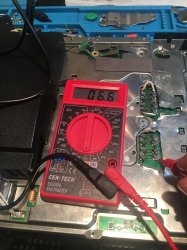
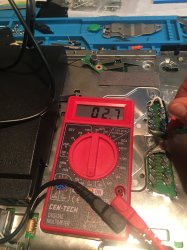
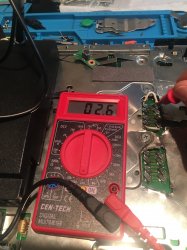
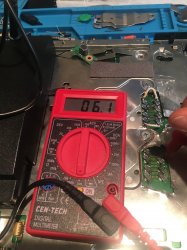
Not too sexy but what do these readings mean? I have the black prong on ground.
 

Attachments

  • 04C947A6-478E-4013-84B9-15E6216E260D.jpeg
    04C947A6-478E-4013-84B9-15E6216E260D.jpeg
    1.9 MB · Views: 100
  • 613C697F-1AF4-46DA-A07B-94F2DCCD1620.jpeg
    613C697F-1AF4-46DA-A07B-94F2DCCD1620.jpeg
    1.8 MB · Views: 667
  • 1FE6017C-2178-4F85-A42E-6AFC23D0C31F.jpeg
    1FE6017C-2178-4F85-A42E-6AFC23D0C31F.jpeg
    1.8 MB · Views: 95
  • 5A08825E-61A3-45D9-87A7-A10DE5BE4627.jpeg
    5A08825E-61A3-45D9-87A7-A10DE5BE4627.jpeg
    1.8 MB · Views: 101
  • 6369B87F-0555-4C8B-A5CE-F7A34B40D536.jpeg
    6369B87F-0555-4C8B-A5CE-F7A34B40D536.jpeg
    1.8 MB · Views: 532
  • B9FD2667-1EB4-4C9B-A7F1-31EA74A5931D.jpeg
    B9FD2667-1EB4-4C9B-A7F1-31EA74A5931D.jpeg
    1.7 MB · Views: 105
So I been reading. What's the vest gauge wire to use for bridging?
Use this chart to decide what gauge to use and how many. Use the "Maximum amps for power transmission" column. Any sustained amperage that exceeds 16A will trip a breaker, so I'd use that as the upper limit. Of course, the CPU and RSX will never see 16A sustained. They'll divide the load between each other and the PSU will loose some to inefficiency, other components will use PWR too, so the actual amperage the processors will ever see is probably less than 7A. So 4 bridge wires of 18AWG would be plenty.

Also, it's best to use the black probe on the GND rail, not clipped to ground far away. That can artificially increase resistance. In any case those resistances look okay. Just get the + rails bridged and then you should be ready for a test!
 
Here is a slim 2000 with a proper tokin fault.
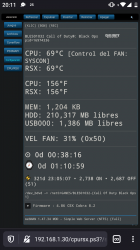
It had about 2s short YLOD; this is the 09 3004 error. But the signature 80 1002 also appered in the log.

It's working stably now in games too. Second time this works for me, so it can't be such a bad idea after all. 0 of the original tokins touched. I didn't even remove the heatsink. Original paste still on.

So guys please stop removing tokins, especially if you are not sure! Even when there is actually a confirmed tokin fault... Removing should be last step. Much less when it is not.

I had posted about it in syscon diagnosis thread but I guess it belongs here more.

Cheers, and please always talk to SYSCON first. There is no excuse for not doing so. Guides and help are available. The dongle is 2$. No need to destroy anything.
 

Attachments

  • IMG_20210306_201323.jpg
    IMG_20210306_201323.jpg
    1.3 MB · Views: 162
  • Screenshot_20210307-201115.png
    Screenshot_20210307-201115.png
    288.2 KB · Views: 154
  • IMG_20210306_175423.jpg
    IMG_20210306_175423.jpg
    5.4 MB · Views: 168
Use this chart to decide what gauge to use and how many. Use the "Maximum amps for power transmission" column. Any sustained amperage that exceeds 16A will trip a breaker, so I'd use that as the upper limit. Of course, the CPU and RSX will never see 16A sustained. They'll divide the load between each other and the PSU will loose some to inefficiency, other components will use PWR too, so the actual amperage the processors will ever see is probably less than 7A. So 4 bridge wires of 18AWG would be plenty.

Also, it's best to use the black probe on the GND rail, not clipped to ground far away. That can artificially increase resistance. In any case those resistances look okay. Just get the + rails bridged and then you should be ready for a test!
Btw, your patience is commendable.

(Your recommendation is good but btw, I thought the current going to the chips can be way higher than 16A. They are working at around 1v right?)

And also btw... Do you think the fact that I had good luck with my capacitor could have something to do with the way I solder it?
Like I mentioned, trying to place it as close as possible instead of resistor legs and so on (I ask this but remember I also tried with parasitic wires and a borrowed Tokin and it worked too. But these smd AlPoly capacitors I used aren't not even necessarily top quality also, yet the result is satisfactory)
 
Last edited:
Btw, your patience is commendable.

(Your recommendation is good but btw, I thought the current going to the chips can be way higher than 16A. They are working at around 1v right?)

And also btw... Do you think the fact that I had good luck with my capacitor could have something to do with the way I solder it?
Like I mentioned, trying to place it as close as possible instead of resistor legs and so on (I ask this but remember I also tried with parasitic wires and a borrowed Tokin and it worked too. But these smd AlPoly capacitors I used aren't not even necessarily top quality also, yet the result is satisfactory)
Can't know without an O-Scope what the before/after looks like. I suspect that you method adds so little ESL that it plays nice. AlPol caps may be a better match to mix with the AlPol Tokins too, IDK. I did try an AlPol parasite, but it didn't make much difference for me. I didn't try it like you have, so who knows.

As for current. Yes and no. Yes, the instantaneous current peaks can exceed 16A. The 380W 12V power supply of the BC models for example can supply 32A Peak. However, like I said, circuit breakers will trip if a sustained current above 15-16 amps is drawn from the wall. So what's really happening are short bursts of current, up to 32A, being delivered during peak loads that don't last very long. Not long enough to burn up the wire, or long enough to trip the breaker. The current is being delivered by the capacitors during these peaks and are charged up in the mean time. The average of the peak loads, nominal load, and minimum load can't be above 15-16 amps without tripping the breaker. What we're concerned with is the average current, not these short peaks. They would be enough to burn up the wire, if they lasted longer, but they don't. Kinda like how you can pick up a hot coal from the fire. It's clearly hot enough to burn you, but if don't hold it too long you won't get burned.
 
Revived another CECH-A01 today. This time i'm using ten 6.3v 22uF MLCC's near both the CPU and GPU. And ten 3mOhm 2.5v 470uF SP-Caps on both processors as well.

None of the systems i've repaired using only SP-Caps have failed so far, which is great. Though im curious if adding MLCC's will actually make any long term differences. Only time will tell!
 

Attachments

  • 20210308_153742.jpg
    20210308_153742.jpg
    3.2 MB · Views: 153
Revived another CECH-A01 today. This time i'm using ten 6.3v 22uF MLCC's near both the CPU and GPU. And ten 3mOhm 2.5v 470uF SP-Caps on both processors as well.

None of the systems i've repaired using only SP-Caps have failed so far, which is great. Though im curious if adding MLCC's will actually make any long term differences. Only time will tell!

Can you show a photo of the other side of you board and what is the model of the SP-Cap and MLCC you are using?
Thank you.
 
Revived another CECH-A01 today. This time i'm using ten 6.3v 22uF MLCC's near both the CPU and GPU. And ten 3mOhm 2.5v 470uF SP-Caps on both processors as well.

None of the systems i've repaired using only SP-Caps have failed so far, which is great. Though im curious if adding MLCC's will actually make any long term differences. Only time will tell!
I hope you realize that in sample sizes of hundreds, only a handful of 90nm bc systems with YLOD like yours, actually needed a capacitor job. And fewer still needed "only" a capacitor job. (They "also" had RSX problems).

So please let's make an effort on documenting this better. Especially if you think it was a success. We all want to see success

If not, people are already wanting to copy something that was probably another false positive. Which would be sad but likely.

Cheers
 
I hope you realize that in sample sizes of hundreds, only a handful of 90nm bc systems with YLOD like yours, actually needed a capacitor job. And fewer still needed "only" a capacitor job. (They "also" had RSX problems).

So please let's make an effort on documenting this better. Especially if you think it was a success. We all want to see success

If not, people are already wanting to copy something that was probably another false positive. Which would be sad but likely.

Cheers
I've posted about a couple other successes i've had a few weeks ago on here. So far my success rate is 7 out of 9 consoles. Earliest being from early February. The two i couldn't fix never got past the YLOD stage ever. If any of the "successes" fail later, i'll update you guys here. And these consoles are not being tested by only me btw, they're literally being daily driven by their original owners who wanted me to replace caps for them.
 
I've posted about a couple other successes i've had a few weeks ago on here. So far my success rate is 7 out of 9 consoles. Earliest being from early February. The two i couldn't fix never got past the YLOD stage ever. If any of the "successes" fail later, i'll update you guys here. And these consoles are not being tested by only me btw, they're literally being daily driven by their original owners who wanted me to replace caps for them.
Yes, but you have made a habit of providing successful results without documenting the problem first. It other words, "It worked for me, my A01's all work fine now!!!" At least this time you provided 1 picture and the cap details, but not what was wrong to begin with! How long of a YLOD? SYSCON errors? RSX pressure test results? Artifacting? We never get these important details in the initial post from you, only with prodding have I gotten more information from you. We can't know if the results are false positives or genuine success. As you said, you've been here since the beginning. So by now you should know why these details are important to document. Why you leave them out calls into question your motivation.
Context matters! I'm not going to call you out unfairly. This is constructive criticism, not character assassination...

As you may recall, I did an intensive review of this thread recently. Here's a bit of a history lesson. The first 20 pages or so everyone was busy with adulating posts for @Naked_Snake1995, congratulating him for 'exposing the reballing lie.' This was the at the height of the Myth and Hype for this mod. So it's no surprise that First critical post by @littlebalup (mechanical fatigue from thermal warping) was ignored. That's where you come in...

You were one of the first users on this thread to begin the mod, on page 3. You "followed [@Naked_Snake1995's] repair, and it work[ed]..." You didn't say what type of YLOD it was in that post. Neither Model nor any details about the caps used, but on page 2 (your very first post here) you said you "look forward to bringing back two chech-A01's that i thought were long gone." You provided a link to the more detailed reddit post, but it has since been deleted. End of trail for me. I assumed it was an A01. You were justifiably excited after a positive result and thanked @Naked_Snake1995 like everyone else. I don't blame you. The lack of details was annoying for me, but since that was your first post, you get a pass. However, it would be nice if you could update us now on those details, if you recall.

On page 12 you talk about an A01 that has "3 beeps on shutdown," but it's not clear if this is the same console or the second one you reffered to on page 2. It's hard to follow your consoles as they don't have any unique identifiers, like PS3#1, 2, 3, etc. You the cut metal shielding above the caps to relieve pressure on them and the beeps disappeared. So initial results were positive (Aug 2/2019). Again, the details are sparse, but at least we got more this time. Good on you! It would be nice if you could provide more details now, if you recall.

On pages 19-24 we have the first real controversy! Up to then, we had users reporting initial success (as is usually the case due to false positives from thermal warping). We also had discussions about the filter circuit, how it works, Silliness, & more ridiculing of reballing. @Naked_Snake1995 doubled down and called Reballing a "Myth." Them's fighting words! The stage is set, Reballing vs Tantalum…FIGHT! @squeept jumped in with his initial critical posts. You came back at squeept on page 21 claiming that your "systems" (pleural) were still working. That's when we learn of 6x "systems" that are still working. Wait, what? So we went from two consoles, one an A01, the other you documented on reddit and was subsequently deleted (presumably an A01 based on context). Then, after some constructive criticism by @squeept, all of a sudden we hear of 6x total "systems" that we are supposed to believe you fixed using this mod?! Where did these other four come from? Based on this new post, it sounds like that first console was a friends and the other 2x A01's were yours? You didn't give any details about 4 of these 6 consoles! No model numbers, YLOD type, nothing. Just that you 'did the tantalum thing and it worked.' This time I don't give you a pass...

Everyone was not happy with @squeept for being a party pooper. Most users were pouring shade on squeept and coming to @Naked_Snake1995's defense. In your initial post you literally said...
I made an account on here to say that you are a genius lol..
If you expect us to believe you, then provide details! Document the consoles and then you'll have credibility. Up to this point, you barely had documented anything and all of a sudden you've repaired 6 systems. I mean, it's suspect that they only appear in defense of the mod. Are you only listing successes? Or are you meaning every YLOD you came across was fixed using the mod? Again...no details! Your lack of details doesn't go unnoticed by other users either. On page 33, @jacobsson said, "I have to ask, did any of these fixed systems have YLOD during boot or where they only YLOD on load? Good job fixing them though!" To which you answered, "They would YLOD upon boot." The point is, you had to be proaded for critical details. How do we know you didn't make up these other 3-4 "systems" up in order to defend your idols honor. I'm not saying you did! I'm just saying the context begs us to be objective and question their existence!

Okay...let's get past that and assume you're being completely honest (which I have been with everyone on my spreadsheet). That's 6/6 "systems" (two A01's) with + results. On page 32, you admit that you "came across a console" that went from a GLOD to YLOD, you "then literally slapped the console with the intent to kill... And it got a green light again!" So now it's 6/7 consoles. That is a clear symptom of a BGA defect. You failed to mention this before! Leaving these details out is bias and counts against your credibility. So why admit it now? Again context matters!

Especially since the OP said that this MOD is 100%, people with negative results were probably discouraged from posting, assuming they just didn't install the caps correctly. So initially, we were only hearing the positive results. Combine that echo with our desire for the MYTH to be true, it's easy to understand why everyone got the jaded idea the mod worked more often than not. Most people don't read past the first 10 pages or so, they just read enough to get a sense of the general success. The first 10 pages would give you the sense that this mod would work. By page 32, you admit negative results, the back and forth discussions/ heated arguments have begun to turn productive and users were starting to realize this was more complex than they hoped. That the idea of a 1-mod-fix-all console claim isn't quite reasonable. There are still fanboys, and people trying to defend their past statements and position, which is contributing to controversy. Moreover the thread is gaining traction on the internet with prominent Youtube channels covering it (RetroRGB, MadLittlePixel, MyMateVince, NSC Modz, etc). This brought in users hoping to revive their beloved consoles and greatly perpetuated the MYTHs. It's when I became aware of it!

Along with the new users, perpetuating myth, dug in positions, and controversy, numerous users have started to respond with negative results. There was a shift in culture. It shifted from defending the original tutorial, to researching the real cause of the YLOD and how to fix it. It made the thread more receptive to negative results and users began feeling comfortable sharing their failures, not just successes. That's the context of @Sampsonay's admission. He would have felt more comfortable sharing negative experiences with the mod now that everyone wasn't just congratulating one another on successful outcomes, and assuming the failures were all due to bad soldering, cheap Chinese caps, or not enough bridge wires. Now it was acceptable for you to admit evidence for a BGA defect and it's a credit to you that you did! It shows that you are willing to admit when you are wrong. So now I feel better about believing you.

After this you are gone! It isn't until page 132 that you mention another console. This time we get...
I piggybacked 4 caps I got off of Mouser on the bottom side of the board (1 cap per nec) and this CECH-A01 boots up! However it randomly freezes. I noticed the freezing is more consistent when I ask the system to do things (like pressing X on an option in the XMB). ..
Again no information on the initial YLOD, but at least this time we get the after behavior. Sounds like either the caps weren't enough ot a BGA defect. 2 months earlier @db260179 started the SYSCON thread, so you could have taken advantage of that, but you didn't. Hindsight being 20/20, we might have been able to confirm if that was due to a BGA defect or not. I was about to call this 6/8 consoles, but 3 pages later you said this...
Lmao i just got YLOD again after soldering on those exact same yellow capacitors. Got them cheap from aliexpress. I soldered 16 on the bottom side of the board where the processors are. Top side still has the Necs. Unfortunately this system only stayed alive for about two hours after revival, i never even played any games on it. Just jailbroke it. I look forward to your next results, i really hope this isnt the end of this PS3 and it just needs the correct ESR.

(BTW, Webman showed 515 days of uptime on it! This thing has lived a long life... but it must live longer!)
That's just confusing! I mean, which of the 7 previous consoles was this? Or was it an 8th? You make it sound like it was one of the 6 that was previously working, because the 8th console you were talking about on Page 132 was piggybacked with Tantalums you got off mouser and the console you mention on page 135 used yellow caps from aliexpress. If so, which of the 6 previous ones had the YLOD recurr? I try to keep track of that sort of thing. Again no model information. I almost assumed that because it came 3 pages after the 8th console is being discussed that this is that console. However, it sounds like one of the six recurred? So that makes 5/8 positive results now. Did you ever try low ESR caps on that one?

The next time we hear from you is on page 172:
So i just installed 32 Panasonic caps that are 330uF and have an ESR of 6 mOhms. System boots up again. Hopefully this machine lasts, tho im a bit skeptical since the GPU seems to have been reflowed or reballed by someone else before. Saw lots of flux residue around the GPU. I hope the caps were actually at fault, we'll see with time.

Anyways, you think i could get away with using 30 of the same caps but with an ESR of 4.5 mOhms? Could a lower ESR than the original spec potentially cause issues? Or is lower always better?

Also, the 4.5 mOhm caps have a Ripple current of 3.8A, and the 6 mOhm caps have a ripple current of 3.5A. Does this matter at all?
I respond to you the way I have always been wanting to, having read all your previous posts...
Can you please provide the following:
  • PS3 model?
  • SYSCON error codes, if you've done it.
  • Specific caps used (link or model number)?
  • Type of YLOD? These are the categories I'm using for my spreadsheet, which describe every YLOD reported on this thread.
    • Warm Start (Only boots when warm)
    • Cold-Start (Only boots when cold)
    • Instant (<1s)
    • Non-Instant (1 - 10s)
    • Delayed (10s - 5mins, YLOD occurs after the console warms up or unstable in menu and dies at the drop of a pin. May be followed by a cold start YLOD)
    • Random (can occur anytime under normal stress, like games, movies, streaming apps, but is usually stable in menu)
    • Intense (High Stress, same place in certain demanding games like TLOU or GT6)

To answer your question, yes the ripple current rating is important. Basically the ESR of a cap is like the resistance of a resistor. The more current you pass through it the more it will heat up until it burns out. Here is a good explanation and quoted below is the juicy bit:
IF you really want to dive into the calculations here is a good overview from KEMET. I would consider that TMI. Suffice it to say that getting the lowest ESR capacitor, with broadest frequency response curve across the frequencies you intend to suppress, with the highest ripple current rating, in the most desirable form factor, the same voltage rating, and using enough of them in parallel to achieve the combined ESR your looking for...are all important parameters to consider. In the real world, the calculations and simulation can only take you so far. You need to try them and measure. That's where we are now.
I was being tactful then. You confirm it's an A01, 2s YLOD, give caps details etc. Awesome, but by this point, we shouldn't have to ask. You should just be providing this info every time. You know we're going to ask...and you did on the next page.
Just finished installing 32 "EEF-LX0E331R4" caps and 8 bridges in another PS3, this one also had a YLOD after 2 seconds every bootup. Model was CECH-E01 and the GPU and CPU both had flux residue around them, so i'll assume they were either reflowed or reballed in the past. Firmware was on OFW 4.80 so i'll assume it died before late 2016.
You didn't say if you got it working, but I'm guessing you did if you were able to find the firmware revision. So this makes 6/9 positive results. That bring us to the present time. On this page you revived another A01. Still no details about the original YLOD, do you see the pattern? By my count, that makes 7/10. Maybe you can help me figure where your count and mine are off.

Given your lackadaisical posting history, why should we care what results you report? If you're trying to help us figure this out, provide the details we need and buy the $2 tool the rest of use are using to progresses the thread. Otherwise, why shouldn't we just assume you're still a fanboy spamming the thread with positive results to "prove" the Myth.

WHY THE ACTUAL "F" ARENT YOU DOING THE SYSCON! It's $2 and will tell us the initial YLOD codes of the consoles you are successfully repairing. If any one of them is a 3034 that changes everything!!!
 
Last edited:
Revived another CECH-A01 today. This time i'm using ten 6.3v 22uF MLCC's near both the CPU and GPU. And ten 3mOhm 2.5v 470uF SP-Caps on both processors as well.

None of the systems i've repaired using only SP-Caps have failed so far, which is great. Though im curious if adding MLCC's will actually make any long term differences. Only time will tell!
That should be an ideal pairing. 4920uF worth of AlPol + MLCC. @vyktormvmpay25 confirmed that the MLCC caps that SONY used on the slim models in addition to the TaPol/AlPol caps measured 20uF (probably 22uF actually). The MLCC they added to the CPU substraite are 10uF. So SONY used:
  • 7x 470uF AlPol (In place of tokins)
  • 12x 22uF MLCC (In place of tokins)
  • 10x 10uF MLCC (directly on CPU)
BC consoles with the 90nm RSX/CPU used more switch mode regulators and are thus noisier. So they had more capacitance and low ESL/ESR caps (TOKINS). So I think sticking to the ~4800uF range is important. And to make up for the loss in HF (impedance/frequency) performance the tokins had, using 12x 22uF MLCC caps in addition to the AlPol/TaPol caps makes sense.
 
Sorry, I was in mourning over my car. I've got my head back on straight now.,

@RIP-Felix that your board responds to pressure is interesting, because I was just about to say my spreadsheet no longer supports that it does anything since these boards and the cracks are so old that they oxidized over. But, that would make sense if it was a fresh break from the damage in shipping. Which chip are you pressing on that gets it all going right?

Also the chips pull like 15 or 20 amps each, they pop my 10A Fluke fuse instantly, I already made the same mistake. Forgot that you convert from 120 down to 1.2 and it scales the amps. The calculation should be done based off of the wattage + voltage of the chip. If you assume 65w chip at 1.2v, that's 50 some amps at peak.
 
Last edited:
Sorry, I was in mourning over my car. I've got my head back on straight now.,

@RIP-Felix that your board responds to pressure is interesting, because I was just about to say my spreadsheet no longer supports that it does anything since these boards and the cracks are so old that they oxidized over. But, that would make sense if it was a fresh break from the damage in shipping. Which chip are you pressing on that gets it all going right?

Also the chips pull like 15 or 20 amps each, they pop my 10A Fluke fuse instantly, I already made the same mistake. Forgot that you convert from 120 down to 1.2 and it scales the amps. The calculation should be done based off of the wattage + voltage of the chip. If you assume 65w chip at 1.2v, that's 50 some amps at peak.
I'll stand my ground on this one. A fuse and a copper wire are different things. A fuse is designed to burn out at a peak amperage above, say 10A. A copper wire is a cigarette lighter. It takes time for the impedance to heat the wire to it's melting point. Peak amps will exceed the amperage, but only sustained averages that add up to the transmission current, can overheat the wire. If they exceeded 16A for long enough to heat the wire, the current would be pulled from the wall for long enough to trip breaker.Think of it like PWM heater. The average cannot exceed 16A, even though the peaks can. So all we care about is the transmission ranting of the wire and the maximum average current. And I guess the peak, but only if they are so large they could pop a 18 gauge wire like it were a fuse. And that would require much more voltage.

It was the RSX. I just pressed down on the leaf spring w/o the BR in place. I felt/heard it compress. Then it booted while it stayed warm, super stable for testing. In the morning after everything had relaxed back to normal position. Instant YLOD (40 3034 + 90 2120). Classic BGA defect.
 
Yes, but you have made a habit of providing successful results without documenting the problem first. It other words, "It worked for me, my A01's all work fine now!!!" At least this time you provided 1 picture and the cap details, but not what was wrong to begin with! How long of a YLOD? SYSCON errors? RSX pressure test results? Artifacting? We never get these important details in the initial post from you, only with prodding have I gotten more information from you. We can't know if the results are false positives or genuine success. As you said, you've been here since the beginning. So by now you should know why these details are important to document. Why you leave them out calls into question your motivation.
Context matters! I'm not going to call you out unfairly. This is constructive criticism, not character assassination...

As you may recall, I did an intensive review of this thread recently. Here's a bit of a history lesson. The first 20 pages or so everyone was busy with adulating posts for @Naked_Snake1995, congratulating him for 'exposing the reballing lie.' This was the at the height of the Myth and Hype for this mod. So it's no surprise that First critical post by @littlebalup (mechanical fatigue from thermal warping) was ignored. That's where you come in...

You were one of the first users on this thread to begin the mod, on page 3. You "followed [@Naked_Snake1995's] repair, and it work[ed]..." You didn't say what type of YLOD it was in that post. Neither Model nor any details about the caps used, but on page 2 (your very first post here) you said you "look forward to bringing back two chech-A01's that i thought were long gone." You provided a link to the more detailed reddit post, but it has since been deleted. End of trail for me. I assumed it was an A01. You were justifiably excited after a positive result and thanked @Naked_Snake1995 like everyone else. I don't blame you. The lack of details was annoying for me, but since that was your first post, you get a pass. However, it would be nice if you could update us now on those details, if you recall.

On page 12 you talk about an A01 that has "3 beeps on shutdown," but it's not clear if this is the same console or the second one you reffered to on page 2. It's hard to follow your consoles as they don't have any unique identifiers, like PS3#1, 2, 3, etc. You the cut metal shielding above the caps to relieve pressure on them and the beeps disappeared. So initial results were positive (Aug 2/2019). Again, the details are sparse, but at least we got more this time. Good on you! It would be nice if you could provide more details now, if you recall.

On pages 19-24 we have the first real controversy! Up to then, we had users reporting initial success (as is usually the case due to false positives from thermal warping). We also had discussions about the filter circuit, how it works, Silliness, & more ridiculing of reballing. @Naked_Snake1995 doubled down and called Reballing a "Myth." Them's fighting words! The stage is set, Reballing vs Tantalum…FIGHT! @squeept jumped in with his initial critical posts. You came back at squeept on page 21 claiming that your "systems" (pleural) were still working. That's when we learn of 6x "systems" that are still working. Wait, what? So we went from two consoles, one an A01, the other you documented on reddit and was subsequently deleted (presumably an A01 based on context). Then, after some constructive criticism by @squeept, all of a sudden we hear of 6x total "systems" that we are supposed to believe you fixed using this mod?! Where did these other four come from? Based on this new post, it sounds like that first console was a friends and the other 2x A01's were yours? You didn't give any details about 4 of these 6 consoles! No model numbers, YLOD type, nothing. Just that you 'did the tantalum thing and it worked.' This time I don't give you a pass...

Everyone was not happy with @squeept for being a party pooper. Most users were pouring shade on squeept and coming to @Naked_Snake1995's defense. In your initial post you literally said...

If you expect us to believe you, then provide details! Document the consoles and then you'll have credibility. Up to this point, you barely had documented anything and all of a sudden you've repaired 6 systems. I mean, it's suspect that they only appear in defense of the mod. Are you only listing successes? Or are you meaning every YLOD you came across was fixed using the mod? Again...no details! Your lack of details doesn't go unnoticed by other users either. On page 33, @jacobsson said, "I have to ask, did any of these fixed systems have YLOD during boot or where they only YLOD on load? Good job fixing them though!" To which you answered, "They would YLOD upon boot." The point is, you had to be proaded for critical details. How do we know you didn't make up these other 3-4 "systems" up in order to defend your idols honor. I'm not saying you did! I'm just saying the context begs us to be objective and question their existence!

Okay...let's get past that and assume you're being completely honest (which I have been with everyone on my spreadsheet). That's 6/6 "systems" (two A01's) with + results. On page 32, you admit that you "came across a console" that went from a GLOD to YLOD, you "then literally slapped the console with the intent to kill... And it got a green light again!" So now it's 6/7 consoles. That is a clear symptom of a BGA defect. You failed to mention this before! Leaving these details out is bias and counts against your credibility. So why admit it now? Again context matters!

Especially since the OP said that this MOD is 100%, people with negative results were probably discouraged from posting, assuming they just didn't install the caps correctly. So initially, we were only hearing the positive results. Combine that echo with our desire for the MYTH to be true, it's easy to understand why everyone got the jaded idea the mod worked more often than not. Most people don't read past the first 10 pages or so, they just read enough to get a sense of the general success. The first 10 pages would give you the sense that this mod would work. By page 32, you admit negative results, the back and forth discussions/ heated arguments have begun to turn productive and users were starting to realize this was more complex than they hoped. That the idea of a 1-mod-fix-all console claim isn't quite reasonable. There are still fanboys, and people trying to defend their past statements and position, which is contributing to controversy. Moreover the thread is gaining traction on the internet with prominent Youtube channels covering it (RetroRGB, MadLittlePixel, MyMateVince, NSC Modz, etc). This brought in users hoping to revive their beloved consoles and greatly perpetuated the MYTHs. It's when I became aware of it!

Along with the new users, perpetuating myth, dug in positions, and controversy, numerous users have started to respond with negative results. There was a shift in culture. It shifted from defending the original tutorial, to researching the real cause of the YLOD and how to fix it. It made the thread more receptive to negative results and users began feeling comfortable sharing their failures, not just successes. That's the context of @Sampsonay's admission. He would have felt more comfortable sharing negative experiences with the mod now that everyone wasn't just congratulating one another on successful outcomes, and assuming the failures were all due to bad soldering, cheap Chinese caps, or not enough bridge wires. Now it was acceptable for you to admit evidence for a BGA defect and it's a credit to you that you did! It shows that you are willing to admit when you are wrong. So now I feel better about believing you.

After this you are gone! It isn't until page 132 that you mention another console. This time we get...
Again no information on the initial YLOD, but at least this time we get the after behavior. Sounds like either the caps weren't enough ot a BGA defect. 2 months earlier @db260179 started the SYSCON thread, so you could have taken advantage of that, but you didn't. Hindsight being 20/20, we might have been able to confirm if that was due to a BGA defect or not. I was about to call this 6/8 consoles, but 3 pages later you said this...
That's just confusing! I mean, which of the 7 previous consoles was this? Or was it an 8th? You make it sound like it was one of the 6 that was previously working, because the 8th console you were talking about on Page 132 was piggybacked with Tantalums you got off mouser and the console you mention on page 135 used yellow caps from aliexpress. If so, which of the 6 previous ones had the YLOD recurr? I try to keep track of that sort of thing. Again no model information. I almost assumed that because it came 3 pages after the 8th console is being discussed that this is that console. However, it sounds like one of the six recurred? So that makes 5/8 positive results now. Did you ever try low ESR caps on that one?

The next time we hear from you is on page 172:
I respond to you the way I have always been wanting to, having read all your previous posts...

I was being tactful then. You confirm it's an A01, 2s YLOD, give caps details etc. Awesome, but by this point, we shouldn't have to ask. You should just be providing this info every time. You know we're going to ask...and you did on the next page.
You didn't say if you got it working, but I'm guessing you did if you were able to find the firmware revision. So this makes 6/9 positive results. That bring us to the present time. On this page you revived another A01. Still no details about the original YLOD, do you see the pattern? By my count, that makes 7/10. Maybe you can help me figure where your count and mine are off.

Given your lackadaisical posting history, why should we care what results you report? If you're trying to help us figure this out, provide the details we need and buy the $2 tool the rest of use are using to progresses the thread. Otherwise, why shouldn't we just assume you're still a fanboy spamming the thread with positive results to "prove" the Myth.

WHY THE ACTUAL "F" ARENT YOU DOING THE SYSCON! It's $2 and will tell us the initial YLOD codes of the consoles you are successfully repairing. If any one of them is a 4034 that changes everything!!!

I apologize, I have absolutely no excuses for my lack of documentation. I was being lazy in that regard, and I understand how that can be harmful with this kind of research. I promise I have no intention of defending the OP, I am only interested in finding a good replacement for these damn caps. Whether or not they're a common issue is something i'm still unsure of, and would like to find out for myself. When I revive a system, I don't exactly consider that a success, atleast not anymore. All I did was get it to turn on again, what I want to see is these things STAY on well into the future.

When I initially found this repair guide, I got excited and tried doing this repair on a bunch of broken ebay systems i got with any random caps that could meet the capacitance and voltage rating needed. I admit I was sloppy, and a complete amateur. After that backfired, I backed off for over a year and lurked this thread to see what other more knowledgeable people than me had to report on this repair before I touched another system. In February I began doing this repair again with low ESR SP-Caps. I never included MLCC's in any of the recent ones till the last one I did which is what I reported today. I intend on using that same combination of SP-Caps and MLCCs for future systems.

From now on i'll record each console's serial number, prior issue before being worked on, cap details and the end results. I'll also look into that syscon thing for the sake of science, tho I won't be able to get that going till the dongle actually arrives. I'll also back trace my steps and record the details on my non MLCC repairs. I took pictures of each board so i'll know the details behind each one, tho i'll have to give each one a nick name since I never recorded their serial number.

To clarify the issues with the 7 recent consoles i've fixed, they all would YLOD within 2-3 seconds after pressing the power on button. 6 are CECH A's, and 1 is a CECH-E.

The 2 I couldn't fix were both CECH-A's. One would YLOD in less than a second, the other would YLOD in about 2 seconds like the others.

The systems i "fixed" over a year ago are currently either collecting dust in my basement or stripped / sold for parts. Id like to forget about these systems for now, and properly revisit them later when i have the time.

Again, I apologize for my sloppiness. I'd like to actually contribute to the on going research being carried out here and i'd like to thank you for calling me out. I wasn't quite aware of how much I deserved that till I actually got it lol.

Lastly, may I ask for an alternate link to one of those dongles for syscon? I don't like ordering from aliexpress because I always wait 2+ months for my orders to arrive.
 
Last edited:
I'll stand my ground on this one. A fuse and a copper wire are different things. A fuse is designed to burn out at a peak amperage above, say 10A. A copper wire is a cigarette lighter. It takes time for the impedance to heat the wire to it's melting point. Peak amps will exceed the amperage, but only sustained averages that add up to the transmission current, can overheat the wire. If they exceeded 16A for long enough to heat the wire, the current would be pulled from the wall for long enough to trip breaker.Think of it like PWM heater. The average cannot exceed 16A, even though the peaks can. So all we care about is the transmission ranting of the wire and the maximum average current. And I guess the peak, but only if they are so large they could pop a 18 gauge wire like it were a fuse. And that would require much more voltage.

It was the RSX. I just pressed down on the leaf spring w/o the BR in place. I felt/heard it compress. Then it booted while it stayed warm, super stable for testing. In the morning after everything had relaxed back to normal position. Instant YLOD (40 3034 + 90 2120). Classic BGA defect.

Well, the RSX is lead now and it's fresh, so you can keep the temps safe and low if you want to try to reflow it yourself.
 
Back
Top