PS3 (Research/Experimental) - NEC/TOKIN Capacitors Replacement - YLOD

Please relax. The ohms reading is just to check if there's a short in the core or not.
Anything over 1 ohm can be perfectly fine and means very little.

I have working machines with working RSX that read 0.9 ohms at some point. The reading also changes up and down from normal use...
Also a practically unused system (8 days use) which is working fine reads 1.4 ohms.

I also have systems (more than a few) which have confirmed RSX issues and read 2.9 and 3.1 ohms.

Unless it's a 0 ohm short, there's nothing to worry about. Stop with the voodoo please.
Enjoy it if it's working!

The RSX from a slim also can fail. The original 40nm frankenstein from Icferrum also developed RSX problems even after official sony 40nm swap (yes).
Nice to hear that, I'll just relax and carry on. Thanks mate
 
Well, even in the video there is a Sony guy saying that the machine would last 10 years. And I don't think he was lying, do you?

I'm not sure which video you're talking about, but a SONY executive privileged to this information will absolutely lie to your face. A PR Guy doesn't know and will repeat whatever he's told, believing it's true.

Do you think an executive would say anything bad about the PS5 right now, while they are trying to convince everyone to keep buying it? No! And they'd fire anyone on the spot for telling you what the CAD simulation results actually were! That's assuming anyone privileged with that information ever appeared in front of a camera!

Big businesses are not stupid.

First, by design the PR guy doesn't know the truth (compartmentalization). The guys who do (engineers) aren't placed in front of the live cameras. And everyone is under NDA. Any official video from SONY is going to be heavily screened. And if anyone talks, it's professional suicide (if you told the truth on the record). Off the record, it's just a conspiracy theory (like what I'm doing here). They can deny-deny-deny! The formula is perfected and ubiquitous.

Yes, they know. If they didn't know, it would be irresponsible. Do you think SONY hasn't heard of CAD modeling and simulation? Do you think they don't test products thoroughly before releasing them? You think they were caught off guard by Lead-Free solder balls?

Have some respect for their intelligence!

Of course they know...and plan...and collude to keep it out of the public eye...avoid backlash...and so on. To reduce cost they compromised too much reliability. It wasn't an unpredictable mistake. It was a gambit they willingly enterd. It's that simple. SONY narrowly avoided a recall. MS didn't. That the razor thin margins game they play. That's what they call business as usual.

It's an open secret. Everyone knows what's up, nobody admits it.
...Of course we all know how that ended, but do you really think he was deliberately saying something known by them to be false? No. They really thought the machine would last 10 years or more.
If they're failing in under 150days, it's because something went really wrong. Something they didn't predict.

But why? Of course as you say, it's all about the money. It's the only reason for them as a business. Just a different business model as the ice cream machines. The key difference is that Sony does not make money on broken machines. They do not make 25% of their revenue on repairs. In fact they were probably "losing" money on repairs too.

If the warranty had ended, you were given the option of paying 128£ to Sony for a solution or official refurbished machine.
Even you are wishing today that you could do that, even today. You also know what was inside those refurbished models. Do you really think they were making their money here? Cashing in after their nefarious plan?


No, they just were affected by the problem just as much as the users.

Selling consoles and repairing them was just a boring part of their business. Precisely the part that they disliked the most.
At this early time of failure, there was no slim to be sold yet actually. And even with the much cheaper cost to them, they still prefer to pass the savings to the potential buyer and lower the retail price. Of course they want people to buy, but their main interest is not taking their money directly from that purchase.
The profit margins from the hardware sales were always small, if any.
That's 150-300 24 hour days, just to be clear. The average gamer wouldn't experience a YLOD in literately half a year. Even a play tester at 8 hours a days 5 days a week (every week), it would take a year and a half to 3 years to experience one. Well outside the warranty (free) repair period.
If you're going to sell a console at a loss and know it. Keeping cost's down is top priority. Repair services are a way to subsidize the loss. If you know the console is going to begin failing after 150-300 days of use, Just after the warranty period for even the most diligent gamer, then you know you can make back some of the money you lost when you sold that unit. SONY charged $150. The console sold for $500 (B model was the largest loss for SONY). So total revenue/unit sold is $650 if they come back for repair. Total BOM + Manufacturing was around $800, so yes it's still a net loss of $150/unit serviced. But that's better than a net loss of $300/unit unserviced. These numbers are actually worse for SONY, because I'm not factoring in wholsale price, which IDK. This is the incentive to obliterate the repair industry, with whom they compete.

Yes, they intended to make up hardware sales losses with software and licensing profits. So yes, building a user base quickly is key to that strategy, which is why the price had to be low enough not to scare customers away. $500 scared me, but a poor college kid wasn't their target market. Their target market was my dad, who 2006 spent $1000 on a Samsung BD-P1000XAA BluRay player, just months before the PS3 released!. Basically working adults with time and money to burn. They knew it was going to be an affordable Blu-Ray player, media player, streaming device, as well as video game console. Instead of $1000 for a Blu-Ray player, you might as well just get a PS3! It seemed like a better deal from that perspective. And since SONY is one of the founding members of the BluRay Disc Association (BDA) they stand to gain big by out competing HD DVD and getting paid for every BluRay ever made thereafter. SONY's long game was much bigger than game sales. Oh, and Microsoft backed HD DVD, so SONY had added incentive to get PS3s out the door. And let's be honest, BluRay sounds like a fish, not a video format! HD-DVD had a better name. I mean, it described what it is! Instead SONY popularized BluRay by subsidizing the PS3 and now all movies with a physical release have to buy a license to from the BDA to burn their movie to a fish disc!

SONY was more concerned with convincing people to buy it initially. So price and features are most important. Great grapghics was a priority (hot expensive chips). The BD was important. PS2 HW BC was a console seller. The media card reader wasn't really, but it was nice to have I guess. So those incentives alingned with consumer intersts. Precisely because SONY had to sell the console at loss is why they had an incentive to to minimize costs and maximize repair revenue. But those are hidden cost born by the consumer. If they just used it as a BluRay drive, they'll probably never have a YLOD. Gamers are a small percentage of the market they targeted anyway.

Just because they make more on licensing doesn't mean they're going to build in extra reliability beyond what their analysts project will keep you buying and putting up with their shit.

And when there's backlash about the price, of course they are going to say the launch price was a mistake. But that's fluff to appease gamers. They knew the PS3 was also a strategy to win the Video format war and that by appealing to everyone they could do it. My dad uses his PS3 exclusively as a MP3 Player and BluRay player to this day. The fact that he can Play Croc: Legend of the Gobos on it is a bonus he still hasn't taken advantage of, even though he like that game.

TL; DR
I don't condone SONY's strategy. It's cut-throat and borderline psychotic, but it's effective and I'l admit they have given us some cool products. And yeah, sometimes their goals and our interests align enough to make a PS3 every once and awhile. But many of those incentive are not aligned with ours interests. And reliability is not one of them. Appearing like they care is.

"How's that APU attached to the MB?"

SONY: BGA!

"Okay how did you solve the BGA defect issue then?"

SONY: 'PS3 not our fault (RoHS). PS5 have Big heatsink with a vapor chamber and Liquid metal TIC. We so smart! Oh, and 50,000 screws to prevent the board from flexing.'

"So you've defied the laws of physics then?"

SONY: Yes! We so smart. Last you 10 years! Buy PS5, you be happy. 1 year guarantee!

"Take my money, sir!"

SONY: "Sorry, all sold out. We have more coming soon. You buy then."

"Okay, I'll signup for restock alerts so I can have 20 tabs open and logged into online retailer websites for the 5 second window I have to get one before the scalper bots crash the website and snipe the entire allotment."

SONY: Haha..yes! PS5 so popular! Don't worry, restock coming. Buy PS5, you be sooooo happy!"
 
Last edited:
I'm not sure which video you're talking about, but a SONY executive privileged to this information will absolutely lie to your face. A PR Guy doesn't know and will repeat whatever he's told, believing it's true.

Do you think an executive would say anything bad about the PS5 right now, while they are trying to convince everyone to keep buying it? No! And they'd fire anyone on the spot for telling you what the CAD simulation results actually were! That's assuming anyone privileged with that information ever appeared in front of a camera!

Big businesses are not stupid.

First, by design the PR guy doesn't know the truth (compartmentalization). The guys who do (engineers) aren't placed in front of the live cameras. And everyone is under NDA. Any official video from SONY is going to be heavily screened. And if anyone talks, it's professional suicide (if you told the truth on the record). Off the record, it's just a conspiracy theory (like what I'm doing here). They can deny-deny-deny! The formula is perfected and ubiquitous.

Yes, they know. If they didn't know, it would be irresponsible. Do you think SONY hasn't heard of CAD modeling and simulation? Do you think they don't test products thoroughly before releasing them? You think they were caught off guard by Lead-Free solder balls?

Have some respect for their intelligence!

Of course they know...and plan...and collude to keep it out of the public eye...avoid backlash...and so on. To reduce cost they compromised too much reliability. It wasn't an unpredictable mistake. It was a gambit they willingly enterd. It's that simple. SONY narrowly avoided a recall. MS didn't. That the razor thin margins game they play. That's what they call business as usual.

It's an open secret. Everyone knows what's up, nobody admits it.
That's 150-300 24 hour days, just to be clear. The average gamer wouldn't experience a YLOD in literately half a year. Even a play tester at 8 hours a days 5 days a week (every week), it would take a year and a half to 3 years to experience one. Well outside the warranty (free) repair period.
If you're going to sell a console at a loss and know it. Keeping cost's down is top priority. Repair services are a way to subsidize the loss. If you know the console is going to begin failing after 150-300 days of use, Just after the warranty period for even the most diligent gamer, then you know you can make back some of the money you lost when you sold that unit. SONY charged $150. The console sold for $500 (B model was the largest loss for SONY). So total revenue/unit sold is $650 if they come back for repair. Total BOM + Manufacturing was around $800, so yes it's still a net loss of $150/unit serviced. But that's better than a net loss of $300/unit unserviced. These numbers are actually worse for SONY, because I'm not factoring in wholsale price, which IDK. This is the incentive to obliterate the repair industry, with whom they compete.

Yes, they intended to make up hardware sales losses with software and licensing profits. So yes, building a user base quickly is key to that strategy, which is why the price had to be low enough not to scare customers away. $500 scared me, but a poor college kid wasn't their target market. Their target market was my dad, who 2006 spent $1000 on a Samsung BD-P1000XAA BluRay player, just months before the PS3 released!. Basically working adults with time and money to burn. They knew it was going to be an affordable Blu-Ray player, media player, streaming device, as well as video game console. Instead of $1000 for a Blu-Ray player, you might as well just get a PS3! It seemed like a better deal from that perspective. And since SONY is one of the founding members of the BluRay Disc Association (BDA) they stand to gain big by out competing HD DVD and getting paid for every BluRay ever made thereafter. SONY's long game was much bigger than game sales. Oh, and Microsoft backed HD DVD, so SONY had added incentive to get PS3s out the door. And let's be honest, BluRay sounds like a fish, not a video format! HD-DVD had a better name. I mean, it described what it is! Instead SONY popularized BluRay by subsidizing the PS3 and now all movies with a physical release have to buy a license to from the BDA to burn their movie to a fish disc!

SONY was more concerned with convincing people to buy it initially. So price and features are most important. Great grapghics was a priority (hot expensive chips). The BD was important. PS2 HW BC was a console seller. The media card reader wasn't really, but it was nice to have I guess. So those incentives alingned with consumer intersts. Precisely because SONY had to sell the console at loss is why they had an incentive to to minimize costs and maximize repair revenue. But those are hidden cost born by the consumer. If they just used it as a BluRay drive, they'll probably never have a YLOD. Gamers are a small percentage of the market they targeted anyway.

Just because they make more on licensing doesn't mean they're going to build in extra reliability beyond what their analysts project will keep you buying and putting up with their shit.

And when there's backlash about the price, of course they are going to say the launch price was a mistake. But that's fluff to appease gamers. They knew the PS3 was also a strategy to win the Video format war and that by appealing to everyone they could do it. My day uses hi PS3 exclusively as a MP3 Player and BluRay player to this day. The fact that he can Play Croc: Legend of the Gobos on it is a bonus he still hasn't taken advantage of, even though he like that game.

TL; DR
I don't condone SONY's strategy. It's cut-throat and borderline psychotic, but it's effective and I'l admit they have given us some cool products. And yeah, sometimes their goals and our interests align enough to make a PS3 every once and awhile. But many of those incentive are not aligned with ours interests. And reliability is not one of them. Appearing like they care is.

"How's that APU attached to the MB?"

SONY: BGA!

"Okay how did you solve the BGA defect issue then?"

SONY: 'PS3 not our fault (RoHS). PS5 have Big heatsink with a vapor chamber and Liquid metal TIC. We so smart! Oh, and 50,000 screws to prevent the board from flexing.'

"So you've defied the laws of physics then?"

SONY: Yes! We so smart. Last you 10 years! Buy PS5, you be happy. 1 year guarantee!

"Take my money, sir!"

SONY: "Sorry, all sold out. We have more coming soon. You buy then."

"Okay, I'll signup for restock alerts so I can have 20 tabs open and logged into online retailer websites for the 5 second window I have to get one before the scalper bots crash the website and snipe the entire allotment."

SONY: Haha..yes! PS5 so popular! Don't worry, restock coming. Buy PS5, you be sooooo happy!"

The Sony/Customer at the end of all that made my day, lol. too accurate
 
They calculate all of this with the efficiency of a multinational conglomerate making billions of dollars a year. They have it down to a science. They tie into the warranty period and price calculations so as to ride the line between loosing customers and convincing them to buy a another one. In that video I posed before the OP said when his launch PS3 experienced a YLOD he bough a slim and transferred his saves. So I'd say they effectively identified the price point at which the PS3 needed to be in order to retain that customer. I guess he didn't wnat to pay SONY's repair service. I myself waited until the PS3 was $300 before buying, because I couldn't justify spending $600. Especially when I could just use my PS2 for those games. But you know who could justify paying $500-600? Sony fanatics and business looking to make supercomputers arrays! OtherOS was a clever strategy to make that gamble work. The PS3 is the most technologically advanced console ever released IMO. It was one hell of an accomplishment. That's not my complaint. I've come to love the console. But what I hate about it is BGA technology.

They could have socketed the RSX and CELL. If it added $20 to a $600 price tag, but made the PS3 as reliable as a N64, won't you pay extra? So ask why they didn't do that! Ask why they didn't for the PS4! Ask why they aren't for the PS5 and won't as long as they can get away with it!

You''re right @Pacorretaco, Initially the console was sold at a loss. Redesigns brought the cost down to a profitable point before the end of the product line. By then they had built a user base. You're right that they "may" not make money on launch consoles, the certainly didn't on the PS3. However, that's not always true. Also, that's not the only cost to consider. Servicing consoles under warranty is expensive, because it comes out of your own pocket. But not servicing consoles outside the warranty period! The customer pays to service after that. So the choice is this, buy a new slim model for $300 (which sony does make a profit on now) or pay $$$ to have your beloved BC launch mode repaired. They have you by the solder balls!

Now we get into the nitty gritty. They were chasing MS down the graphics rabbit hole to hell. Hell is hot, which is why they die a fiery death...see how that works? Nintendo didn't take the bait, proving there are different approaches to doing business. I have said this before and will say it again. Sony can take chances because they are diversified. The video game division could go bankrupt and they'd still have TVs, Movies, Music, and basically every other electronic device ever made to fall back on. Microsoft has windows. Video games are their side hassle.

It's different for Nintendo. They can't take chances like SONY and MS can. So their incentive are far more aligned with ours. They're more vulnerable to a PR nightmare and total recall. So reliability and good games (to make up for less powerful HW) are far more important to them than they are to SONY and MS. But even they are playing the "have it serviced by Nintendo authorized technician" game, same as everyone else. It's that profitable.

First they killed the secondary repair market. Now they are the only ones "authorized" to repair it. That's not by accident. We got here deliberately!

To drive the point home...

It's not specific to SONY, but this is a systemic problem resulting from deregulation. So it affects every sector of society. It's not just your video game console.

One can argue that these initial phat models are designed poorly so by the time the slim/super slim rolls around, the original user's consoles die and out of warrant so the user has to replace with the new model that cost cheaper to make.Capatlism at its best. If the original phats were super reliable and lasted 10 years, why would anyone buy the super slim/slim models. I bet a big chunk of sales of slims/super sllims didn't come from new users and instead from gamers whose consoles broke. I wonder what the number is of people who bought slim/super slim after their phat died vs users who never owned a phat and got a slim/super slim as their first ps3 console.
 
I don't think it's as simple as "make it as crappy and cheap as we can get away with". The success of your product also relies on the reliability of it, and if reliability really stinks, people will simply stop buying it, regardless of how popular the brand is. Blackberry is a classic example -- they killed most of their user base by releasing some of the worst phones ever and once you acquire that reputation you're toast, no matter how nice follow up products get. With Sony, on the other hand, pretty much only the original Fat PS3 has had major reliability issues -- people are still paying pretty good money for PS1 and PS2. That's a pretty good track record. Not saying they were all perfect, but the fact that I just bought an original PS1 from a thrift store and that works perfectly is saying something.

As for Sony, you can see the improvement curve -- each PS3 generation was smaller, consumed less power and most important for Sony, played recent games. As someone pointed out above, recent games at top price point is where the $$$ comes from and that's where sony will keep on focusing. Making better hardware does a couple of things for Sony:

* lowers the entry point for new consumers -- a lot more people bought a $300 PS3 than those that bought a $600 PS3
* resolve reliability issues with the original editions -- every PS generation went through this
* improves the Return on Investment -- it costs less to produce a single unit, so you make your per-unit investment back faster
* Gives something else for collectors to buy -- Nintendo is a master of this, and has been for a very long time! They release more "special" editions than anyone else.

That's one of the main reasons I'm holding off on the PS5 -- I'm waiting for the inevitable PS5 slim that will cost less, won't take forever to find, will be smaller and run cooler.
 
You guys are forgetting the launch PS3's target market. It was SONY fanboys who would buy it and love it regardless of the cost, just because it was a sony Product. They'd have it serviced or buy another one if it broke and wouldn't put up a big stick. Even if they did, they are a small fraction of the user base. The larger target market for the Launch PS3 was my dad and computational analytics - people who wouldn't use the console in a way that would reveal the reliability faults. They guy who'd spend $1000 on a stand alone BluRay player would rather buy a PS3 for $400 less and get more. Or the data farmers with multithreaded CPU applications that don't even touch the GPU. These people will not encounter the problem.

Gamers would discover this, but gamers didn't buy launch models! I'm talking percentages. Of course some gamers did, but on mass they waited for the price to come down first. The slim models are when gamers adopted the PS3 on mass. $300 is the magic number. Sony knew it and pushed HW design and cost down measures and had agressive schedules for price reductions. With these revisions came improved reliability...not in response to discovering a defect and fixing it, but instead because now that gamers was their target market they'd loose face if it wasn't reliable enough for that userbase.

SONY knows how to plan a product line according to Moore's law and project the timetables for price reductions based on it. They probably had to wing it somewhat, but I bet they had a pretty good roadmap in mind from the start.
 
I'm not sure which video you're talking about, but a SONY executive privileged to this information will absolutely lie to your face. A PR Guy doesn't know and will repeat whatever he's told, believing it's true.

Do you think an executive would say anything bad about the PS5 right now, while they are trying to convince everyone to keep buying it? No! And they'd fire anyone on the spot for telling you what the CAD simulation results actually were! That's assuming anyone privileged with that information ever appeared in front of a camera!

Big businesses are not stupid.

First, by design the PR guy doesn't know the truth (compartmentalization). The guys who do (engineers) aren't placed in front of the live cameras. And everyone is under NDA. Any official video from SONY is going to be heavily screened. And if anyone talks, it's professional suicide (if you told the truth on the record). Off the record, it's just a conspiracy theory (like what I'm doing here). They can deny-deny-deny! The formula is perfected and ubiquitous.

Yes, they know. If they didn't know, it would be irresponsible. Do you think SONY hasn't heard of CAD modeling and simulation? Do you think they don't test products thoroughly before releasing them? You think they were caught off guard by Lead-Free solder balls?

Have some respect for their intelligence!

Of course they know...and plan...and collude to keep it out of the public eye...avoid backlash...and so on. To reduce cost they compromised too much reliability. It wasn't an unpredictable mistake. It was a gambit they willingly enterd. It's that simple. SONY narrowly avoided a recall. MS didn't. That the razor thin margins game they play. That's what they call business as usual.

It's an open secret. Everyone knows what's up, nobody admits it.
That's 150-300 24 hour days, just to be clear. The average gamer wouldn't experience a YLOD in literately half a year. Even a play tester at 8 hours a days 5 days a week (every week), it would take a year and a half to 3 years to experience one. Well outside the warranty (free) repair period.
If you're going to sell a console at a loss and know it. Keeping cost's down is top priority. Repair services are a way to subsidize the loss. If you know the console is going to begin failing after 150-300 days of use, Just after the warranty period for even the most diligent gamer, then you know you can make back some of the money you lost when you sold that unit. SONY charged $150. The console sold for $500 (B model was the largest loss for SONY). So total revenue/unit sold is $650 if they come back for repair. Total BOM + Manufacturing was around $800, so yes it's still a net loss of $150/unit serviced. But that's better than a net loss of $300/unit unserviced. These numbers are actually worse for SONY, because I'm not factoring in wholsale price, which IDK. This is the incentive to obliterate the repair industry, with whom they compete.

Yes, they intended to make up hardware sales losses with software and licensing profits. So yes, building a user base quickly is key to that strategy, which is why the price had to be low enough not to scare customers away. $500 scared me, but a poor college kid wasn't their target market. Their target market was my dad, who 2006 spent $1000 on a Samsung BD-P1000XAA BluRay player, just months before the PS3 released!. Basically working adults with time and money to burn. They knew it was going to be an affordable Blu-Ray player, media player, streaming device, as well as video game console. Instead of $1000 for a Blu-Ray player, you might as well just get a PS3! It seemed like a better deal from that perspective. And since SONY is one of the founding members of the BluRay Disc Association (BDA) they stand to gain big by out competing HD DVD and getting paid for every BluRay ever made thereafter. SONY's long game was much bigger than game sales. Oh, and Microsoft backed HD DVD, so SONY had added incentive to get PS3s out the door. And let's be honest, BluRay sounds like a fish, not a video format! HD-DVD had a better name. I mean, it described what it is! Instead SONY popularized BluRay by subsidizing the PS3 and now all movies with a physical release have to buy a license to from the BDA to burn their movie to a fish disc!

SONY was more concerned with convincing people to buy it initially. So price and features are most important. Great grapghics was a priority (hot expensive chips). The BD was important. PS2 HW BC was a console seller. The media card reader wasn't really, but it was nice to have I guess. So those incentives alingned with consumer intersts. Precisely because SONY had to sell the console at loss is why they had an incentive to to minimize costs and maximize repair revenue. But those are hidden cost born by the consumer. If they just used it as a BluRay drive, they'll probably never have a YLOD. Gamers are a small percentage of the market they targeted anyway.

Just because they make more on licensing doesn't mean they're going to build in extra reliability beyond what their analysts project will keep you buying and putting up with their shit.

And when there's backlash about the price, of course they are going to say the launch price was a mistake. But that's fluff to appease gamers. They knew the PS3 was also a strategy to win the Video format war and that by appealing to everyone they could do it. My dad uses his PS3 exclusively as a MP3 Player and BluRay player to this day. The fact that he can Play Croc: Legend of the Gobos on it is a bonus he still hasn't taken advantage of, even though he like that game.

TL; DR
I don't condone SONY's strategy. It's cut-throat and borderline psychotic, but it's effective and I'l admit they have given us some cool products. And yeah, sometimes their goals and our interests align enough to make a PS3 every once and awhile. But many of those incentive are not aligned with ours interests. And reliability is not one of them. Appearing like they care is.

"How's that APU attached to the MB?"

SONY: BGA!

"Okay how did you solve the BGA defect issue then?"

SONY: 'PS3 not our fault (RoHS). PS5 have Big heatsink with a vapor chamber and Liquid metal TIC. We so smart! Oh, and 50,000 screws to prevent the board from flexing.'

"So you've defied the laws of physics then?"

SONY: Yes! We so smart. Last you 10 years! Buy PS5, you be happy. 1 year guarantee!

"Take my money, sir!"

SONY: "Sorry, all sold out. We have more coming soon. You buy then."

"Okay, I'll signup for restock alerts so I can have 20 tabs open and logged into online retailer websites for the 5 second window I have to get one before the scalper bots crash the website and snipe the entire allotment."

SONY: Haha..yes! PS5 so popular! Don't worry, restock coming. Buy PS5, you be sooooo happy!"
I'm talking about the legendary video that I linked in this post of mine:
Well, we are getting old. The PS4 is 8 years old now. And I don't think very many ps4 users know what a BLOD even is. Sure ebay may look full, but might be because the demand for those didn't quite catch up either. So they keep stacking.

The "YLOD" and their fun stories became popular way sooner.
Look what I found from 2009 (3 years after launch, 2 in the UK):

The video is a gem, but I'm just pointing out its existence. Not really addressing the contents of it, which are priceless too haha.
I couldn't find a ps4 version of it.
And yeah I must be naive... But really I don't think they were lying. Just look at the machine. You can't deny it was built to last (...at least in principle). I don't see a deliberately cheap thing that clearly wasn't intended to last those 10 years.

We don't really have to wait to talk about the reliability of the ps5. We can already talk about the ps4 or even the ps3, which already reached an OK reliability starting with the newer fat models.
You make it sound like it's an issue across the board, when really I don't see like that. What about the xbox one too then? Most are still running.
But really we don't need to stray very far from the ps3.
Just because they make more on licensing doesn't mean they're going to build in extra reliability beyond what their analysts project will keep you buying and putting up with their shit.
I could pull out a parallellism here and say YES! Yes it does. It makes sense from the beginning because the machine for them is just the entry point to their real money making business. You think they were saved and happy to be selling discount supercomputers to corporations that would never buy a game or a movie? That's as if the cryptominers also started to snatch ps5s now. Which they would if they could. Probably it's the real reason for them to rectify and remove OtherOS feature.

They never seeked profit directly from the hardware. They really don't make more money from the guy who buys 2 (or 3) machines instead of one. But they do lose money from the guy that doesn't buy the second one after the first one breaks. The profit margins from hardware are kept to a minimum. Simply because it makes sense economically in the bigger picture. It's a big risk for the expectation of a big payoff. And they had competition too.

Again, I have no reason at all for defending a company here. They're just trying to make money as is natural. But there's nothing necessarily wrong with that.
 
Last edited:
Just watched that video, yeah it's awesome! I need that song as my ringtone!
And yeah I must be naive... But really I don't think they were lying. Just look at the machine. You can't deny it was built to last (...at least in principle). I don't see a deliberately cheap thing that clearly wasn't intended to last those 10 years.
Go back and listen to what the president said again. He said, "the PlayStation 3 is not only going to be relevent in 5 years time, but it's going to be a relevent platform in ten years time. So I think the investment consumers make on day 1 with the PlayStation 3 is an investment they can enjoy for many many, years to come."

First he's talking about the platform. When he got specifc to Day 1 adopters he litteraly say "many, many, years to come." That doesn't mean it'll last 10 years. You might even say he meant it would last as "many" years as he said "many" in that sentence. 2 years!

There was a telling point in that report when one of the hosts paraphrased SONY official response to their questions:

She said, 'Sony stressed PS3s don't have an inherit defect...and while they're disappointed that a small number of their 2.5 million customers appear to have experienced problems, after the warranty has expired, they say it's common business practice to charge for repairs after one year and that they don't profit from the cost of that.'

That's the statement you get when they don't want to take an official position (for liability reasons). I've heard enough guarded language to know a non-answer when I hear it.

First red flag: They claimed 'PS3s don't have a defect,' but didn't specify the model of PS3 they were referring to. "PS3" is intentionally open to interpretation. Launch models? Slim models? Legally speaking it's non-committal. If they were sure there really wasn't a defect, they'd have said, 'no model of PS3 past or present has any defect that we have identified at this time.' That would have reassured customers, because it's clearly true or false - not open interpretation and might be considered an official position (legally speaking).

The second red flag: Why point out how it's 'common business practice to charge for repairs after one year and that they don't profit from the cost of that'? They're clearly defending from multiple avenues of attack, indicating premeditation. If you know you're guilty, you'll have your defence ready. That's how that that statement reads to me. Normalizing is the most common defense for shady practices. "Everyone does it, so that makes it okay." If it were standard and okay, then why do you feel the need to tell us how normal it is? The fact they felt it necessary to point out they don't profit from repairs is the giveaway.

They're trying to imply that they loose money, when you pay them to repair your console! They were again careful to use the word profit. Technically that's true, as cost of repair + BOM/MNF the launch PS3 was a Net loss. But that's increadbly misleading! Those are not the only revenue sources. Sales are only one revenue source, repair is another. The revenue from those 2 helps make the entire venture profitable even if alone they are not enough. But they're not alone! Licensing BluRays and Video Games, and taking commisions on PSN saled for their backlibrary of digital titles is where SONY made up the difference...BIG TIME!

SONYs revenue sources are many. Their expenditures are many. They can point to any one revenue source and say they don't profit from it, because it's the sum total of revenue sources where their profits are realized. Profits result from reducing overhead costs and generating revenue. Any revenue source helps, be it sales and supports. And anything they can do to reduce costs while appearing to deliver SONY quality helps too.

Think of it this way:
  1. The prevailing incentive for expenditures is reducing overhead
  2. The prevailing incentive for revenue streams is maximizing profits.
If you push either one too hard, it hurts you reputation, reliability of the product, will drive your customers to competitors, etc. So you have to balance them both. That's where priorities come in.

My point is that if reliability was a top priority, they'd ditch BGA in favor of sockets & PGA. There must be other priorities that keep them using BGA, such as locking down the hardware, reducing BOM/manufacturing costs, limiting it's lifespan, etc. Only SONY knows why. And my other point is that they know exactly how to quantify, calculate, estimate, extrapolate, exploit each of those factors.

I have MAD RESPECT for SONY's engineers! I admire their work on the hardware level. But that's where the admirable talent ends for me. There's no denying SONYs management has talent too. But it's not admirable IMO! When I see a another hot CPU, GPU, or APU soldered directly to the motherboard, I know it wasn't an engineering decision. That's management!

I need to talk about the law of diminishing returns as it applies to Moore's law. Look at the PS5. The APU is a 7nm manufacturing process and is so hot it requires liquid metal to cool it properly. It's currently rumored that the next HW revision will use an APU that's 5nm. With miniaturization comes effiency increases. So if it's the same spec they can use lower voltages and it'll product less heat. But how much less?

The difference between PS3 launch model RSX at 90nm and its next reduction to 65nm equates to about 10C. Instead of needing 50% fan speeds to cool intense games the fan barely needed to go above 35%. But that was a 25nm decrease and the PS5 is talking about reducing 2nm! Whoppy-doo!

Moore's Law has already begun to slow down. Actually it's a relationship, not a "law." The law of diminishing returns is now kicking in. That law is based on a hard limit in how small a transistor can get, on the atomic scale. There are a minimum number of atoms needed to create a transistor and you cannot get any smaller than that. PERIOD! Once we hit the miniaturization limit, that's it! No Moore's law anymore. The only gains to be made after that are efficiency refinements to design and architecture. Otherwise the entire technology has to shift to another paradigm for advancement, like quantum computing.

Unless the PS5's next hardware revision is the worlds most affordable quantum computer, the APU is going to be HOT AF, just like this one is.

Remember my question to ask? The one that tells you if SONY is prioritizing reliability?

"How's that APU attached to the motherboard?"

SONY: "BGA"

"Have you learned nothing!?"

SONY: "BGA industry standard! Everybody use BGA. PS4 have BGA! PS4 have no problem! PS5 have Big heatsink with a vapor chamber and Liquid metal TIC. 50,000 screws to prevent the board from flexing."

"Don't normalize a flawed technology. You can't cheat the laws of physics!"

SONY: "Haha..yes! PS5 do the impossible! We so smart! Don't worry, BGA no problem anymore. Buy PS5, you be sooooo happy!"

"Gad-am-it! Fine! Just take my money!"

SONY: "Sorry, all sold out. We have more coming soon. You buy then."

"AAAHHHHHHHHH!"

SONY: "Guards, seize him!"

"YOU WON'T GET AWAY WITH THIS! YOU BASTA....

SONY: "Next question please."
 
Last edited:
That's one of the main reasons I'm holding off on the PS5 -- I'm waiting for the inevitable PS5 slim that will cost less, won't take forever to find, will be smaller and run cooler.
I'm concerned we may be nearing the end of those type of improvements. Moore's Law has slowed to the point where we can't expect there to be a PS5 hardware revision that improves thermals significantly. It may become more available, but we're up against the miniaturization limit for performance improvements.

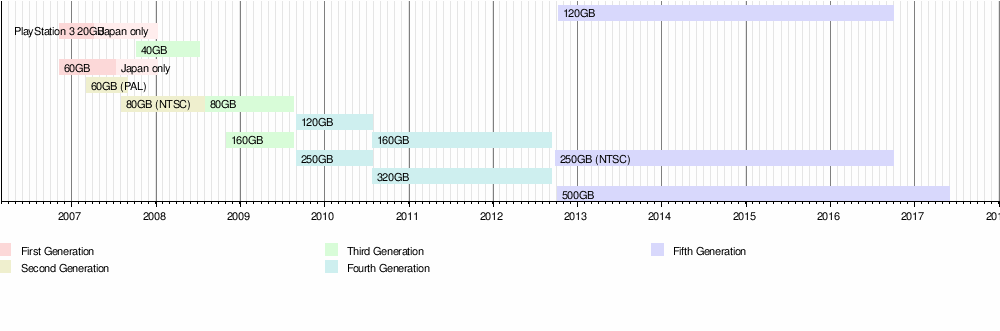
For comparison, let's look at the timeline for PS3s...
4a837273cb0da2417a0cf40a6b274911.png

  • In November 2006 the launch 60GB models released with 90nm CELL BE and 90nm RSX.
  • A year later in November 2007 40GB J models released with 65nm CELL BE and 65nm RSX
  • In September 2009 that the 120GB/250GB 21xx models released with a 45nm CELL BE and 40nm RSX.
  • Lastly, in August 2013 the 42xx SS models released with 45nm CELL BE and 28nm RSX.
RSX:
  • 1 year from 90nm - 65nm (-25nm)
  • 2 years from 65nm - 40nm (-25nm)
  • 4 years from 40nm - 28nm (-12nm)
CELL BE:
  • 1 year from 90nm - 65nm (-25nm)
  • 2 years from 65nm - 45nm (-20nm)
...but now with the PS5 we're only talking about 7nm APU to 5nm APU in about a 2 year span (-2nm). The thermal improvement will be negligible.
To put that in perspective. A single gold atom is about 1/3rd of a nanometer in diameter. So 7nm is 21 gold atoms wide. 5nm manufacturing tech can get it down to 15 gold atoms wide. That's pretty close to the limit. So now the only improvements to be gained are coming from 3D stacking and efficiency improvements. They have not allowed the industry to keep pace with Moore's law, however. So it's officially dead. The electronics industry is about to undergo some growing pains, as the fact we cannot expect the cost of performance to come down quickly anymore.

I have been saying this for awhile now. We need to make better games, not just better looking games. Now that we're near the limit of performance gains, maybe the industry will stop with the photo-realism non-sense and get back to what matters - fun games.

And perhaps they will realize that smaller teams can work more efficiently making games for older, simpler consoles. Consoles that last longer thanks to cooler running components. Consoles that millions of people are discovering thanks to the retro gaming scene. Maybe the big wigs will even make new hardware capable of playing multiple generations of old games to accommodate the changing trends in consumer and developer demands. New hardware that is easier to develop for than the OG consoles were. New hardware to replace aging and dying HW, like Sega-CD solid state lasers and leaking X-box clock capacitors. Or dying PS3's?

The next step forward is a step backwards. Maybe the PS6 doesn't have better graphics than PS5, but plays every PlayStaion game ever made. Maybe it improves PSVR, portability, integration with your computer/digital game library, or opens some new avenue of gaming that is still improving, even if it isn't graphics fidelity. If all of PlayStation were one platform, physical/digital, that would truly feel next gen to me. And it would be cathartic knowing that my game library isn't dependent upon old failing hardware anymore. That SONY cared enough to unify ALL of their customers under one console again - instead of drawing a line between old and new, alienating PlayStaion fans by how old they and their game libraries are.
 
I'm concerned we may be nearing the end of those type of improvements. Moore's Law has slowed to the point where we can't expect there to be a PS5 hardware revision that improves thermals significantly. It may become more available, but we're up against the miniaturization limit for performance improvements.

For comparison, let's look at the timeline for PS3s...
4a837273cb0da2417a0cf40a6b274911.png

  • In November 2006 the launch 60GB models released with 90nm CELL BE and 90nm RSX.
  • A year later in November 2007 40GB J models released with 65nm CELL BE and 65nm RSX
  • In September 2009 that the 120GB/250GB 21xx models released with a 45nm CELL BE and 40nm RSX.
  • Lastly, in August 2013 the 42xx SS models released with 45nm CELL BE and 28nm RSX.
RSX:
  • 1 year from 90nm - 65nm (-25nm)
  • 2 years from 65nm - 40nm (-25nm)
  • 4 years from 40nm - 28nm (-12nm)
CELL BE:
  • 1 year from 90nm - 65nm (-25nm)
  • 2 years from 65nm - 45nm (-20nm)
...but now with the PS5 we're only talking about 7nm APU to 5nm APU in about a 2 year span (-2nm). The thermal improvement will be negligible.
To put that in perspective. A single gold atom is about 1/3rd of a nanometer in diameter. So 7nm is 21 gold atoms wide. 5nm manufacturing tech can get it down to 15 gold atoms wide. That's pretty close to the limit. So now the only improvements to be gained are coming from 3D stacking and efficiency improvements. They have not allowed the industry to keep pace with Moore's law, however. So it's officially dead. The electronics industry is about to undergo some growing pains, as the fact we cannot expect the cost of performance to come down quickly anymore.

I have been saying this for awhile now. We need to make better games, not just better looking games. Now that we're near the limit of performance gains, maybe the industry will stop with the photo-realism non-sense and get back to what matters - fun games.

And perhaps they will realize that smaller teams can work more efficiently making games for older, simpler consoles. Consoles that last longer thanks to cooler running components. Consoles that millions of people are discovering thanks to the retro gaming scene. Maybe the big wigs will even make new hardware capable of playing multiple generations of old games to accommodate the changing trends in consumer and developer demands. New hardware that is easier to develop for than the OG consoles were. New hardware to replace aging and dying HW, like Sega-CD solid state lasers and leaking X-box clock capacitors. Or dying PS3's?

The next step forward is a step backwards. Maybe the PS6 doesn't have better graphics than PS5, but plays every PlayStaion game ever made. Maybe it improves PSVR, portability, integration with your computer/digital game library, or opens some new avenue of gaming that is still improving, even if it isn't graphics fidelity. If all of PlayStation were one platform, physical/digital, that would truly feel next gen to me. And it would be cathartic knowing that my game library isn't dependent upon old failing hardware anymore. That SONY cared enough to unify ALL of their customers under one console again - instead of drawing a line between old and new, alienating PlayStaion fans by how old they and their game libraries are.
I have good news for you;
Those numbers are not concerning.
You mention for example that a 2 nm reduction from 7 to 5 is seems little compared to a 20nm reduction from 65 to 45.
When in fact is pretty much the same. What makes the difference is the total area of the die, in terms of manufacturing costs and such. With the 2nm reduction, the step is just as significant as the 20nm reduction. The die shrinks roughly by the same percentage. About 30%. Because shaving those 2nm increases the areal density of the same transistors by the same amount. Allowing to fit everything in a smaller die.
This can be measured with a ruler or your eyeballs. No need to go to the atomic level. The nanometer ratio will be similar to the die size ratio. You can measure for example the dies and their physical size and will find that their ratio corresponds to 7/5. The power consumption should go down similarly for the same number of now smaller transistors.
And the next possible shrink to 2nm from 5 will be even bigger if it happens.

Of course you are right when you say that it becomes progressively more challenging to go smaller. Intel has been stuck in 14nm for quite a long while.
New approaches need to be explored, such as 3d stacking and things like that.
But it's always been like that. AMD recently showed the stacking and other things like copper to copper bond alternative to say goodbye to the famous lead free solder bumps and such. IBM is confident about 2nm.

And it's no secret the real diminishing returns for the end player were reached long ago. It's no wonder we are still here after so many years. General game quality peaked a long time ago. Those numbers mentioned earlier are only interesting from a business point of view. The improvements that new technology brings to games is less tangible.
Yes, a new game that is pretty and fun at the same time happens from time to time, taking advantage of these advances. But we don't see the other new great games that don't happen anymore because the barrier for development is so strong now. Only possible for a few huge corporations with huge investments. And a terrible drive to get those investments back.

They certainly don't make them like they used to.
 
I'm concerned we may be nearing the end of those type of improvements. Moore's Law has slowed to the point where we can't expect there to be a PS5 hardware revision that improves thermals significantly. It may become more available, but we're up against the miniaturization limit for performance improvements. For comparison, let's look at the timeline for PS3s... In November 2006 the launch 60GB models released with 90nm CELL BE and 90nm RSX. A year later in November 2007 40GB J models released with 65nm CELL BE and 65nm RSX In September 2009 that the 120GB/250GB 21xx models released with a 45nm CELL BE and 40nm RSX. Lastly, in August 2013 the 42xx SS models released with 45nm CELL BE and 28nm RSX. RSX: 1 year from 90nm - 65nm (-25nm) 2 years from 65nm - 40nm (-25nm) 4 years from 40nm - 28nm (-12nm) CELL BE: 1 year from 90nm - 65nm (-25nm) 2 years from 65nm - 45nm (-20nm) ...but now with the PS5 we're only talking about 7nm APU to 5nm APU in about a 2 year span (-2nm). The thermal improvement will be negligible.
To put that in perspective. A single gold atom is about 1/3rd of a nanometer in diameter. So 7nm is 21 gold atoms wide. 5nm manufacturing tech can get it down to 15 gold atoms wide. That's pretty close to the limit. So now the only improvements to be gained are coming from 3D stacking and efficiency improvements. They have not allowed the industry to keep pace with Moore's law, however. So it's officially dead. The electronics industry is about to undergo some growing pains, as the fact we cannot expect the cost of performance to come down quickly anymore. I have been saying this for awhile now. We need to make better games, not just better looking games. Now that we're near the limit of performance gains, maybe the industry will stop with the photo-realism non-sense and get back to what matters - fun games. And perhaps they will realize that smaller teams can work more efficiently making games for older, simpler consoles. Consoles that last longer thanks to cooler running components. Consoles that millions of people are discovering thanks to the retro gaming scene. Maybe the big wigs will even make new hardware capable of playing multiple generations of old games to accommodate the changing trends in consumer and developer demands. New hardware that is easier to develop for than the OG consoles were. New hardware to replace aging and dying HW, like Sega-CD solid state lasers and leaking X-box clock capacitors. Or dying PS3's? The next step forward is a step backwards. Maybe the PS6 doesn't have better graphics than PS5, but plays every PlayStaion game ever made. Maybe it improves PSVR, portability, integration with your computer/digital game library, or opens some new avenue of gaming that is still improving, even if it isn't graphics fidelity. If all of PlayStation were one platform, physical/digital, that would truly feel next gen to me. And it would be cathartic knowing that my game library isn't dependent upon old failing hardware anymore. That SONY cared enough to unify ALL of their customers under one console again - instead of drawing a line between old and new, alienating PlayStaion fans by how old they and their game libraries are.
Funny you mention how maybe good old Sony may bring back access to old games from old platforms.
Well If I were defending them on the technical side...
They are totally to blame at the end of the day here for their unquestionably harmful decisions and practices.

They removed the ps2 compatibility from the ps3! That's why we are here. Not because they didn't design a machine that would last forever. But because they realized that they could approach the thing in a different, more profitable way:

Sell the old games again, even to those who already purchased. Buy the same old games again, but from the imaginary store at new prices.

They had the software means for ps2 emulation. Netemu is almost there. But they decided they should remove the ability to play from the original discs. This was "the" move. Proving their real intentions for the future.
Next they also removed ps1 compatibility from ps4 as well. When it's clear that they already had near perfect emulation. But of course their priorities changed.

They realize the potential in the older games, and these diminishing returns we already discussed. They want their old games, but not for the players to play them. They want them to sell them again.

Hell, your ps5 sketch is missing the most aggravating fun!


"Wow, this machine really is amazing! Can I buy one now? I promise I'll be careful with the HDMI port"

Sony: Yes! Just pay the scalpers 1500$ Fast! Gotta love the new Demon's souls!

"Hmm, didn't I already play this game 10 times over on the ps3?" "Wait wasn't the ps3 just better?"

Sony: What ps3? (Guards! The brainwash didn't work! Clean his memory again! We can't do business like this dammit!)

"AAAAaaAAA...."
 
it does seem we're reaching the end of the line as far as miniaturization goes... But from what I've seen, that's only opening the door for more creative design. Back when I started in IT, a single HP server with 4 parallel processors was pretty awesome. The fact that today even the most barebones laptop is at least two cores, and that you can buy a home desktop with 16 cores is mind-blowing.

Sony tends to be pretty creative sometimes, and it feels to me they're trying some new ideas with the ps5. I'm going to wait for them to iron out the initial kinks that every new idea has, and see what they come up with.
 
I have good news for you;
Those numbers are not concerning.
You mention for example that a 2 nm reduction from 7 to 5 is seems little compared to a 20nm reduction from 65 to 45.
When in fact is pretty much the same. What makes the difference is the total area of the die, in terms of manufacturing costs and such. With the 2nm reduction, the step is just as significant as the 20nm reduction. The die shrinks roughly by the same percentage. About 30%. Because shaving those 2nm increases the areal density of the same transistors by the same amount. Allowing to fit everything in a smaller die.
This can be measured with a ruler or your eyeballs. No need to go to the atomic level. The nanometer ratio will be similar to the die size ratio. You can measure for example the dies and their physical size and will find that their ratio corresponds to 7/5. The power consumption should go down similarly for the same number of now smaller transistors.
And the next possible shrink to 2nm from 5 will be even bigger if it happens.

Of course you are right when you say that it becomes progressively more challenging to go smaller. Intel has been stuck in 14nm for quite a long while.
New approaches need to be explored, such as 3d stacking and things like that.
But it's always been like that. AMD recently showed the stacking and other things like copper to copper bond alternative to say goodbye to the famous lead free solder bumps and such. IBM is confident about 2nm.

And it's no secret the real diminishing returns for the end player were reached long ago. It's no wonder we are still here after so many years. General game quality peaked a long time ago. Those numbers mentioned earlier are only interesting from a business point of view. The improvements that new technology brings to games is less tangible.
Yes, a new game that is pretty and fun at the same time happens from time to time, taking advantage of these advances. But we don't see the other new great games that don't happen anymore because the barrier for development is so strong now. Only possible for a few huge corporations with huge investments. And a terrible drive to get those investments back.

They certainly don't make them like they used to.
Touché! Yeah, that's a solid point I didn't think of.

I wonder if heat density will become a problem? Will heatsinks, vapor chambers and thermal pipes will be enough to disperse the heat away from the die fast enough? I think it will be okay, but will require much more expensive heatsink designs to accommodate them.

This is actually a topic I've been contemplating with the PS3.
Certain parts of the die have "hot spots." You can have great thermal contact with the IHS using products like Liquid metal or, even better, indium foil. The problem with the IHS between the Die and Heatsink is that it creates an unnsecessary layer, a barrier that must be overcome before the heatsink can do it's job. This is why newer devices like PS4 and PS5 heatsinks have direct die contanct now. But the PS3 doesn't. So that's problem #1.

Second, the heat has to wick up into the IHS above the hot spot vertically, through the thermal interface material (thermal grease, liquid metal, whatever) and spreads out along the copper IHS as fast as its thermal conductivity will allow. That is slow! Again the heat has to make it past another Thermal Interface Material to get to the Aluminum block. And again, it has to spread into the aluminum and across another interface material to get into the heatpipes that can efficiently spread the heat evenly across the fins. So the PS3's heatsink presents 3 barriers (stop lights, if you will) to the efficient transfer of heat...
  1. Heat produced at hot spots on die --{TIC}--> IHS
  2. Heat spreads out on IHS above hot spots first --{TIC}--> Aluminum block of heatsink
  3. Heat spreads out on Aluminum block --{TIC}--> Heat Pipes
We can replace the TIC between 1 and 2. IDK how the heatpipes are bonded to the aluminum. I assume thermal adhesive. So #3 is out of our control.

What I've done about #2 is use Indium foil to solder the IHS to the aluminum heat sink using hot air. While the stuff melts at 57C, it proved very difficult to drive that much heat into the heatsink, even with a hot air station set to 400C it took a few minutes before it melted into position. But now they are one. Basically this turns the heatsink into one with direct die contact, like the PS4 or PS5. Many heatsinks have heat pipes in direct contact with the IHS nowadays. Or even a vapor chamber. So once the heat makes it to the heatsink it can wick the heat away faster than copper's thermal conductivity allows. Heat pipes and vapor chambers are extremely efficient at moving the heat away from the source of the heat. But the PS3's HS design isn't ideal, since the heat pipes are buried and not making direct contact with the die. This is the best we can do.

When I say indium foil is the best we can do I mean the very best. Indium foil has better thermal conductivity than liquid metal does because it doesn't contain gallium. Gallium actually has a lower thermal conductivity than other elements in the alloy, like indium, tin, zinc and sliver. It's only there to make LM "liquid" at room temperatures. It also makes LM volitile and oxidative. It literally evaporates and oxidizes at high temperatures. That and it alloys with copper, soaking in. The combination of these factors is why LM appears to "dry out." You have to reapply if every 1-2 years. Most important, since indium foil doesn't contain gallium, it is safe to use on aluminum (gallium is corrosive to alluminum). So Indium won't soak into and destroy the aluminum. It's the ideal TIC for #2.

As for #1, this is where I'm not sure. We want to be able to remove the heatsink, so we don't want to solder it on with indium foil. We could use liquid metal, which would provide the next best thermal conductivity and still allow easy separation later. That'll be important with LM, since it'll ned reapplied every few years. But I wonder if those hot spots on the die could be better dealt with using a graphite pad? Why?

On paper graphite has a great thermal conductivity (35W/mK). Even better than liquid metal at around 20W/mK. In reality however, the pad is much thicker and it take up all the gains. That causes the heat to travel through much more material before making the transfer. Also the air gap insulates the transfer. Liquid materials take up the space in the microscopic grooves, greatly increasing surface area contact, increasing the efficiency of the TIC. So in reality these graphite pads tends to perform just a little worse than High quality thermal pastes, like MX-4. Why am I considering it then. you ask? Because it's lateral thermal conductivity is EXTREEMLY high. It transfers heat from the center of the pad to the edge faster than any other material, except for heat pipes. That means it can move the heat away from hot spots on the die immediately. It'll move to the edge of the graphite pad and spread the heat out over the pads entire surface area, limiting any local buildup of heat on the die. It might make the chip last longer and reduce bump fatigue!

So while the thermal transfer from die to the IHS won't transfer the heat vertically into the IHS and HS any faster than OEM TIC, it will greatly reduce hotspots on the die, never degrade in performance, and it's reusable. As long as the PS3 lives, you'll never have to worry about thermal paste performance. And when that PS3 does finally die, you can reuse the pads on another console. Attaching the IHS to the HS with indium foil is hard and you probably won't want to do it again. With graphite pads you can get away reusing that HS on another console. It's not normally a good idea to use different IHS than the one that was originally on the chip, because the IHS has slowly conformed to the die shape, but the graphite pads will make up the microscopic difference.

The question is, is the trade off worth using graphite pads vs liquid metal? I think it might be!
 
Last edited:
Graphite is still conductive, so you have to take care to cover the SMD components on the RSX, but yeah you don't have to worry about it dripping.

I still want to know what that foam SONY is using on the PS5 is called. I ordered a very expensive high temperature open cell silicone foam that's 1/8th inch thick (too thick). I was hoping it's compression force would be low enough to work. However, it's too springy. You know how spongy the foam strips SONY used to seal off the fan and route air inside the PS3? I wanted something with that level of springiness, but thin enough to fit on the substrate surface around the die. It's to contain the excess liquid metal and limit evaporation. That's how SONY is using LM on the PS5. Excess to account for what soaks into the HS and sealed to limit evaporation.

The foam I'm looking for also needs to be able to handle the high temperatures of the die without melting. The silicone foam was described as low compression force and High temp resistant. It sounded perfect, but is too springy. I'm afraid it would apply too much upward force against the Heatsink and not allow the TIC to contact the die. And it's still too thick. It needs to be just over 1mm thick. The graphite pad is certainly easier.

I'm waiting to see what happens with the LM in the PS5. I'm not convinced it's going to last. The fanboy's all seem convinced that SONY is as smart as they claim to be. That it's not a problem. As always, I'm impressed with their engineering, but I don't trust the marketing.

I would still like to replicate the design for use on the PS3, if I could find that damn foam!
 
Yes, sometimes it's just a BGA defect under the RSX. This is why reballing is the valid step forward once you find RSX problems. If and when it fails again, then you will know if your problem was actually on top, and not under the chip.

I think our friend Botakompong has provided a very interesting observation on the topic. It seems even reballing is just delaying the inevitable, CXD2971 appears to have a design flaw/internal fault that will eventually manifest itself one way or another.

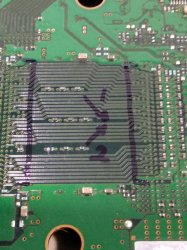
I will give examples of problems that are often encountered from ps3, especially on the RSX CXD2971, I took pictures from the DIA-001
Lanes cxd2971.jpg

Remember !!!, this is just an example, in my picture the pin-pin connection data from CellBe to RSX, a common problem that occurs in the CXD2971, when measuring resistance in IC using a digital meter pin 1 and pin 2 are shorted, Pin1 and pin2 are connected internally in RSX, which shouldn't happen, that's what causes PS3 YLOD. Then I heat the RSX CXD2971 with a temperature increase of max 200c for 15 minutes, after it cools down I re-measure pin1 and pin2 that were previously connected, the RESULT? pin1 and pin2 separate back to normal, no longer connected, from such conditions I conclude that using heat can change the conditions inside the RSX CXD2971, but such repairs cannot last long, 2-3 days later pin1 and pin2 are shot again, reconnected Internally in RSX. There are a lot of similar cases like this with different results, but from the many ps3s that have been treated like this, I conclude:
1. RSX that has never been HEATED, will last quite a long time, approx. 3-6 months, will have a longer lifespan if it is used frequently, harvested continuously
2. RSX that has been HEATED, DON'T WASTE YOUR TIME, REPLACE RSX CXD530XX IMMEDIATELY !!!!!
That's why my brother("KIAW'S) made the MODRSX IC so that the old CXD2971 could be replaced.
how to heat RSX like this can only be done on RSX CXD2971, does not apply to other RSX, why? Ask Sony ...(what is clear is that the make is different)
 
I think our friend Botakompong has provided a very interesting observation on the topic. It seems even reballing is just delaying the inevitable, CXD2971 appears to have a design flaw/internal fault that will eventually manifest itself one way or another.
That resistance healing effect could be due to raising the temperature above the Curie Point of dielectric in the SMD capacitors. Or it may help to realign molecules that have shorted due to electromigration. Both of which, are temporary.

Point is, you can not subject any microprocessor to temperatures above 100C without damaging it. They are designed to survive the initial installation at reflow temperatures, then perform to spec. But each time you reball you have to subject it to 2 more reflow cycles it wans't designed to experience. You can't expect the chip to last more than a few reballs. This is why the "Orbis" Mod chip is a game changer. It allows you to install a 65nm or 40nm RSX which will not need to be replaced again. And since they are more available it means there's a sustainable repair path for Backwards compatible PS3 now!
 
I think our friend Botakompong has provided a very interesting observation on the topic. It seems even reballing is just delaying the inevitable, CXD2971 appears to have a design flaw/internal fault that will eventually manifest itself one way or another.
Hehehe, yes.
If you notice, that's what I was insinuating the whole time. There's something else going on with the RSX. Something nobody predicted. Not just the BGA defects or even the famous "bumps", the underfill... Or even the memory modules.

This is probably the real bad guy of this movie that is known to laugh every time heat is applied. Be it a fake tokin fix, a hairdryer trick, a towel trick, a "reflow"... Global warming... You name it.

But I didn't want to be too direct because people always read things the wrong way. It's an innate human desire for oversimplifying complex things. When in reality, it's just something that nobody can know 100%.

The reality is, that many things can cause a 3034/44XX RSX related error. There is still no single cause. And therefore it's dangerous to make assumptions.

This is why reballing is still the valid step forward. Because sometimes, it really is just the balls. And is the only way to isolate the problem further. Eliminate the possibility of problem under the chip vs on top of the chip. Perhaps more importantly, isolate what can be fixed vs what you cannot fix.

As I've said before, I wish I knew the real ratio of each type of failure, but I don't.
What I do know, is that many people including botakompong himself have reballed thousands of consoles and kept doing it because they know it's another type of failure that does happen.

This includes slim playstations which also get their share of RSX problems. Problems that again, often reballing can fix but not always. Remember the original 40nm CECHA official from SONY also had RSX problems.

If they invented the modchip is because they felt the need to solve a real problem that exists. But this doesn't mean that every single chip needs to be replaced.
When they still do so many reballings after inventing the modchip themselves, you can realize that reballing is neither stupid, nor a scam.

It's the correct step forward that shouldn't be skipped most cases. Of course different people have different priorities. Some are just little destroyers that just can't help it.

In any case we can be happy because thanks to them, (reballers at the end of the day) now even dead chips are no longer a Dead End.
 
Last edited:
Just to be clear, SONY didn't invent the mod chip that allows you to replace a 90nm RSX with a 65nm or 40nm. @botakompong's brother did. SONY doesn't need a mod chip to do this, they installed a newer model SYSCON chip with a FW update that allows it. We have attempted to replicate SONY's process and it didn't work. Then we found the "orbis" mod that has been allowing this for the last 5 years in Indonesia. It spoofs the SPI signal the SYSCON is expecting from a 90nm RSX. It's easier to install than trying to replicate SONY's method anyway.

SONY has been fine with allowing backwards compatible PS3 consoles die, consoles that could otherwise be saved with a 65nm or 40nm RSX. They have been siting on the procedure to do this since 2012 with no plans on ever doing it themselves again or releasing the instructions. There is no benefit to keeping it secret anymore, but they continue to. That's the SONY I know. I admire the engineers, but whoever made that decision deserves a block of coal for Christmas.
 
That resistance healing effect could be due to raising the temperature above the Curie Point of dielectric in the SMD capacitors. Or it may help to realign molecules that have shorted due to electromigration. Both of which, are temporary.

Point is, you can not subject any microprocessor to temperatures above 100C without damaging it. They are designed to survive the initial installation at reflow temperatures, then perform to spec. But each time you reball you have to subject it to 2 more reflow cycles it wans't designed to experience. You can't expect the chip to last more than a few reballs. This is why the "Orbis" Mod chip is a game changer. It allows you to install a 65nm or 40nm RSX which will not need to be replaced again. And since they are more available it means there's a sustainable repair path for Backwards compatible PS3 now!
Please, let's not make a good thing into a bad thing.
Oversimplifying can only bring problems. Just look at this thread and its 200 pages.

Of course no chip lasts forever, but this also includes the 65 and 40nm chips.

Please be careful because this kind thinking can be dangerous. People don't last forever either. Wanting your game console to last forever can be more destructive than it sounds.

You can certainly heat a chip over 100c without damaging it. Especially if it's not during operation and for a short period of time. But you only reball once. And yes, this is a reason reflows can be destructive as opposed to reballing.

Just enjoy the good times.
 
Back
Top