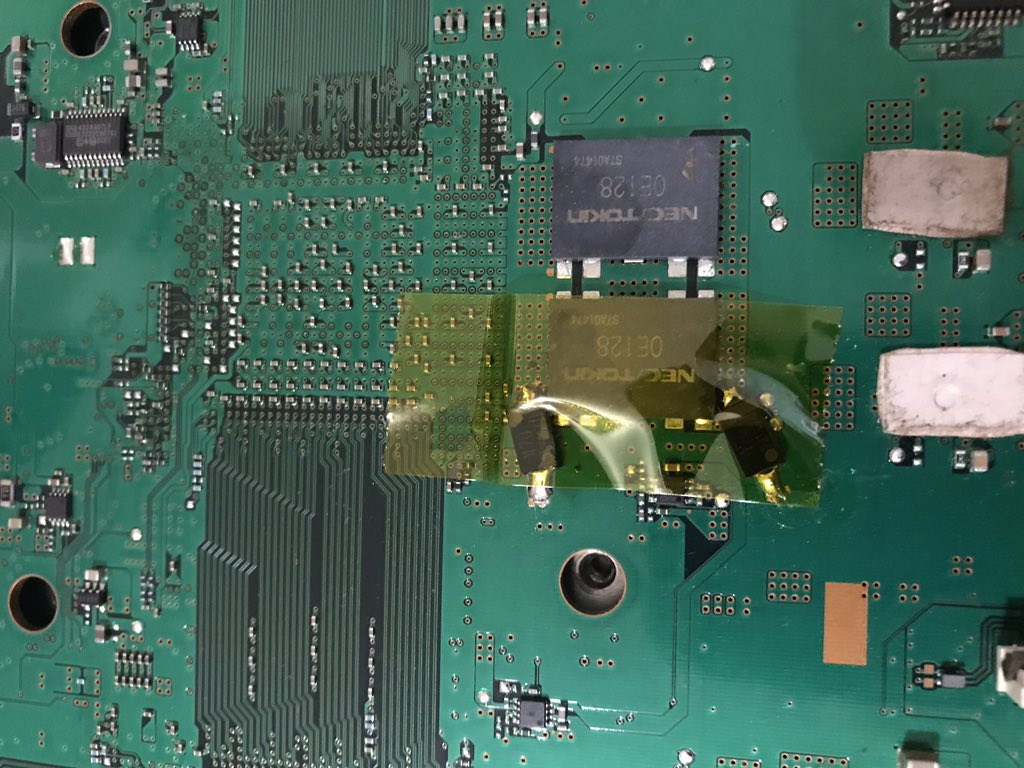
PS3 (Research/Experimental) - NEC/TOKIN Capacitors Replacement - YLOD

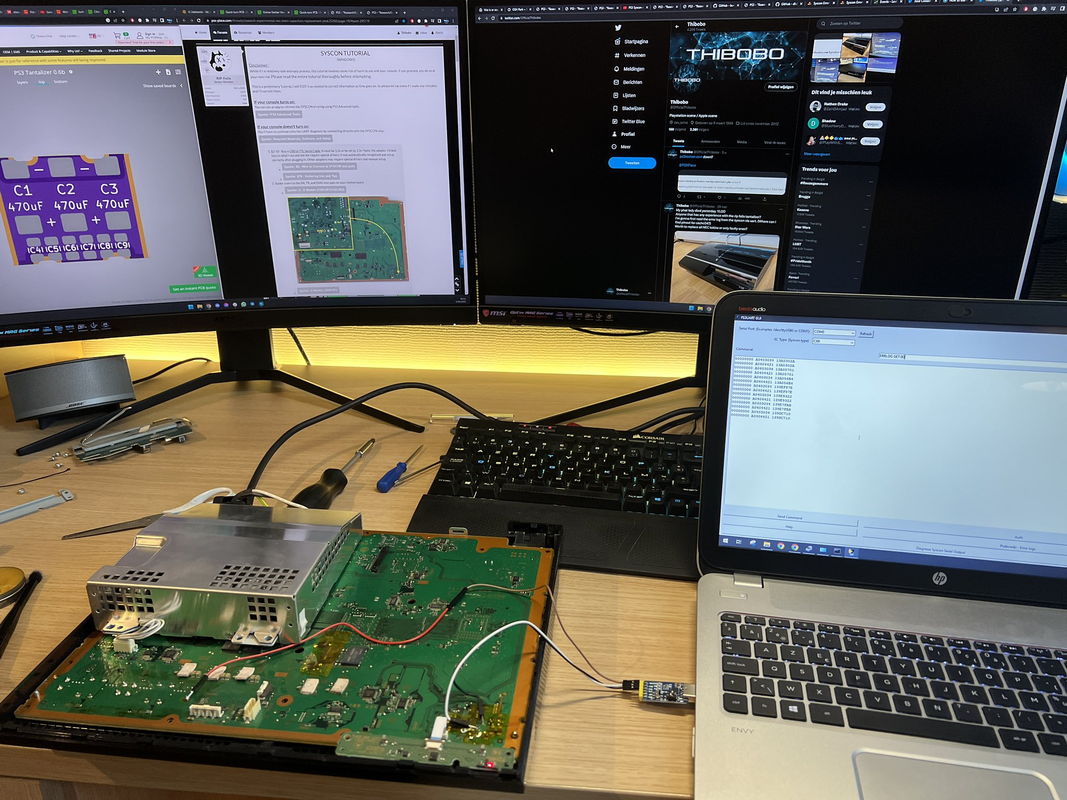
That's why I made the PS3 Tantalizer.


Hello RIP-Felix, if the positive solder of one MLCCs comes into contact with the positive solder of a tantalum or two MLCCS as shown in the photo, do the two stop working correctly or did they work normally as they were not connected by the positive?

Remembering that in this photo they don't touch is an example, if they touched those points where I circled in red in this image.

WIN_20230213_12_57_33_Pro.jpg
 
Last edited:
Is there an alternative Tantalizer board like this? The pcb is too tightly packed. Each component barely has any spacing between the other component. And it's so easy to bridge those decoupling caps. I wish this pcb was larger with more spacing for each component.
 
Last edited:
Hey guys

I am looking for some guidance on the next steps. I have a COK-002 board that was giving A0081001 and A0093003s. I then replaced 2 of the TOKINs on the Cell side and am getting A0404412 and A0403034. I've been reading some of the amazing work across this form and devwiki and anywhere I can but i'd like to get a steer on what I should be learning/doing next from here (from someone with a bit more experience than myself)

COK-002

A0404412
A0403034
A0404412
**Replaced 2x Cell NEC/TOKINS here**
A0081001
A0081001
A0093003
A0091001
A0081001
A0081001
A0404412

I checked Ohm readings around RSX and Cell based on an image I found here. No substantial differences. At a bit of a loss on how to progress at this point, anyone got any suggestions? Thanks!
 
Hello RIP-Felix, if the positive solder of one MLCCs comes into contact with the positive solder of a tantalum or two MLCCS as shown in the photo, do the two stop working correctly or did they work normally as they were not connected by the positive?

Remembering that in this photo they don't touch is an example, if they touched those points where I circled in red in this image.

View attachment 40658
This is fine. As long as you don't bridge + and GND it's electrically the same. There are just 2 planes.
 
Is there an alternative Tantalizer board like this? The pcb is too tightly packed. Each component barely has any spacing between the other component. And it's so easy to bridge those decoupling caps. I wish this pcb was larger with more spacing for each component.
It's designed to fit in the same footprint as a tokin, so there isn't enough room for hand soldering pads. They are designed to be populated using hot air.
 
Hey guys

I am looking for some guidance on the next steps. I have a COK-002 board that was giving A0081001 and A0093003s. I then replaced 2 of the TOKINs on the Cell side and am getting A0404412 and A0403034. I've been reading some of the amazing work across this form and devwiki and anywhere I can but i'd like to get a steer on what I should be learning/doing next from here (from someone with a bit more experience than myself)

COK-002

A0404412
A0403034
A0404412
**Replaced 2x Cell NEC/TOKINS here**
A0081001
A0081001
A0093003
A0091001
A0081001
A0081001
A0404412

I checked Ohm readings around RSX and Cell based on an image I found here. No substantial differences. At a bit of a loss on how to progress at this point, anyone got any suggestions? Thanks!
3034/4xxx is the RSX (most likely). It'll need replaced.
 
RIP-Felix, I've been reading a lot about your research into the PS3's common issues with tantalum capacitors. Thanks for those in-depth videos by the way, they've been very interesting to me.
 
3034/4xxx is the RSX (most likely). It'll need replaced.

Thanks mate. I've got my BGA machine arriving this week so I guess that's where I'll start! Oh I also ordered a bunch of your PCB designs yesterday for the TOKIN replacements, awesome work man really appreciate you making those available.

Also, I don't suppose anyone knows where to find a replacement connector for the penny battery (motherboard side), I may have pulled the plastic off (pins are still there).

hCD14FS.png
 
PS3 Tantalizer - Beta Release (v0.6b)
(Order or Download from OSH Park HERE)


EDIT: OSH Park had trouble manufacturing v0.3b, which is not much different than 0.6b. I've been in contact with them about what's going wrong. Apparently, there's not enough room for support tab placement allowing the board to twist and fly off during routing. Because of this I revised the design to have a little more room for them to place tabs, but it's not easy to keep this design doing so. I have been trying to make a revision that will improve manufacturability, but that hasn't been going well.

So my recommendation is that you Download the Gerber files and have PCBway or JLCPCB make it instead, since they haven't complained about manufacturing issues.
View attachment 36416
Notes:
  • If you choose to use this PCB, you are doing so at your own risk! I cannot be held responsible for any damages.
  • This PCB is designed to make it easier and safer to attach tantalum/MLCC capacitors to your PS3. Removing the NEC/TOKINs and replacing with Tantalum/MLCC capacitors is an experimental mod not guaranteed to fix the problems you are experiencing. You must properly troubleshoot your console to decide if this mod is right for you.
  • MLCC pads are meant for 0805 case size.
  • You must choose 0.8mm board thickness in the options during checkout. This ensures it'll fit underneath the RF shield when you reassemble the console.
  • You must buy 2mm height capacitors or shorter. This ensures it'll fit underneath the RF shield when you reassemble the console.
  • Tantalum pads are for 7343 (7.3 x 4.3 x 1.9mm, LxWxH). You can use other types of capacitors that fit this footprint, such as aluminum polymer, tantalum polymer, etc. However, they must be low ESR/ESL processor decoupling capacitors. The PCB takes up 0.8mm of height, so caps need to be low profile (less than 2mm). Each one should be less than 9mΩ ESR, 4.5mΩ ideally. I recommend...
  • You do not need to buy the MLCC capacitors. The 470uF capacitors are enough on their own. However, the MLCC capacitors help to attenuate the higher frequency noise component up to around 2MHz, better mimicking the NEC/TOKIN proadlizer it's meant to replace. This is probably overkill on PS3's with 1000uF tokins. I still recommend using 470uF caps, because 3x 330uF is only 990uF and may not be enough. It's better to have more capacitance than less, but not too much more. The MLCCs are more needed on 90nm CPU/GPU early models (A-H). They have noisier switching VRM and higher load, which requires more decoupling than later models. Use them if your tokins are OE128 models. You probably don't need them otherwise.
  • You can download the Gerber files from OSH Park if you perfer to have another board house manufacture your Tantalizers. Just be sure they know the edges are castellated and that you need 0.8mm board thickness. In fact I recommend you do this since OSH park has been having trouble making them lately.
Pictures:
View attachment 37669 View attachment 37668

Note: The following pictures are of v0.3a I made with 7x MLCC pads. I decided to remove C10 because there was too little clearance between +/GND. v0.6b linked above will not have 7 MLCC pads. It has 6. And instead of a long edge for the GND connection, it now has 4 plated vias. These changes where needed to make it easier to manufacture. But the following pictures will give you a general idea of what they look like.
View attachment 35177 View attachment 35178
View attachment 35179 View attachment 35180

Here's one of v0.6b with Aluminum Polymer Caps.

View attachment 37675
Discussion:

People have asked me if the ceramic caps are necessary and how to calculate the right ones to use. I use KEMET's K-Sim to model the frequency response curve of any capacitor combination, to decide what values best attenuate the higher frequencies TaPol caps aren't as good at rejecting. The tokins were better at that. However you can use MLCC's to push the combined frequency response curve down. The MLCCs are not needed, we have confirmed the 470uF caps are sufficient on their own. But you can use them if you'd like to.

Here is an example of the frequency response curves:

Felix,

I'm about to order my set of tantalizers via pcbway,

Is this good or anything else i should change or keep in mind?

Thanks for all your work, my phat lady gave the ylod yesterday.

upload_2023-5-30_23-24-6.png
 
Thanks mate. I've got my BGA machine arriving this week so I guess that's where I'll start! Oh I also ordered a bunch of your PCB designs yesterday for the TOKIN replacements, awesome work man really appreciate you making those available.

Also, I don't suppose anyone knows where to find a replacement connector for the penny battery (motherboard side), I may have pulled the plastic off (pins are still there).

hCD14FS.png
Be sure to practice on a junk board A LOT before you attempt rework on a board you care about!

Also, please take this advice. Bake ANY board that has ANYTHING you want to salvage. 24hrs @100C, no less. I reccomend buying ESD bags and silica gel dessicant to store them until you're ready for rework. I AM DEAD SERIOUS. Moisture WILL delaminate your boards and ruin your life until you decide to bake.

I had to popcorn a NOS 40nm RSX to finally realize this step wasn't optional and couldn't be cheated by baking less time. I got lucky a few times, but my yield was atrocious and popcorning/delaminating really kills your momentum.

It's akin to soldering without flux. A very bad idea.
 
Felix,

I'm about to order my set of tantalizers via pcbway,

Is this good or anything else i should change or keep in mind?

Thanks for all your work, my phat lady gave the ylod yesterday.

View attachment 40659

Looks fine to me. BTW, you say your "phat lady gave the YLOD" but you didn't say what caused it - Post SYSCON errorlogs and provide some behavioral details that support that conclusion. Are you sure these are even necessary?
 
Looks fine to me. BTW, you say your "phat lady gave the YLOD" but you didn't say what caused it - Post SYSCON errorlogs and provide some behavioral details that support that conclusion. Are you sure these are even necessary?
Thanks for the reply.

I haven't read out the syscon error logs (that's work for this weekend), but i'm pretty sure it'll be the tokins as the console had been piggy back'd before dumping syscon error logs were even a thing.
My guess is that the tokins got even worse and the extra caps alone aren't enough to settle a clean power delivery to the rsx.

This console also has only 35d of running hours

image.png
 
Last edited:
Be sure to practice on a junk board A LOT before you attempt rework on a board you care about!

Also, please take this advice. Bake ANY board that has ANYTHING you want to salvage. 24hrs @100C, no less. I reccomend buying ESD bags and silica gel dessicant to store them until you're ready for rework. I AM DEAD SERIOUS. Moisture WILL delaminate your boards and ruin your life until you decide to bake.

I had to popcorn a NOS 40nm RSX to finally realize this step wasn't optional and couldn't be cheated by baking less time. I got lucky a few times, but my yield was atrocious and popcorning/delaminating really kills your momentum.

It's akin to soldering without flux. A very bad idea.

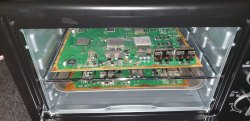
Thanks, RIP-Felix. I think I've seen you mention this elsewhere so it was definitely on my radar to do, however, logistically how do you guys actually bake the boards? Do you literally put them in the small convention ovens for 12-24 hours or just have them on the BGA machine with the bottom heater going.

I've got about 6 Fat non backwards compatible boards I've purchased second-hand to practice on, then I have another 6 COK-002 boards that I've sourced locally. Mostly 3034 errors. So ill be doing a bit of trial and error first. Also my own launch day machine that i'd kept in storage and away from harm died this week, I turn it on about once a year, this week it met the YLOD. :( So now I'm more motivated than ever.
 
Last edited:
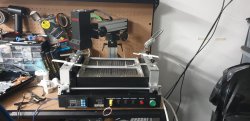
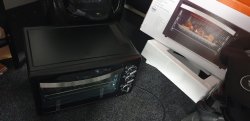
On your advice above i've gone and purchased a little oven. Time to cook. BGA machine arrived and is assembled today as well. I'll move everything around a bit and tidy up before I turn anything on (aware that there's a bit of a fire hazard situation happening right now lol.


Cook1.jpg Cook3.jpg cook4.jpg
 
Looks fine to me. BTW, you say your "phat lady gave the YLOD" but you didn't say what caused it - Post SYSCON errorlogs and provide some behavioral details that support that conclusion. Are you sure these are even necessary?

Thanks for the reply.

I haven't read out the syscon error logs (that's work for this weekend), but i'm pretty sure it'll be the tokins as the console had been piggy back'd before dumping syscon error logs were even a thing.
My guess is that the tokins got even worse and the extra caps alone aren't enough to settle a clean power delivery to the rsx.

This console also has only 35d of running hours

Looks like it's the RSX afterall, keep getting these 2 errors:

A0403034 139DC70A
A0404421 139DC70A

3034 means CELL/RSX communication error 4421 means CELL/RSX error Common cause of this is a broken bga ball I will look for someone to reball my console or maybe i should buy a bga rework station and learn the skill of reballing myself…


image.png
 
@RIP-Felix Alright feedback time

Ok so to start with I baked two SEM (I think they were the SEM ones) boards for 7 hours (scrap boards so not overly fussed if they popcorned while configuring the machine). Straight forward, into the oven with a thermocouple sticking in. 110c or there about for the whole time.

BGA Machine:
So to start with I used @Shawn Shakir 's profile for the Achi Pro SC as a base.

R1: step
L1 0 d1 360 r2 1.00
L2 190 d2 30 r3 1.00
L3 200 d3 25 r4 1.00
L4 210 d4 25 r5 1.00
L5 220 d5 25 r6 1.00
L6 230 d6 25 r7 end
hb 230. (I didn't know what this was initially)

Shawn's post suggested that he uses the bottom heater at 280 to get the board heat reporting at 160. I tend to overshoot the reported 160 pretty quickly if I have it at 280 however, we'll revisit this in a moment. Also for clarity, this is 280 reported from the built-in thermocouple that sticks up from the middle of the heating plates (but not touching the board) and the 160 is on the additional thermocouple attached close to the RSX with some aluminium tape. I also had a 3rd Thermocouple that I got from Aliexpress taped to the bottom of the board in the opposite location to ensure some level of consistency in board temp reporting.

So on the overshooting, I've found that L1 D1 360 is probably more time than I need at this stage. Either that or I need to bring the temp of the lower heater down a bit initially.

However, what I've found is that as I progress through the stages of the profile even at L6 my RSX solder wasn't getting molten. So I amended the profile to go up to a reported L7 240 and L8 245. Even then though I wasn't having much luck when the top thermocouple near the RSX was reporting 240etc. At this point I started playing with the bottom heater, I pushed that up to 310c and was getting around 200-210ish reported for the board temp prior to the top heater kicking in. The idea was to have the bottom heater do most of the work and the top heater just push us over the edge.

This combination worked to get me to the melting point but, also proved fatal to one of the boards. The reported board temp rose to 240-250, RSX was molten but small caps around it were acting like it was movie night. Now for complete transparency, I didn't put aluminium tape or foil on top of them, so they were in a direct sunbathing position. I may have been able to save them if I'd done this but I was being cheap on not using my tape. Lesson learnt.

At this point I was scratching my head a bit, the reported temps are much higher than I want the board to be getting to but equally nothing seemed to be hitting a melting point lower than that. At this point, I decided to look into what "hb 230" actually meant. Turns out it's the maximum temp for the top heater output.

I've upped that ever so slightly to 235.

This is pretty much where I'm at currently. I lifted the CELL on the same board and nothing went catastrophic with the settings above (and I splashed out on some aluminium tape this time to practice protecting surrounding components) but it felt more like a "fake win" that something that would be consistently repeated.

So I don't know at this point, more playing around with scrap boards tonight trying to dial something stable in.

I've got a COK-002 board baking for 10 hours (not going to put this onto the BGA machine until I'm confident in the profile) and a DAI-002 board. 10 hours is about the max I can leave the oven unattended, two small children could theoretically get into the garage and touch it so I can only do it while being attentive)

If anyone has any advice at this point by all means.

Edit: Image of board gore for engagement.

 

Attachments

  • PCBGore.jpg
    PCBGore.jpg
    300.7 KB · Views: 74
Last edited:
Looks like it's the RSX afterall, keep getting these 2 errors:

A0403034 139DC70A
A0404421 139DC70A

3034 means CELL/RSX communication error 4421 means CELL/RSX error Common cause of this is a broken bga ball I will look for someone to reball my console or maybe i should buy a bga rework station and learn the skill of reballing myself…


image.png
It is an RSX issue most likely, but reballing can't fix bumpgate. Since we can replace the RSX with a 65nm or 40nm RSX that are not affected, that is now the reccomended repair.
 
@RIP-Felix Alright feedback time

Ok so to start with I baked two SEM (I think they were the SEM ones) boards for 7 hours (scrap boards so not overly fussed if they popcorned while configuring the machine). Straight forward, into the oven with a thermocouple sticking in. 110c or there about for the whole time.

BGA Machine:
So to start with I used @Shawn Shakir 's profile for the Achi Pro SC as a base.

L1 0 d1 360 r2 1.00
L2 190 d2 30 r3 1.00
L3 200 d3 25 r4 1.00
L4 210 d4 25 r5 1.00
L5 220 d5 25 r6 1.00
L6 230 d6 25 r7 end
hb 230. (I didn't know what this was initially)

Shawn's post suggested that he uses the bottom heater at 280 to get the board heat reporting at 160. I tend to overshoot the reported 160 pretty quickly if I have it at 280 however, we'll revisit this in a moment. Also for clarity, this is 280 reported from the built-in thermocouple that sticks up from the middle of the heating plates (but not touching the board) and the 160 is on the additional thermocouple attached close to the RSX with some aluminium tape. I also had a 3rd Thermocouple that I got from Aliexpress taped to the bottom of the board in the opposite location to ensure some level of consistency in board temp reporting.

So on the overshooting, I've found that L1 D1 360 is probably more time than I need at this stage. Either that or I need to bring the temp of the lower heater down a bit initially.

However, what I've found is that as I progress through the stages of the profile even at L6 my RSX solder wasn't getting molten. So I amended the profile to go up to a reported L7 240 and L8 245. Even then though I wasn't having much luck when the top thermocouple near the RSX was reporting 240etc. At this point I started playing with the bottom heater, I pushed that up to 310c and was getting around 200-210ish reported for the board temp prior to the top heater kicking in. The idea was to have the bottom heater do most of the work and the top heater just push us over the edge.

This combination worked to get me to the melting point but, also proved fatal to one of the boards. The reported board temp rose to 240-250, RSX was molten but small caps around it were acting like it was movie night. Now for complete transparency, I didn't put aluminium tape or foil on top of them, so they were in a direct sunbathing position. I may have been able to save them if I'd done this but I was being cheap on not using my tape. Lesson learnt.

At this point I was scratching my head a bit, the reported temps are much higher than I want the board to be getting to but equally nothing seemed to be hitting a melting point lower than that. At this point, I decided to look into what "hb 230" actually meant. Turns out it's the maximum temp for the top heater output.

I've upped that ever so slightly to 235.

This is pretty much where I'm at currently. I lifted the CELL on the same board and nothing went catastrophic with the settings above (and I splashed out on some aluminium tape this time to practice protecting surrounding components) but it felt more like a "fake win" that something that would be consistently repeated.

So I don't know at this point, more playing around with scrap boards tonight trying to dial something stable in.

I've got a COK-002 board baking for 10 hours (not going to put this onto the BGA machine until I'm confident in the profile) and a DAI-002 board. 10 hours is about the max I can leave the oven unattended, two small children could theoretically get into the garage and touch it so I can only do it while being attentive)

If anyone has any advice at this point by all means.

Edit: Image of board gore for engagement.
So I tried a similar profile and the same result. Instead of increasing the temps, what I found works is lowering the ramp rates. 0.5C/s allowed the temps to rise slower and the board to absorb the heat from each stage, before moving on.

What happens when you ramp to quickly is the heater cranks to max to try and raise the temp at the TC, but tge board can't get there, the dwell doesn't give it enough time to catch up, and then it ramps up to the next higher temp. So in other words the heater is being driven 100% the whole time. And that is overheating the laminated layers, vulcanizing and volitilizing them from thermal shock. It's litterally frying it!

So baked or not, thermal shock will popcorn your board. You need to lower the ramp rates. The slower profile will have set value and process value temps more closely match.

L1 0 d1 360 r1 0.50
L2 190 d2 45 r2 0.50
L3 200 d3 45 r3 0.50
L4 210 d4 45 r4 0.50
L5 220 d5 45 r5 0.50
L6 230 d6 45 r6 0.50
L7 235 d7 45 r7 0.50
L8 240 d8 45 r8 0.50

This is what I've currently been trying. Worked to remove RSX, CELL, EEGS, and SB from a COK-001. The boards were quite wet and popcorned. I baked 2 DIA-002's and harvested the 65nm RSXs sucessfully with that profile. I may try tweaking it more, cuz the dwell times might be a bit too long. But the temps track well, the profile seems much more gentile. It takes about 10mins to reflow LF, but that's fine
 
So I tried a similar profile and the same result. Instead of increasing the temps, what I found works is lowering the ramp rates. 0.5C/s allowed the temps to rise slower and the board to absorb the heat from each stage, before moving on.

What happens when you ramp to quickly is the heater cranks to max to try and raise the temp at the TC, but tge board can't get there, the dwell doesn't give it enough time to catch up, and then it ramps up to the next higher temp. So in other words the heater is being driven 100% the whole time. And that is overheating the laminated layers, vulcanizing and volitilizing them from thermal shock. It's litterally frying it!

So baked or not, thermal shock will popcorn your board. You need to lower the ramp rates. The slower profile will have set value and process value temps more closely match.

L1 0 d1 360 r1 0.50
L2 190 d2 45 r2 0.50
L3 200 d3 45 r3 0.50
L4 210 d4 45 r4 0.50
L5 220 d5 45 r5 0.50
L6 230 d6 45 r6 0.50
L7 235 d7 45 r7 0.50
L8 240 d8 45 r8 0.50

This is what I've currently been trying. Worked to remove RSX, CELL, EEGS, and SB from a COK-001. The boards were quite wet and popcorned. I baked 2 DIA-002's and harvested the 65nm RSXs sucessfully with that profile. I may try tweaking it more, cuz the dwell times might be a bit too long. But the temps track well, the profile seems much more gentile. It takes about 10mins to reflow LF, but that's fine
Awesome, thanks man. I'll give this a try. Taking a little break for today, I've been reballing the RSX chip to put it back on (testing leaded solder etc) but realized I need an extraction fan or something, my lungs might be be 50% kingbo right now lmao.
 
Hi guys,
for the first time I got a YLOD on my ps3 80gb cechk-04 (supposedly with 65nm rsx). It's a weird YLOD though. It happened to me the first time while playing and the ps3 suddenly shut down. After leaving it off for a few days I tried to turn it back on. At the first attempts it turns off within a few seconds (with a yellow light and then a flashing red light) while after a few attempts the ps3 manages to turn on. Every time I turn it on the ps3 stays on a little longer until I can access the XMB. I even managed to jailbreak it in these conditions, if it is left on for some time it becomes "almost" stable. But when I open a game or do something heavy, the ps3 turns off within a few seconds (at most 1 minute). I installed "PS3 Advanced Toolset" and downloaded the SYSCON logs. The only error that comes up is "a0801002". What do you think is the problem? The RSX or the Nec/Tokins?
Thanks!
 
Back
Top