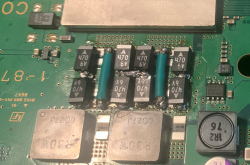
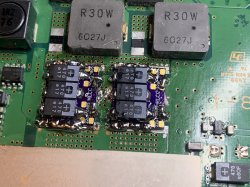
I would imagine if there isn't enough capacitance to smooth out voltage drops during peak loads, the console will likely just YLOD on boot during the POST process. It does a basic test on boot to see if the processors are alive and kicking. That's the rev-up you hear when you first start the console. It's not taxing like an intense game, but it's more than just idling in the XMB. So that really only leaves the noise component.
The noise is more variable. Noise spikes can occur at any time due to any load. If they occur at an important time, they'll interfere and eat up CPU cycles. If it gets bad enough, they'll cause a YLOD. So in
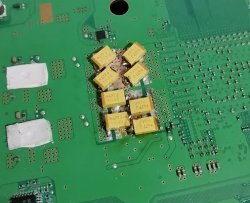
@Pacorretaco's case the noise increase caused by removing half the tokins wasn't enough to cause an instant YLOD, but it surely would have caused the CPU/GPU to work harder (more heat) and probably would have caused a YLOD under stress (like a game). In the case of tokins losing capacitance, they steadily allow more noise in. So you can add tantalums like he did to replace the lost capacitance, but the reason we use 470uF is because they're impedance vs frequency curve (frequency response curve) has a resonance frequency centered at the correct range of the switching noise range. So yes, it adds back capacitance, but does so surgically targeting the noise frequency.
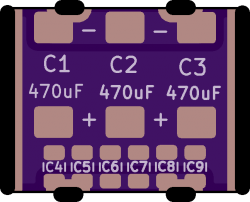
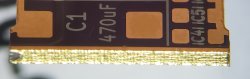
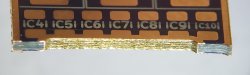
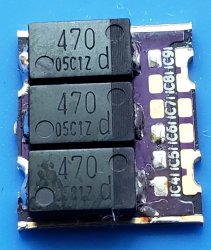
Here's an example of just 3x 470uF TaPol caps...
The red box is the area of concern. from 100KHz-10MHz is the component of switching noise that the tokins are responsible for decoupling. Notice how the impedance curve pops out the top of the box? That means noise of 3MHz+ will not be reduced below 10mOhms (I chose that number to be safe, but can it be calculated as Z_target if you have the correct information). Here's an Oscilloscope image of the noise left over after replacing with just 470uF tantalum Polymer caps...

The RSX (Blue) has 12x470uF TaPol caps and the CPU (Yellow) has 18x 270uF TaPol B-case caps. You can see that the remaining noise on the RSX has a frequency of 1.92MHz and an amplitude of about 10mVpp. Based on the K-sim above we were expecting it to be 3MHz, but real world doesn't match theoretical exactly. It was pretty close though. The frequency of the noise on the CPU is 2.63MHz and if you look closely there are 2 distinct amplitudes of noise. One 30mVpp peak followed by two ~20mVpp peaks. That's what I meant when I said there appears to be 2 distinct peaks when I combined having 470uF caps on the RSX and 270uF caps on the CPU. The K-sim of the 270uF caps shift their frequency response curve to the left. So they allow more noise through the "red box" above (target frequency). I "think" that explains why the frequency of the noise is different and why it's amplitude is higher. However, it's important to note that this noise is being produced primarily by the IOR switching voltage regulators and the CPU has three of them, whereas the RSX has two. So the RSX filter doesn't have to remove as much noise as CPU's does.
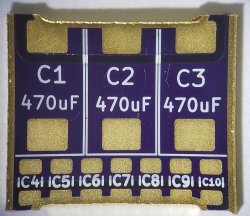
The above noise is fine. That combination of capacitors was stable in intense games, no problem, but I think I could do better. That's why I added MLCC pads to my Tantalizer PCB. Here's what the K-sim of my recommended combination looks like (3x470uF TaPol + 3x22uF MLCC + 3x10uF MLCC)...[
That gets the combined frequency response curve below the 10mOhm threshold I'm shooting for. But notice that the capacitors I chose target the 1-3MHz frequency? That's the noise I measured! I think this is the easiest and cheapest solution, since you only have to buy 2 additional caps. It's easier to source them and to keep them separate while installing. However, the curve can be theoretically improved using this combination...
...But it's more expensive sourcing 47uF MLCCs and keeping 6 different MLCCs separate during installation is annoying. It does look sweet on paper, but who knows if the real world performance is worth the added expense and headache. Also, it could result in worse performance, since it's doesn't reduce the 1-3MHz noise as much as my targeted approach does (theoretically. I still need to measure the results). EDIT: Here are the measurements for the tantalizers on the CPU...
Noise on the CPU went down predictably. It's well under control now, but there appears to be more noise on the RSX now. It is stable. Perhaps the RSX needs MLCCs also, IDK. It's possible that an anti resonance peak in the CPU side has amplified the noise in the RSX side, but it's still under the threshold and not causing problems, so I'll leave it alone until it does. However, it's up to you what you populate the PCB with, so you can
play with the K-sim and come up with a frequency response curve you like.