PS3 (Research/Experimental) - NEC/TOKIN Capacitors Replacement - YLOD

@SeanRanklin , why don't you reach out to @squeept to see if you can work out some sort of deal for him to do the repair for you? It would help further our research because he has all of the tools to properly document and diagnose the repair? I'm sure he would love the chance to prove its a bga issue and not a tokin issue....lol
See if he is interested and hope you can come to an agreement.

I'm not very familiar with the users on this board. I've only ever really had one main topic on here and that was revolving around the same issue i am still facing till this day. Chances are i wouldnt be able to post it to them either as i am certain i am on a different continent lol

I am leaning towards the tokin as the issue only occurs on a limited amount of certain games. Certain games trigger the shut down while other games can be played for hours with no issue. I would assume if its a BGA issue the console wouldnt boot
 
Hello All!

First time posting here - please be gentle.

After reading god knows how many pages of this, we have at least two schools of thoughts.

1) A large portion of the YLODs experienced by PHAT PS3s are caused by NEC/TOKIN Capacitors dying over time, just as they did in Toshiba laptops back in the day. This may or may not be exacerbated by the incredible heat cycles that the PS3 goes through. Reballing the GPU and CPU isn't necessary in the majority of cases.

2) The idea of replacing NEC/TOKIN Capacitors with Tantalum Capacitors is stupid because the properties of the Tantalum Capacitors are completely different to that of the NEC/TOKIN Capacitors.

The primary proponent of the 2nd idea is a poster called @squeept who definitely does have a vested interest in that he sells reballed PS3s. However, that doesnt make him wrong, and it doesn't make him right.

He has said that the vast majority of NEC/TOKIN Capacitors he has found are absolutely fine. He has also said that whilst the capacitance of the NEC/TOKIN Capacitors does change with heat, they do so only temporarily and so the idea that reballing is fixing these machines because it heats up the secaps is folly. Again, this may or may not be true, but I wonder if there could be a different issue with the caps. They way they are on the board makes it unlikely that it could be a contact issue, but are these caps not in layers? @squeept has been testing them by pulling them off the board... which would presumably push these layers together allowing them to work again.

What I am interested in right now, is whether we can come up with a guide on how to diagnose what the actual issue is.

One of the things he said early on is, to try to put a lot of weight on the GPU/CPU and see if it turns on. That seems like a sensible step 1 - the caps aren't affected. If so, it implies a problem with the RSX/CPU not the caps?

Could that be a good first step, and if so, what would be the second step (before yanking caps off the board)
Just my two cents = i cant weigh in for YLODs that occur as soon as the console turns on, but for YLODs caused only by certain games and at certain points of the game, it MUST be the capacitors. As i have had webman running and monitoring the tmperatures whle running games that are known to cause the shutdown and they are PERFECTLY fine. I can run other demanding games such as uncharted 1 and have the temps go rather high and no shutdown. Yet on others like GT6 and Tekken tag, i get them almost instantly.
 
Just my two cents = i cant weigh in for YLODs that occur as soon as the console turns on, but for YLODs caused only by certain games and at certain points of the game, it MUST be the capacitors. As i have had webman running and monitoring the tmperatures whle running games that are known to cause the shutdown and they are PERFECTLY fine. I can run other demanding games such as uncharted 1 and have the temps go rather high and no shutdown. Yet on others like GT6 and Tekken tag, i get them almost instantly.
GPU and cpu demand lots of power in those games. If is capacitance problems or degradation of NEC/TOKIN, there is not enough voltage to supply them,
 
Hey guys, i am yet again here, because my PS3 is not working. I removed all tantalums, cleaned everything with IPA (very hard to get these days) and resoldered them.
But nothing, I get instant YLOD.
How likely is it that with philips branded high quality tantalums that this problem will propably dissapear? I would have to order them from china, which is not very easy for me, as I am very in fear of the virus... But it should be dead / inactive after 8 hours, so this should be fine.

Hiya, if you have a multimeter, that measures capacitance, you could measure (out of circuit) each capacitor's capacitance and also its voltage, can use like a 1.5V AA or AAA battery to charge up the cap so you can measure it under a load too. To see if the caps are matching their rated values and are fitting with your calculations.

Why? Because caps sourced from China, that aren't coming from a well-known established authorized distributer, carries the risk of not having passed through strict quality assurance controls. Meaning, instead of a guaranteed Class-A quality capacitor (for example) the caps could be Class-B, Class-C, Class-D, etc, etc.

Also, the caps from China could be old stock, from decades ago. That's sometimes why components from the authorized distributers can be much more expensive, because it's new, Class-A quality stock, guaranteed. Point in case:- 50 x 470uF 6.3V Tantalum caps for like $4+ from AliExpress / Chinese eBay sellers, where as from the authorized distributers like DigiKey, Mouser, Farnell, etc, they are much more expensive.

In short, we can never guarantee that what we'll get from sellers in China won't be 2nd class / 3rd rate quality components (or worse). And it makes a huge difference to a device working or not, because if the values are so far off from what they are supposed to be rated as, then it could be like some fellow PS3 comrades have seen here - a cheap 470uF rated cap from China will actually measure as 350uF in a person's hands. And when we are trying to match the NEC/Tokin 1000uF / 1200uF (with their rated 20% plus, or 20% minus of that 1000uF / 1200uF) then minimum values really matter, because if we go under the minimum value the NEC/Tokins provided to the CELL / RSX then it seems the YLOD will still be there.

And maybe even if we used 1%, 5%, 10% (+/-) 'tight' valued Class-A capacitors, with quality & value ratings guaranteed, sourced from the authorized distributers, then still there is the following information to consider:- (below is a link to NEC/Tokin's own datasheet - (test2) using the '0E108' 1000uF)
https://web.archive.org/web/2007121...-tokin.com/product/cap/proadlizer/test02.html
(The guys from way back on Page 6 posted this, but the link didn't work, so here is the web archive link version)

....basically NEC shows to replace one of their 1000uF NEC/Tokin caps, we would need approx' 1200uF, using a combination of big tantalums (220uF in the NEC's example) capacitors and an array of small (10uF) MLCC (ceramic caps). The large tantalums for passing (fast transit) the low frequencies and the small MLCC caps for passing the high frequencies with fast response times. The special part of a single NEC/Tokin cap is that it can handle both low & high frequencies, all in one unit, so this is something to consider when trying to match the values of a replaced NEC/Tokin cap.

We can see what Sony did when they started replacing the NEC/Tokins with TANs + MLCCs combinations on the later PS3 boards, here is a link where we can see photos of PS3 board revisions / evolutions, and can see Sony adding more TANs + MLCCs:-
https://www.psdevwiki.com/ps3/Motherboard_Revisions

Seems that Sony didn't replace the NEC/Tokins like NEC suggested in the NEC 'datasheet' (test2). Because instead of 4 x 220uF Tans' and 35 x 10uF MLCCs, Sony decided to up the value of the Tans' to 470uF and reduced the number of MLCCs by alot, Sony's replacement version has (approx) 2 to 3 x MLCCs for every 1 x 470uF Tan' (photo below is from @littlebalup and his KTE-001 board, posted on Page 6 of this guide)

YMQ9IFW.png
 
Just my two cents = i cant weigh in for YLODs that occur as soon as the console turns on, but for YLODs caused only by certain games and at certain points of the game, it MUST be the capacitors. As i have had webman running and monitoring the tmperatures whle running games that are known to cause the shutdown and they are PERFECTLY fine. I can run other demanding games such as uncharted 1 and have the temps go rather high and no shutdown. Yet on others like GT6 and Tekken tag, i get them almost instantly.
Makes sense as a likely cause.

One of my PS3s that I've had from new is YLODing at turn on.

So for that, what is best diagnostic test?

1) Weight on the CPU/GPU?
2) What is the next test.?
 
Makes sense as a likely cause.

One of my PS3s that I've had from new is YLODing at turn on.

So for that, what is best diagnostic test?

1) Weight on the CPU/GPU?
2) What is the next test.?
You could heat up NEC/ TOKIN'S with hair dryer or heat gun to see if the console might boot. I would not put pressure on cpu/gpu until you are certain it is a solder joint problem. And be Careful not to cook your console! Heating up the NEC/TOKIN'S!:D
 
Thats exactly what i have been told in the past. Only certain games cause this, thats why i dont believe its BGA related.
Happened to me with my CECHA01, CECHE01 and CECHL01. They all were having issues with certain games like TloU , Tekken Tag Tournament 2 , Bioshock Infinite, etc. After replacing all the NEC's in bottom of the mobo with proper tantalum capacitors with value of 330uf and 2.5v (4 tantalums per each tokin) , all these PS3 are working right now till this day since the replacement without any kind of issue.
 
You could heat up NEC/ TOKIN'S with hair dryer or heat gun to see if the console might boot. I would not put pressure on cpu/gpu until you are certain it is a solder joint problem. And be Careful not to cook your console! Heating up the NEC/TOKIN'S!:D
Okay - so I just did this (funnily enough, without seeing this post)

I was trying to work out what squeebz meant about putting pressure on something (I'll have to go through his posts and find it) but couldnt work it out. So thought I'd try and heat up the NEC/Tokins with a heat gun and see what happens.

The console - PAL CECHG03

So - this is a CECHG03 (no backwards compatibility, so not bothered about killing it). I've had this console from new - in 2008 I think.

It's never had a problem until last year. I've replaced the thermal paste on tops of the heat spreaders several times, and cleaned it out ever a couple of years. Last year I gave it to my sister so she could watch "Sky TV" in her flat. Thats what it was used for (a TV box) for about a month until it YLODd

The Problem

So since then it's had a YLOD problem. You push the button and it turns off immediately flashing Yellow once.

The test

So I heated the NEC/TOKIN's for a few minutes. The whole board definitely got hotter in that time, not just the NEC/Tokins, but the heat gun was aimed at the caps, not the GPU.

I quickly re-assembled the UNIT and turned it on. Low and behold it turns on. It ran for 10 minutes before turning off.

So what does this tell us? Well - not a lot? Either

a) the balls in the RSX chip heated up enough to get a better connection for a while whilst the board was still hot. or.
b) the heat helped the NEC/TOKIN's regain enough conductivity to allow the board to function (either by getting better internal connections themselves or through whatever function allows them to have capacitance)

Except the board is hypothetically 'saveable'.
 
Last edited:
Okay - so I just did this (funnily enough, without seeing this post)

I was trying to work out what squeebz meant about putting pressure on something (I'll have to go through his posts and find it) but couldnt work it out. So thought I'd try and heat up the NEC/Tokins with a heat gun and see what happens.

The console - PAL CECHG03

So - this is a CECHG03 (no backwards compatibility, so not bothered about killing it). I've had this console from new - in 2008 I think.

It's never had a problem until last year. I've replaced the thermal paste on tops of the heat spreaders several times, and cleaned it out ever a couple of years. Last year I gave it to my sister so she could watch "Sky TV" in her flat. Thats what it was used for (a TV box) for about a month until it YLODd

The Problem

So since then it's had a YLOD problem. You push the button and it turns off immediately flashing Yellow once.

The test

So I heated the NEC/TOKIN's for a few minutes. The whole board definitely got hotter in that time, not just the NEC/Tokins, but the heat gun was aimed at the caps, not the GPU.

I quickly re-assembled the UNIT and turned it on. Low and behold it turns on. It ran for 10 minutes before turning off.

So what does this tell us? Well - not a lot? Either

a) the balls in the RSX chip heated up enough to get a better connection for a while whilst the board was still hot. or.
b) the heat helped the NEC/TOKIN's regain enough conductivity to allow the board to function (either by getting better internal connections themselves or through whatever function allows them to have capacitance)

Except the board is hypothetically 'saveable'.
At least the heat gun let you know something? Or is (A) and (B) problems not a good point in the right direction to diagnose at least close to the problem so I would call this learning something know?
 
At least the heat gun let you know something? Or is (A) and (B) problems not a good point in the right direction to diagnose at least close to the problem so I would call this learning something know?
Yeah it's great news in that the board works.

But I'm none the wiser as the cause of my YLOD. Is it bad caps. Does it need a reball.
 
I think I'm going to try and replace the caps. Just to test what happens really, as I say I it's not a BC board so I'm not overly bothered what happens to it.

If replacing the caps 'solves' the YLOD or even makes it better, I'm not sure how Sqeeubz can argue it does nothing. But that's getting ahead of ourselves
 
I think I'm going to try and replace the caps. Just to test what happens really, as I say I it's not a BC board so I'm not overly bothered what happens to it.

If replacing the caps 'solves' the YLOD or even makes it better, I'm not sure how Sqeeubz can argue it does nothing. But that's getting ahead of ourselves
People do what they like to do if it's fun for them than f..k it. Hobbys always have their opinions. Of course the technical side of it does have merit.
 
Happened to me with my CECHA01, CECHE01 and CECHL01. They all were having issues with certain games like TloU , Tekken Tag Tournament 2 , Bioshock Infinite, etc. After replacing all the NEC's in bottom of the mobo with proper tantalum capacitors with value of 330uf and 2.5v (4 tantalums per each tokin) , all these PS3 are working right now till this day since the replacement without any kind of issue.
Hey! That's sounds very promising and just like my problem! However when you say replace all on the bottom, you don't just mean the 2 per RSX and 2 per CPU do you? Or do you mean the other side of the mobo?

Also, I'm putting new tokins instead of Tantalums, should be fine?
 
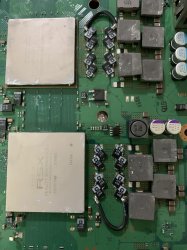
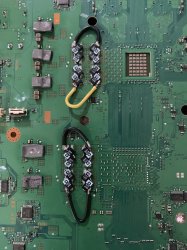
Just to share: I had fully replace NEC Tokin for 3 Ps3 (CECHA01 Jap, CECHE01 Jap and CECHE06 USA) with 32 piece of 470 uf Capacitor. All 3 set are working very well since then. Photo taken from one of the set I did.
I also replaced the thermo pad and thermo paste after replacing the capacitors. Used electric tape to insulate the metal shield covering the capacitors.

Hope it helps those working to restore dead PS3.
 

Attachments

  • 2AB582D4-2FC2-41CB-9CE0-00C3CE409A5B.jpeg
    2AB582D4-2FC2-41CB-9CE0-00C3CE409A5B.jpeg
    1.9 MB · Views: 188
  • A4668624-E5E9-43B6-BCD5-E935BC303709.jpeg
    A4668624-E5E9-43B6-BCD5-E935BC303709.jpeg
    2.2 MB · Views: 700
Hey! That's sounds very promising and just like my problem! However when you say replace all on the bottom, you don't just mean the 2 per RSX and 2 per CPU do you? Or do you mean the other side of the mobo?

Also, I'm putting new tokins instead of Tantalums, should be fine?
Yep! for a total of 50% tantalums and 50% NEC TOKIN's , these PS3's are working since november 2019 after the replacement dude! hope u can fix ur PS3.

P.D: Before the replacement i used a heat gun to heat all the NEC's on those PS3's and they started to work fine again but you know that NEC TOKIN's will start failing again soon or later, so i did what is posted in this thread and now im so happy with my beloved consoles :)
 
Just to share: I had fully replace NEC Tokin for 3 Ps3 (CECHA01 Jap, CECHE01 Jap and CECHE06 USA) with 32 piece of 470 uf Capacitor. All 3 set are working very well since then. Photo taken from one of the set I did.
I also replaced the thermo pad and thermo paste after replacing the capacitors. Used electric tape to insulate the metal shield covering the capacitors.

Hope it helps those working to restore dead PS3.
Well done! Can I ask what testing you've done on these since then? Hours of testing on games and heat cycles?
 
Yep! for a total of 50% tantalums and 50% NEC TOKIN's , these PS3's are working since november 2019 after the replacement dude! hope u can fix ur PS3.

P.D: Before the replacement i used a heat gun to heat all the NEC's on those PS3's and they started to work fine again but you know that NEC TOKIN's will start failing again soon or later, so i did what is posted in this thread and now im so happy with my beloved consoles :)
Yes will definitely let you know how I go.
 
Back
Top