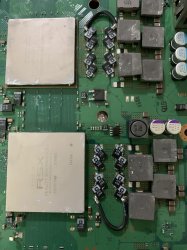
Hey guys, i am yet again here, because my PS3 is not working. I removed all tantalums, cleaned everything with IPA (very hard to get these days) and resoldered them.
But nothing, I get instant YLOD.
How likely is it that with philips branded high quality tantalums that this problem will propably dissapear? I would have to order them from china, which is not very easy for me, as I am very in fear of the virus... But it should be dead / inactive after 8 hours, so this should be fine.
Hiya, if you have a multimeter, that measures capacitance, you could measure (out of circuit) each capacitor's capacitance and also its voltage, can use like a 1.5V AA or AAA battery to charge up the cap so you can measure it under a load too. To see if the caps are matching their rated values and are fitting with your calculations.
Why? Because caps sourced from China, that aren't coming from a well-known established
authorized distributer, carries the risk of not having passed through strict quality assurance controls. Meaning, instead of a guaranteed Class-A quality capacitor (for example) the caps could be Class-B, Class-C, Class-D, etc, etc.
Also, the caps from China could be old stock, from decades ago. That's sometimes why components from the authorized distributers can be much more expensive, because it's new, Class-A quality stock, guaranteed. Point in case:- 50 x 470uF 6.3V Tantalum caps for like $4+ from AliExpress / Chinese eBay sellers, where as from the authorized distributers like DigiKey, Mouser, Farnell, etc, they are much more expensive.
In short, we can never guarantee that what we'll get from sellers in China won't be 2nd class / 3rd rate quality components (or worse). And it makes a huge difference to a device working or not, because if the values are so far off from what they are supposed to be rated as, then it could be like some fellow PS3 comrades have seen here - a cheap 470uF rated cap from China will actually measure as 350uF in a person's hands. And when we are trying to match the NEC/Tokin 1000uF / 1200uF (with their rated 20% plus, or 20% minus of that 1000uF / 1200uF) then minimum values really matter, because if we go under the minimum value the NEC/Tokins provided to the CELL / RSX then it seems the YLOD will still be there.
And maybe even if we used 1%, 5%, 10% (+/-) 'tight' valued Class-A capacitors, with quality & value ratings guaranteed, sourced from the authorized distributers, then still there is the following information to consider:- (below is a link to NEC/Tokin's own datasheet - (test2) using the '0E108' 1000uF)
https://web.archive.org/web/2007121...-tokin.com/product/cap/proadlizer/test02.html
(The guys from way back on Page 6 posted this, but the link didn't work, so here is the web archive link version)
....basically NEC shows to replace one of their 1000uF NEC/Tokin caps, we would need approx' 1200uF, using a combination of big tantalums (220uF in the NEC's example) capacitors and an array of small (10uF) MLCC (ceramic caps). The large tantalums for passing (fast transit) the low frequencies and the small MLCC caps for passing the high frequencies with fast response times. The special part of a single NEC/Tokin cap is that it can handle both low & high frequencies, all in one unit, so this is something to consider when trying to match the values of a replaced NEC/Tokin cap.
We can see what Sony did when they started replacing the NEC/Tokins with TANs + MLCCs combinations on the later PS3 boards, here is a link where we can see photos of PS3 board revisions / evolutions, and can see Sony adding more TANs + MLCCs:-
https://www.psdevwiki.com/ps3/Motherboard_Revisions
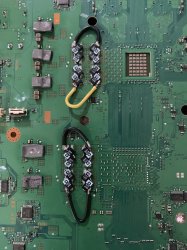
Seems that Sony didn't replace the NEC/Tokins like NEC suggested in the NEC 'datasheet' (test2). Because instead of 4 x 220uF Tans' and 35 x 10uF MLCCs, Sony decided to up the value of the Tans' to 470uF and reduced the number of MLCCs by alot, Sony's replacement version has (approx) 2 to 3 x MLCCs for every 1 x 470uF Tan' (photo below is from
@littlebalup and his KTE-001 board, posted on Page 6 of this guide)