PS3 (Research/Experimental) - NEC/TOKIN Capacitors Replacement - YLOD

@ElGris ...Hiya mate, please could you let me know what size gauge wire you used, i've been using 22-23AWG solid wire, but i see alot of people using what seems like 20AWG and/or 18AWG stranded. So i'm in the middle of re-doing the bridge wires and was wondering what you had used?

Also @cfreddykrueger, and @Yugonibblit, and others, what size gauge did you guys use for the bridge wires, and were they solid, or stranded? Soz to bring up old posts, you guys prolly busy now, rinsing out 'The Last of Us' on your Super Ultra PS3s (wings of gold edition) :angel:
Haha, I don't even know what kind of "sizes" are those. I only, and always used ATX wires on my fatties, and all of them just ran fine. Never had those "melted wires" problem, since I believe those might be related to bad soldering or something bad in the 12V stage. Make them double, two wires per processor, one in one side.

s-l300.jpg
 
To be honest bro, your 1st attempt was actually really good, for someone who has never soldered before as you mentioned, i was super impressed with your de-soldering & soldering work. I think you have a natural talent for it. As you said - this is not an easy job, many here with a spectrum of experience are finding it difficult.

Add to that, like others have said here too - this board needs to get really hot for the solder to wet properly, i found i had to go upto 433°C with a phat flat iron tip else i would keep getting cold solders, and de-soldering under 433°C, like at 400°C, was difficult too.

So with the tools you had, you did a great job. Took me years until i could do what you did on your 1st attempt.
Hey thanks so much for the kind words buddy!

As you said, the board just needs to be extremely hot to get this done and I just don't have the tools. My main issues were removing the metal strips from the old tantalums on the positive poles and keeping the solder warm while placing the tantalums down... as soon as I'd lift the wand, the solder would solidify!
 
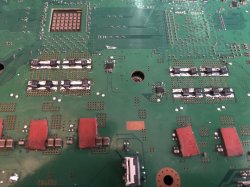
Well, maybe that's the end for me? I've finished replacing all my tokins tonight on both sides of the board, tested continuity, checked all my solder points with a magnifying lens and... Nothing. Still getting a ylod. I'm going to get an oscilloscope soon so I can do some more investigating, but in the meantime I'm at a total loss. Any suggestions? Anything I missed?
 

Attachments

  • 11EFB89F-853A-4294-9CA8-989BDD3816B6.jpeg
    11EFB89F-853A-4294-9CA8-989BDD3816B6.jpeg
    344.4 KB · Views: 163
  • 782FB242-B334-4850-B406-9FC581F56699.jpeg
    782FB242-B334-4850-B406-9FC581F56699.jpeg
    301.6 KB · Views: 161
  • 1F1E40F4-8859-4354-8ABA-44E3F7D79F40.jpeg
    1F1E40F4-8859-4354-8ABA-44E3F7D79F40.jpeg
    347 KB · Views: 162
Well, maybe that's the end for me? I've finished replacing all my tokins tonight on both sides of the board, tested continuity, checked all my solder points with a magnifying lens and... Nothing. Still getting a ylod. I'm going to get an oscilloscope soon so I can do some more investigating, but in the meantime I'm at a total loss. Any suggestions? Anything I missed?

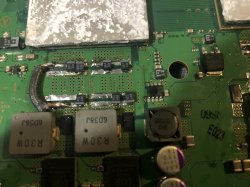
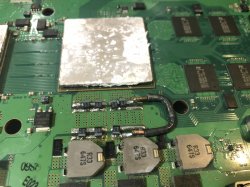
Hey don't give up. My only suggesting is adding one more jumper for the RSX and for the CELL like I did for mine.

Also... really look over both sides of the boards and all of the components. Make sure everything's still there.

It can be so easy to knock off one of those little tiny fuses, capacitors etc. Trust me I've done it before and it sucks.

I tried my hand at delidding one of my perfectly working A01's before and accidentally knocked some of these off. This was my second delid and my first one was successful so I was pretty confident.
b6a2d2e7f9e0c1f640504dd1ec26aea4.jpg


I'm not saying this is your problem but it's always a possibility.


https://gamesx.com/wiki/lib/exe/fetch.php?media=schematics:sony_playstation3_service_manual.pdf


Sent from my iPhone using Tapatalk
 
Hey don't give up. My only suggesting is adding one more jumper for the RSX and for the CELL like I did for mine.

Also... really look over both sides of the boards and all of the components. Make sure everything's still there.

It can be so easy to knock off one of those little tiny fuses, capacitors etc. Trust me I've done it before and it sucks.

I tried my hand at delidding one of my perfectly working A01's before and accidentally knocked some of these off. This was my second delid and my first one was successful so I was pretty confident.
b6a2d2e7f9e0c1f640504dd1ec26aea4.jpg


I'm not saying this is your problem but it's always a possibility.


https://gamesx.com/wiki/lib/exe/fetch.php?media=schematics:sony_playstation3_service_manual.pdf


Sent from my iPhone using Tapatalk

59ea1072b32e04872fa7c48a08f654ea.jpg


Other than adding the other two jumpers and double checking the whole mother board for missing components I'm not sure what else to suggest at the time. Keep your head up though. Maintaining these old systems can be taxing mentally at times. So stay positive and have confidence in yourself.


Sent from my iPhone using Tapatalk
 
Well, maybe that's the end for me? I've finished replacing all my tokins tonight on both sides of the board, tested continuity, checked all my solder points with a magnifying lens and... Nothing. Still getting a ylod. I'm going to get an oscilloscope soon so I can do some more investigating, but in the meantime I'm at a total loss. Any suggestions? Anything I missed?
The caps look rather small, how were they able to stay upright? What values are those?
Cfreddys' caps are the usual size and alignment in these fixes.

Sent from my TRT-LX2 using Tapatalk
 
@ElGris ...Hiya mate, please could you let me know what size gauge wire you used, i've been using 22-23AWG solid wire, but i see alot of people using what seems like 20AWG and/or 18AWG stranded. So i'm in the middle of re-doing the bridge wires and was wondering what you had used?

Also @cfreddykrueger, and @Yugonibblit, and others, what size gauge did you guys use for the bridge wires, and were they solid, or stranded? Soz to bring up old posts, you guys prolly busy now, rinsing out 'The Last of Us' on your Super Ultra PS3s (wings of gold edition) :angel:
@Workz_777 , I have used an old extension cord for jumper 16awg, copper strands, but that was just to test this tutorial, I do have pics, in this thread, but, I use 14awg solid copper wire,90/105 temp rating, u can find this by using some old electrical household romex wire, but 18awg, solid copper will work just fine. Anything smaller will get hot.:noobzilla:
 
Well, maybe that's the end for me? I've finished replacing all my tokins tonight on both sides of the board, tested continuity, checked all my solder points with a magnifying lens and... Nothing. Still getting a ylod. I'm going to get an oscilloscope soon so I can do some more investigating, but in the meantime I'm at a total loss. Any suggestions? Anything I missed?
Know the feeling. Mate..we will get it all of them going
I wanted to ask would puting jumper wire both sides fix a delayed ylod. Maybe 2 -4 seconds delayed
This motherboard has a short on12v line which got fixed
Please
Thanks
 
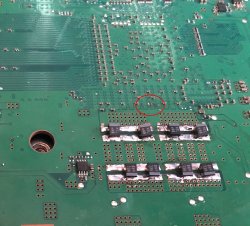
Those caps ARE tiny! But they're definitely on spec, 330uf and 2.5v (here's the link -- https://www.newark.com/kemet/t520b337m2r5ate009/cap-tant-polymer-330uf-2-5v-case/dp/49Y1307)

They were a lot easier to solder than soldering bigger caps on an angle, and I don't have to worry about space under the heat shield. Once the pad was clean, installation was pretty simple:
  • Add a bit of solder to the pad
  • Add a bit of flux
  • set the cap down in place -- the flux helps a bit
  • use the flat end of my trusty pick to hold it down
  • solder one side
  • turn the board and solder the other
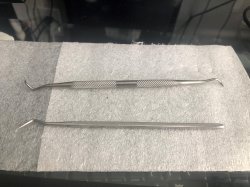
Seriously, buying those picks are one of the most useful tools I've added to my kit. They help clean, position parts, hold parts down, etc. I've attached a pic of two of the ones I used.

I actually am missing a cap... It's on the bottom side of the board, on the RSX side (see picture). I still have the little sucker, but i can't put it back on, pick or no pick, because I only have a flat solder tip, and I need to pick up needle-nose tip.

As far as adding another jumper wire, I guess I can try that? I'll have to move some caps around to make room, but why not :)
Thanks all, this community is awesome.
 

Attachments

  • 20200502_162547654_iOS (2).jpg
    20200502_162547654_iOS (2).jpg
    2.1 MB · Views: 123
  • 20200428_125442664_iOS cropped.jpg
    20200428_125442664_iOS cropped.jpg
    2.3 MB · Views: 402
6932a4da7cc6f1198b139bca1dde44fa.jpg

@Workz_777

Here's the wire I used for my jumper. I found it at work so I don't have a link.

It's 18 awg single conductor good for 105 c at 600 volts or 90 c at 1000 volts. Well we're getting nowhere near those temps so we're good [emoji1787]

Hope this helps

abd4bb458bfe256fd95420ba746ac339.jpg

c43cd7c1e6de14fd108c81c71ee806a8.jpg


Sent from my iPhone using Tapatalk

Thanks so much, that's most appreciated, wow nice using solid copper core 18AWG i wish i had some around the house, most i have is 20AWG stranded, i might see what i can find online.
 
Haha, I don't even know what kind of "sizes" are those. I only, and always used ATX wires on my fatties, and all of them just ran fine. Never had those "melted wires" problem, since I believe those might be related to bad soldering or something bad in the 12V stage. Make them double, two wires per processor, one in one side.

s-l300.jpg

Thanks for that, yeah i have an old PSU which i could use its 12V wires, was thinking about that before too. Good to know what size bridge wires you guys have been using for your success stories.
 
@Workz_777 , I have used an old extension cord for jumper 16awg, copper strands, but that was just to test this tutorial, I do have pics, in this thread, but, I use 14awg solid copper wire,90/105 temp rating, u can find this by using some old electrical household romex wire, but 18awg, solid copper will work just fine. Anything smaller will get hot.:noobzilla:

Thanks for the info it's most appreciated, yeah i would like to go for a thick gauge like those, i only have at home 23awg solid, or 20awg stranded, so i think i'll aim to get some 18awg - 14awg solid copper, either from stuff around the house, or online.

I was reading:- stranded wire is better for AC because of the "skin effect", where the high frequencies travel on the skin of the wire, and the low frequencies travel through the core. And then solid wire is better for DC, where there is little to no skin effect happening, but i only became aware of this recently so i could have that totally back-to-front lol. :confused:
 
Well, maybe that's the end for me? I've finished replacing all my tokins tonight on both sides of the board, tested continuity, checked all my solder points with a magnifying lens and... Nothing. Still getting a ylod. I'm going to get an oscilloscope soon so I can do some more investigating, but in the meantime I'm at a total loss. Any suggestions? Anything I missed?

Hiya, i too was trying with some small size B caps like yours (mine were 470uF - 2.5V), also tried adding some 10uF - 25V MLCCs (see photo) but had no success.

I tried just doing the RSX 1st but still had YLOD, then tried doing the CELL same way as seen in the photo, but no joy. Then i tried without any MLCCs and only had 4 x 470uFs per NEC/Tokin replacement, which was all of them in the end, on both sides, for both RSX & CELL, but still had YLOD.

So i've ordered some size D Panasonic caps in the meantime and desoldered everything. I also have some 470uF 6.3V AVX type around the house that i could try while waiting for the Panasonics to arrive, all being well. I need to replace the bridge wires anyway.

I might have missed the post, but i don't think i have seen a success story using the smaller size B caps yet, seems most / all success stories are with the size D caps. Although it shouldn't make a difference, but maybe there is a tradeoff.

Will aim to update when trying with other caps and larger gauge bridge wires soon, all being well.


ps3_caps.JPG
 
Last edited:
Hiya, i too was trying with some small size B caps like yours (mine were 470uF - 2.5V), also tried adding some 10uF - 25V MLCCs (see photo) but had no success.

I tried just doing the RSX 1st but still had YLOD, then tried doing the CELL same way as seen in the photo, but no joy. Then i tried without any MLCCs and only had 4 x 470uFs per NEC/Tokin replacement, which was all of them in the end, on both sides, for both RSX & CELL, but still had YLOD.

So i've ordered some size D Panasonic caps in the meantime and desoldered everything. I also have some 470uF 6.3V AVX type around the house that i could try while waiting for the Panasonics to arrive, all being well. I need to replace the bridge wires anyway.

I might have missed the post, but i don't think i have seen a success story using the smaller size B caps yet, seems most / all success stories are with the size D caps. Although it shouldn't make a difference, but maybe there is a tradeoff.

Will aim to update when trying with other caps and larger gauge bridge wires soon, all being well.


View attachment 25665

There's something you and many people are overlooking. What kind of YLOD you have?

Are you sure you're not having a short somewhere? The YLOD in its original state was instant or slow? In my experience, if the YLOD is slow, the fix is straightforward. Can you perform the fan test? On most PS3 with delayed YLOD you can activate it, on shorted PS3 you should not. I'll recommend you to see the RSX caps' state, if they are shorting or not, or if you made a delid, check if you didn't damage any die.

P/S: Pretty clean and pro job on that mobo
 
Got a whole bunch of notifications and apparently stuff wasn't getting to my e-mail, so if anyone still wanted anything I'll stay logged in for a few days to make sure I see it this time.

I must repeat: I do not repair consoles FOR people. I'll pay you cash money for whatever broken, butchered junk you have laying around, but I absolutely DO NOT engage in repair contracts with individuals. I only offered warranty-less, as-is, at-cost repair for delidding scratches because nobody else does it so I'd be saving them from the trash. Anything else you can go get scammed by your local repair shop like everybody else.

"Anything else you can go get scammed by your local repair shop like everybody else"

I must say..

https://i.pinimg.com/originals/07/12/0b/07120bd2aefcbd516154277d42d6cdb2.jpg


I laughed so hard lol!!!
 
I think slow/fast is a bit hard to measure, since it all happens relatively quick. I recorded the whole process, tried a couple of times, and it seems consistent at around 3-4 seconds. If you crank the volume up, you can even hear the clicks of the power supply switching on and off.

Another interesting factor is that i can't trigger than fan test! I've put everything back together, just in case, but it just won't go. If i just press the eject button, i get 3 quick beeps, which IIRC indicates there's no disk in the drive. If i follow the correct process (rear switch off, hold eject, rear switch on), it just sits there and then gives me the three beeps. Maybe that's an indicative of... something?

Here's the video

 
I think slow/fast is a bit hard to measure, since it all happens relatively quick. I recorded the whole process, tried a couple of times, and it seems consistent at around 3-4 seconds. If you crank the volume up, you can even hear the clicks of the power supply switching on and off.

Another interesting factor is that i can't trigger than fan test! I've put everything back together, just in case, but it just won't go. If i just press the eject button, i get 3 quick beeps, which IIRC indicates there's no disk in the drive. If i follow the correct process (rear switch off, hold eject, rear switch on), it just sits there and then gives me the three beeps. Maybe that's an indicative of... something?

Here's the video


Here's a video of my YLOD before changing my first Nec/Tokin.


Sent from my iPhone using Tapatalk
 
Here's a video of my YLOD before changing my first Nec/Tokin.


Sent from my iPhone using Tapatalk

That seems to be about the same amount of time as mine! Here's another thing i noticed while tinkering with the tests -- when my system first died, and before I made any modifications, it would power on, get a ylod, then start blinking red. At that point, it would become completely non-responsive and none of the buttons would do anything until I flipped the switch in the back.

Now, however, when it goes into ylod it still sits there blinking, but if i touch the power button, it actually stops blinking. It still goes into ylod if i push the power button again, and if I push the eject button it still gives me the 3 beeps and nothing happens. So is my device in a different state now than before?
 
Back
Top