PS3 (Research/Experimental) - NEC/TOKIN Capacitors Replacement - YLOD

My guess is I'm not soldering the capacitors correctly on the rail or I'm shorting something somewhere. Or maybe I messed up the repasting after delid. Any suggestions? Has anyone removed a nec tokin and tried booting. Do you get ylod or glod?Thanks in advance.
In short, yes. Start on page 137. That documents PS3#1 (YLOD), in which I did get a GLOD after multiple failed attempts with the capacitor replacement. If you want to follow that PS3 from the very beginning you can read more on SHMUPS. To summarize my experience so far with this mod:
  1. PS3#1 (YLOD) was and wasn't "fixed" after multiple capacitor attempts. Yes it did boot, then it failed. Then I resoldered things, it booted again and failed shortly thereafter - for various reasons you can read all about. This culminated in graphical artifacts that led me to attempt a reflow, which resulted in a GLOD. I then attempted my first reball...which didn't end well.
  2. PS3#2 (YLOD) was initially "fixed" by the cap replacement too. It seemed solid for the first few thermal cycles, then it YLOD again. I got SYSCON error logs and O-scope measurements that indicate the tantalum bypass caps are working. I concluded that an BGA crack initially made contact from the minute flex in the board caused by installing the tantalum caps. It took a while for that that flex to relax. After a few thermal cycles the YLOD returned when the crack broke the connection again. It must have always been there and the fact that the cap replacement initially worked was all a diversion, a RED HERRING. I now believe this was the case with PS3#1 as well. I'm starting to think this whole Tantalum "fix" is BS. I'm waiting on a nozzle for my second reball attempt.
  3. PS3#3 is a working console that gave me stock oscilloscope measurements to use for control. It showed me that the measurements I made on the tantalum caps from PS3#2 had a normal level of noise. Thus they are working. The current YLOD isn't due to bad caps.
  4. PS3#4 (YLOD) still has stock Tokins that I'll get some scope images off soon. This should prove if they are good or bad. If they're good, that's the final nail in the coffin for me personally. That'll make 3 strait console not caused by bad caps. If bad caps caused the YLOD more often than cracked solder balls or die bumps, as the "narrative/myth" suggests, then the chances of getting 3 YLOD consoles in a row that couldn't be fixed with Tantalum bypass caps is unlikely. Perhaps it's not proof, but I'm not going to spend the money on enough consoles to get a statistically significant sample.
 
In short, yes. Start on page 137. That documents PS3#1 (YLOD), in which I did get a GLOD after multiple failed attempts with the capacitor replacement. If you want to follow that PS3 from the very beginning you can read more on SHMUPS. To summarize my experience so far with this mod:
  1. PS3#1 (YLOD) was and wasn't "fixed" after multiple capacitor attempts. Yes it did boot, then it failed. Then I resoldered things, it booted again and failed shortly thereafter - for various reasons you can read all about. This culminated in graphical artifacts that led me to attempt a reflow, which resulted in a GLOD. I then attempted my first reball...which didn't end well.
  2. PS3#2 (YLOD) was initially "fixed" by the cap replacement too. It seemed solid for the first few thermal cycles, then it YLOD again. I got SYSCON error logs and O-scope measurements that indicate the tantalum bypass caps are working. I concluded that an BGA crack initially made contact from the minute flex in the board caused by installing the tantalum caps. It took a while for that that flex to relax. After a few thermal cycles the YLOD returned when the crack broke the connection again. It must have always been there and the fact that the cap replacement initially worked was all a diversion, a RED HERRING. I now believe this was the case with PS3#1 as well. I'm starting to think this whole Tantalum "fix" is BS. I'm waiting on a nozzle for my second reball attempt.
  3. PS3#3 is a working console that gave me stock oscilloscope measurements to use for control. It showed me that the measurements I made on the tantalum caps from PS3#2 had a normal level of noise. Thus they are working. The current YLOD isn't due to bad caps.
  4. PS3#4 (YLOD) still has stock Tokins that I'll get some scope images off soon. This should prove if they are good or bad. If they're good, that's the final nail in the coffin for me personally. That'll make 3 strait console not caused by bad caps. If bad caps caused the YLOD more often than cracked solder balls or die bumps, as the "narrative/myth" suggests, then the chances of getting 3 YLOD consoles in a row that couldn't be fixed with Tantalum bypass caps is unlikely. Perhaps it's not proof, but I'm not going to spend the money on enough consoles to get a statistically significant sample.
Thank you so much. I been reading. Have u ever turned on the console with one nec token removed just bare rails? Did you get ylod or glod?
 
Thank you so much. I been reading. Have u ever turned on the console with one nec token removed just bare rails? Did you get ylod or glod?

I've run with 2 each on CPU and GPU missing, console will run fine. 3 each missing, it will try to boot normally but then YLOD immediately after it puts an image on your screen. All 4 missing will IMMEDIATELY turn off, but I can't remember what color it was.
 
that's the final nail in the coffin for me personally

I look forward to welcoming you to the club! (assuming you don't hit the 3 in 100 chance)

I may be an asshole, and the entire premise of this thread is pretty much wrong, but I am grateful for it. It made me revisit a topic I'd entirely written off previously, then find the correct way to diagnose it, and two of the consoles it then eventually saved from the parts bin were CECHA01.
 
Last edited:
I've run with 2 each on CPU and GPU missing, console will run fine. 3 each missing, it will try to boot normally but then YLOD immediately after it puts an image on your screen. All 4 missing will IMMEDIATELY turn off, but I can't remember what color it was.

Any idea why I have glod when I remove a single nec tokin from the gpu?
 
Any idea why I have glod when I remove a single nec tokin from the gpu?

The odds that I've personally seen say you've got a BGA defect or a bad GPU, and your fiddling with it is agitating the defect to behave slightly differently. I absolutely recommend replacing ALL of the TOKIN caps at once if you're going to bother doing it at all, so I'd start there before you spend the money on getting it reballed.
 
Thank you so much. I been reading. Have u ever turned on the console with one nec token removed just bare rails? Did you get ylod or glod?
I have not, but @squeept said he did some tests where a console ran fine with 2 tokins removed! Not that it's recommended...lol! Let me find the quote...yeah, here it is on Page 141:
If you're bothering to do the repair, please replace all of the TOKINs at once. Do it right the first time. While the exact mechanism of failure still isn't clear to me, the failed capacitors need to be removed. I even verified this by moving a bad cap to a console that was running fine with a missing cap, and this caused it to YLOD. Missing capacitance isn't the problem - remember my videos of running just fine with half of the caps removed? There is some kind of short or something when under load, so the bad cap has to go, not just have more capacitance thrown at it.
He said he had video of it, but I can't' find it.

PS3 #4: Update
(...Continued from)
I just ran a SYSCON errlog and got some scope images off the PS3#4:
PS3_4 SYSCON (errlog).JPG

Interestingly you can see the timeline. Since this console hasn't been opened before I did, you can see the date and time of all the errors. That is until I opened the console and disconnected the clock battery. That's when it changed to "clock:0xffffffff". The bunch of extra errors are all the times I flipped the switch to trigger my oscilloscope while taking images.

Looks like this console only has a 3034 (BE Error). Now I haven't removed the NEC/TOKIN caps yet, so this is the error that caused the YLOD. On PS3#2, I didn't have an Oscilloscope when I removed the NEC/TOKINs, nor did I get a SYSCON off of it before installing the Tantalum capacitors. So I don't know if it's errors were there before or if they showed up afterwards. This time I have a before to compare with, if it turns out I need to replace the tokins. Speaking of which, let's see how they are doing...
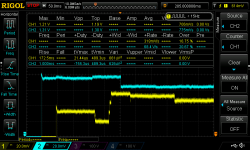
  • CPU = CH1 Yellow
  • RSX = CH2 Blue
PS3#4: YLOD
PS3_4_1.png
PS3_4_2.png
PS3_4_3.png

This one lasts longer than PS3#2. This one YLOD after 1.5 seconds instead of 0.5. This is long enough for it to get past the power up procedure though. When I input the "lasterrlog" command it only displayed the 3034, not all the extra stuff about the powerup procedure. So that fits. Interestingly this doesn't look the same as the startup for PS3#3 or PS3#2. Here they are for comparison:

PS3#2: YLOD (Tantalum Cap "Fix")
CPU_YLOD2.png

PS3#3: Working Stock:

Working_NEC_RSX&BE.png

Notice that PS3#4's CPU skipped a step after the second plateau and doesn't drop down on the last plateau. PS3#4 also jumps up to a High state just before the YLOD, like PS3#2 does, and the duration before the YLOD is about 150ms for both. I wonder if this is a YLOD trigger. They both have a 3034 error, so maybe this is what it looks like on an oscilloscope.

Back to the scope. Here is the noise on the CPU & RSX when zoomed in on the middle plateau...

PS3#4: YLOD

PS3_4_4.png
PS3_4_5.png
PS3_4_6.png

WOW. A lot more noise on the CPU this time! I need to go back and get some better, more comparable, images from the other 2 consoles, but I can already tell the CPU has more noise.

PS3#2: YLOD (Tantalum Cap "Fix")
interesting_signal_normal-png.28549

cpu_plateau_normal-png.28536

cpu_plateau_hires-png.28538

Much less noise on PS3#2 with it's tantalum array & yet that doesn't get rid of the YLOD. That's pretty damning evidences against this mod.

I wonder how far out of wack the bypass caps have to be before the console will experiance any sort of issue. @squeept, you said you had 2 of the tokins off and it kept running? How did the scope look? I wonder how far out of tolerance the (peak to peak) this noise can get before the console YLOD.

My guess is that 50mV P-P is still not far enough out of spec for me to be worried that the caps on this console are bad. They certainly are not as healthy as the ones on PS3#2 (new tantalum), but I need better images from PS3#3 for comparison to a working console. That'll be next.
 
Last edited:
My guess is that 50mV P-P

I deleted all social media awhile ago, so the Youtube videos are gone too. Covid winter will be long and lonely, so I may start streaming on twitch again...

I think there are images somewhere from one of the CECHA01, but I think when it was running fine missing 2, it was more than 200 mv peak to peak. Maybe even 500? The spikes were HUGE and it still ran fine without switching over to the bad waveform.

Keep in mind, though, that this was before you schooled me on being dumb with the ground clip on the outer copper so the noise was much higher. And the 90nm systems seem to be way better with the noise.
 
What voltage should the nec tokin positive and negative rails show with a multimeter and what setting should I set the multimeter on ? If I get some solder on the little holes above the positive rail of the nec tokin on the opposite side of the rsx would that short anything or positive on positive doesn't matter
 
What voltage should the nec tokin positive and negative rails show with a multimeter and what setting should I set the multimeter on ? If I get some solder on the little holes above the positive rail of the nec tokin on the opposite side of the rsx would that short anything or positive on positive doesn't matter
DC Voltage would read 1 - 1.3V +/GND and it shouldn't matter if you get extra solder in those small vias above or below the caps. As long as there are no bridges between +/GND rails and the tiny caps aren't shorted you're fine.

Also resistance between +/GND should read 2.5 - 4 Ohms. Anything less that 0.5ohms is a short. I forgot to note this, but PS3#4 reads a resistance of 3.5Ohms (CPU) and 3.4Ohms (RSX). This is evidence that the NEC/TOKINs and chips are okay (not proof). For comparison, PS3#3, the working stock console I'm using for control, reads 3.7 Ohms (CPU) and 2.9 Ohms (RSX).

PS3#3 Update: More O-Scoping & Speculation
(...continued from.)​
Startup:
1.png

2.png

3.png
Shutdown:
2.png


As we zoom in, and after successful startup, signals begin on the RSX. Note the Timescale in the milliseconds/div range. 10ms/div. That pulse is about 2 divisions P-P or 20ms (50Hz).
4.png


At about 50us/div (20KHz/div) you can start to make out ripples on the CPU and by 5us/div (200KHz/div) you can see the first waveform. The wavelength (p-p) seems to be about 2 divisions (10us), or about 100KHz in frequency. This is probably the DC/DC switching noise from the voltage regulators. This is the waveform that the bulk capacitors are responsible for flattening (low frequency noise, less than 1MHz).
5.png
6.png
7.png


As we zoom in even further we can see there is another waveform. This one is about 1us (P-P) which means it has a frequency of around 1MHz. This is higher frequency noise that the ceramic capacitor array is for (36x 0.1uF MLCCs). They will effectively decouple (reduce) noise in this frequency range. This is not the noise we're looking for, but it can be increased by bad tokins. It's just that were too far zoomed in to see what's happening in the range we care about for evaluating the NEC/TOKINs.
8.png
9.png


From this information I think I have an idea of how to set a scope to evaluate the health of the tokins.
  • Set the horizontal timescale to 5us/div and adjust the horizontal position to about +500ms, so it captures the last plateau before startup finishes. Idle is better, but a YLOD happens before that and wee need to have something. The idea here is to catch it before the YLOD, but after the initial startup sequence.
  • Set the vertical voltage scale to 20mV/div and adjust the vertical position to around -1.2v to -1.3v so it will appear in view.
  • Set the trigger to 1.0V
  • Adjust the scope to single capture and to wait for the trigger.
  • Use a probe set to 10x and the scope to match. Use a ground spring, not the alligator clip ground wire, for less noise and better resolution. Place the GND spring in a VIA close to the NEC/TOKIN GND rail and probe a + VIA as close to the GND rail VIA you chose.
  • Flip the PS3 pwr rocker on, then start the console. The trigger should catch the YLOD, but you may need to adjust the vertical position knob to get the waveform in view.
  • CPU waveform: The smaller spikes are higher frequency noise that should be around 50mV P-P. The height of the spikes will be greater if the tokins are bad, because the MLCCs work in combination, but the lower frequency waveform is what we're primarily interested in. Going off @squeept's image of a bad CPU tokin and my image of a good one, the frequency of the waveform should be around 10us P-P (around 100KHz). His bad tokin had a frequency closer to 2us P-P (around 500KHz). And it should have a voltage amplitude of around 10-20mV P-P. @squeept's bad tokin was around 50mV P-P. The Spikes were in the hundreds of mV P-P, but that's higher frequency noise and we're not sure how much of that's interference picked up by the ground clip he used.
    Nl4sfTu.png
  • RSX waveform: The GPU appears to be more stable when zoomed in. A good tokin reads 10-20mV P-P, whereas @squeept's read upwards of 100mV P-P. Assuming that 50Hz signal I'm seeing in the RSX is some kind of communication, then I wouldn't think you don't want the noise to vary by enough to make the square wave indistinguishable. The bottom of the signal is about 20mV, so noise that's much greater could start to make this harder to see. Going off @squeept's image of a bad GPU tokin and my image of a good one, there shouldn't be a distinguishable waveform. His has this very obvious sawtooth pattern with a large voltage swing...
    LNit0tL.png
    ...this is more than enough to completely drown out that 50Hz signal!
I still don't know how much the voltage amplitudes can vary before they would cause problems. But it seems safe to say 20mV PP CPU and RSX is good. If you assume the engineers did the old "double the tolerance to be safe" trick, then the upper limit would be ~40mV PP. Based on what I've read, 50mV PP seems to be a pretty standard upper limit for sensitive circuits. So I would say that anything higher than that be considered a failure.
 
Last edited:
DC Voltage would read 1 - 1.3V +/GND and it shouldn't matter if you get extra solder in those small vias above or below the caps. As long as there are no bridges between +/GND rails and the tiny caps aren't shorted you're fine.

Also resistance between +/GND should read 2.5 - 4 Ohms. Anything less that 0.5ohms is a short. I forgot to note this, but PS3#4 reads a resistance of 3.5Ohms (CPU) and 3.4Ohms (RSX). This is evidence that the NEC/TOKINs and chips are okay (not proof). For comparison, PS3#3, the working stock console I'm using for control, reads 3.7 Ohms (CPU) and 2.9 Ohms (RSX).

PS3#3 Update: More O-Scoping & Speculation
Startup:
View attachment 28653
View attachment 28654
View attachment 28655
Shutdown:
View attachment 28654

As we zoom in, and after successful startup, signals begin on the RSX. Note the Timescale in the milliseconds/div range. 10ms/div. That pulse is about 2 divisions P-P or 20ms (50Hz).
View attachment 28656

At about 50us/div (20KHz/div) you can start to make out ripples on the CPU and by 5us/div (200KHz/div) you can see the first waveform. The wavelength (p-p) seems to be about 2 divisions (10us), or about 100KHz in frequency. This is probably the DC/DC switching noise from the voltage regulators. This is the waveform that the bulk capacitors are responsible for flattening (low frequency noise, less than 1MHz).View attachment 28657 View attachment 28658 View attachment 28659

As we zoom in even further we can see there is another waveform. This one is about 1us (P-P) which means it has a frequency of around 1MHz. This is higher frequency noise that the ceramic capacitor array is for (36x 0.1uF MLCCs). They will effectively decouple (reduce) noise in this frequency range. This is not the noise we're looking for, but it can be increased by bad tokins. It's just that were too far zoomed in to see what's happening in the range we care about for evaluating the NEC/TOKINs. View attachment 28660 View attachment 28661

From this information I think I have an idea of how to set a scope to evaluate the health of the tokins.
  • Set the horizontal timescale to 5us/div and adjust the horizontal position to about +500ms, so it captures the last plateau before startup finishes. Idle is better, but a YLOD happens before that and wee need to have something. The idea here is to catch it before the YLOD, but after the initial startup sequence.
  • Set the vertical voltage scale to 20mV/div and adjust the vertical position to around -1.2v to -1.3v so it will appear in view.
  • Set the trigger to 1.0V
  • Adjust the scope to single capture and to wait for the trigger.
  • Use a probe set to 10x and the scope to match. Use a ground spring, not the alligator clip ground wire, for less noise and better resolution. Place the GND spring in a VIA close to the NEC/TOKIN GND rail and probe a + VIA as close to the GND rail VIA you chose.
  • Flip the PS3 pwr rocker on, then start the console. The trigger should catch the YLOD, but you may need to adjust the vertical position knob to get the waveform in view.
  • CPU waveform: The smaller spikes are higher frequency noise that should be around 50mV P-P. The height of the spikes will be greater if the tokins are bad, because the MLCCs work in combination, but the lower frequency waveform is what we're primarily interested in. Going off @squeept's image of a bad CPU tokin and my image of a good one, the frequency of the waveform should be around 10us P-P (around 100KHz). His bad tokin had a frequency closer to 2us P-P (around 500KHz). And it should have a voltage amplitude of around 10-20mV P-P. @squeept's bad tokin was around 50mV P-P. The Spikes were in the hundreds of mV P-P, but that's higher frequency noise and we're not sure how much of that's interference picked up by the ground clip he used.
    Nl4sfTu.png
  • RSX waveform: The GPU appears to be more stable when zoomed in. A good tokin reads 10-20mV P-P, whereas @squeept's read upwards of 100mV P-P. Assuming that 50Hz signal I'm seeing in the RSX is some kind of communication, then I wouldn't think you don't want the noise to vary by enough to make the square wave indistinguishable. The bottom of the signal is about 20mV, so noise that's much greater could start to make this harder to see. Going off @squeept's image of a bad GPU tokin and my image of a good one, there shouldn't be a distinguishable waveform. His has this very obvious sawtooth pattern with a large voltage swing...
    LNit0tL.png
    ...this is more than enough to completely drown out that 50Hz signal!
I still don't know how much the voltage amplitudes can vary before they would cause problems. But it seems safe to say 20mV PP CPU and RSX is good. If you assume the engineers did the old "double the tolerance to be safe" trick, then the upper limit would be ~40mV PP. Based on what I've read, 50mV PP seems to be a pretty standard upper limit for sensitive circuits. So I would say that anything higher than that be considered a failure.

how come I get glod when I remove the two nec tokins?
 
Has anybody removed a nec tokin completely and tried booting the console? Ylod or glod?
I tried I removed all nec from rsx and the result was YLOD directly and for further testing i solder tantalum caps only on bottom to see if ps3 boots and she booted. I don't know some people say nec isn't a problem other say is cell or rsx BGA don't know lol
 
Will this fix a red light of death? I have the fat 60gb launch model CECHA. It took a dump with the YLOD ten years ago playing a 24 hour race in GT5. Bought a slim to hold me over. I had a reball done by the most reputable place, i forget who. They called me to tell me that they did 2 reballs and that it wasn't working. They would try a reball again and eventually they got it to work. Around nine months later the console crapped out again with the RLOD. I put the system away figuring that it was unfixable. Having read this i have renewed hope in my launch PS3. The console gives three beeps and shuts off immediately after firing it up. I figure i've got nothing to lose so why not try.
 
I had a reball done

Sounds like they were reflowing it, not reballing it. There would be no reason to reball several times in a row unless they screwed something up majorly. If it went through that many rework cycles, I fear that even if the GPU was okay before, it's probably dead now. But if it's going in the trash otherwise, there's no reason not to try the new caps despite the long odds.
 
Any idea why I have glod when I remove a single nec tokin from the gpu?
You're trying to boot a console without a few NECs? You can get an instant YLOD or GLOD, it depends of the state of the remaining NECs.

You won't get a console running if you don't add a few tantalums, the best you can get in the worst situation is a GLOD. I have an H that didn't want to boot even with 4 NECs replaced, I removed the 5th and it booted. Meaning that sometimes a NEC is not only there doing nothing, but will prevent you to get the console booting.

This is only for testing the console's start up. Some PS3s, specially 2xxx, don't need all the NEC replaced for playing games normally, but in FATs, depending of the size of both dies, you'll need a complete or partial replacement.
 
You're trying to boot a console without a few NECs? You can get an instant YLOD or GLOD, it depends of the state of the remaining NECs.

You won't get a console running if you don't add a few tantalums, the best you can get in the worst situation is a GLOD. I have an H that didn't want to boot even with 4 NECs replaced, I removed the 5th and it booted. Meaning that sometimes a NEC is not only there doing nothing, but will prevent you to get the console booting.

This is only for testing the console's start up. Some PS3s, specially 2xxx, don't need all the NEC replaced for playing games normally, but in FATs, depending of the size of both dies, you'll need a complete or partial replacement.


So I have replaced the 2 rsx bottom necs with tantalums and still glod. I understand that I remove all 4 rsx necs then I need to bridge. Should I remove the 3rd nec (rsx side) and try again? Or should I replace 1 of the bottom cpu necs first and try?
 
You're trying to boot a console without a few NECs? You can get an instant YLOD or GLOD, it depends of the state of the remaining NECs.

You won't get a console running if you don't add a few tantalums, the best you can get in the worst situation is a GLOD. I have an H that didn't want to boot even with 4 NECs replaced, I removed the 5th and it booted. Meaning that sometimes a NEC is not only there doing nothing, but will prevent you to get the console booting.

This is only for testing the console's start up. Some PS3s, specially 2xxx, don't need all the NEC replaced for playing games normally, but in FATs, depending of the size of both dies, you'll need a complete or partial replacement.

is there a way to use a multimeter to see which necs aren't working before removing them? Or is just trial and error.
 
Back
Top